The Unraveling of Erdogan’s Regime: March to May 2025
Introduction
The period from March to May 2025 marked the dramatic collapse of Recep Tayyip Erdogan’s 22-year grip on Turkish politics.
Triggered by the arrest of Istanbul Mayor Ekrem Imamoglu, the crisis exposed deep fractures within Turkey’s institutions, economy, and society.
FAF, Europe.Fo analyzes the pivotal developments dismantling Erdogan’s authoritarian framework and catalyzing a historic political transition.
Escalation of Protests and State Repression
Nationwide Mobilization and Civil Disobedience
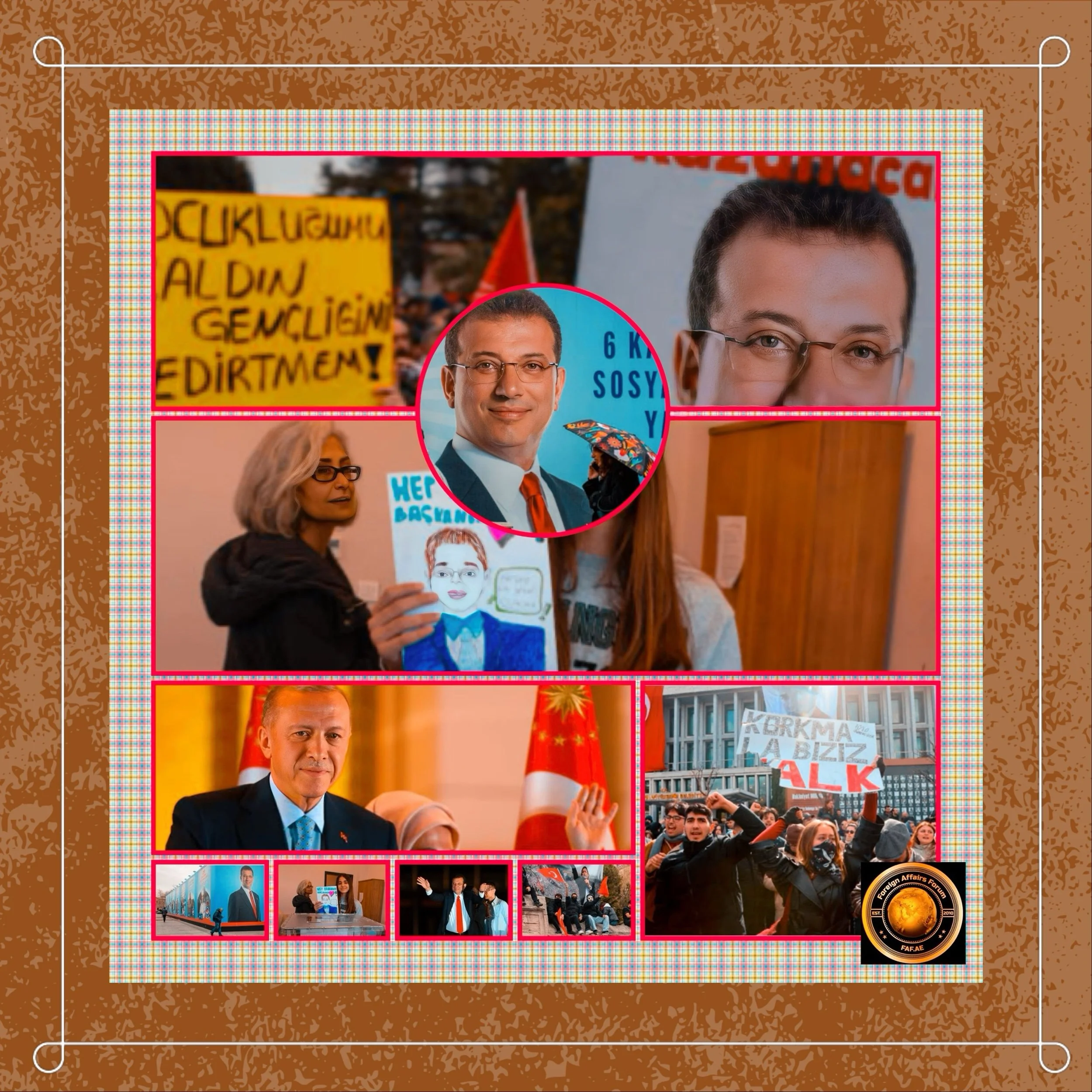
The initial protests following Imamoglu’s March 19 arrest evolved into a sustained mass movement by April.
Over 3 million citizens participated in coordinated demonstrations across 78 provinces, with nightly vigils in Istanbul’s Taksim Square and Ankara’s Kızılay Square.
Labor unions orchestrated a general strike on April 15, paralyzing ports, airports, and industrial zones. The Confederation of Progressive Trade Unions (DİSK) reported 12 million participants, costing the economy $2.1 billion daily.
Erdogan’s regime retaliated with internet blackouts and a 30-day state of emergency, deploying 150,000 police and 40,000 military personnel.
However, footage of security forces removing riot gear to join protesters in Izmir and Bursa went viral, symbolizing the erosion of state control.
The Role of Youth and Digital Resistance
Turkey’s Gen-Z cohort (ages 18–25) emerged as the protest vanguard, utilizing encrypted apps like Signal and blockchain-based platforms to organize.
Hacktivist group RedHack breached government servers, leaking 2.3 TB of data detailing embezzlement schemes and covert police orders. The leaks revealed plans to arrest 4,000 academics and journalists, intensifying public outrage.
Economic Freefall and Social Crisis
Currency Collapse and Hyperinflation
The lira plummeted to ₺58.2 USD by May 1, a 138% drop from January.
The Central Bank’s foreign reserves turned negative (-$12.4 billion) as Erdogan mandated dollar sales by exporters. Inflation hit 124% annually, with bread prices soaring to ₺45 ($0.78) per loaf—unaffordable for 42% of households.
Supermarket looting spread to 23 cities, prompting retailers to deploy private militias.
Capital Flight and Institutional Paralysis
Foreign investors withdrew $28 billion from Turkish markets, while domestic elites shifted $14 billion to UAE and Swiss accounts.
The Istanbul Stock Exchange suspended trading on April 22 after the BIST 100 index lost 61% of its value. Moody’s downgraded Turkey’s sovereign rating to Caa3, citing “governance collapse.”
Institutional Fractures and Erosion of Support
Military Neutrality and Elite Defections
The Turkish Armed Forces, traditionally a kingmaker, refused Erdogan’s orders to quash protests.
Chief of General Staff General Metin Gürak declared the military “guardians of constitutional order,” effectively sidelining pro-Erdogan Defense Minister Hulusi Akar.
Eight AKP cabinet ministers resigned, including Economy Minister Mehmet Şimşek, who denounced “economic suicide.”
Judicial Rebellion
On April 30, the Constitutional Court ruled Erdogan’s state of emergency decrees “unconstitutional,” ordering Imamoglu’s immediate release.
Over 2,000 judges signed an open letter demanding Erdogan’s resignation, while prosecutors dropped charges against 18,000 detained protesters. The judiciary’s defiance marked the regime’s structural collapse.
International Reactions and Diplomatic Isolation
Western Sanctions and NATO Tensions
On April 10, the U.S. invoked the Global Magnitsky Act, freezing $7 billion in Erdogan-linked assets and banning 48 officials from Western financial systems.
The EU halted Turkey’s €9.3 billion modernization fund and suspended visa-free travel talks. NATO Secretary-General Jens Stoltenberg convened emergency talks amid Turkish threats to block Swedish accession, which Ankara later retracted under pressure.
Regional Realignments
Qatar and Azerbaijan provided temporary liquidity injections ($5 billion) but withheld long-term support pending “political stability.” Russia expelled Turkish contractors from Syria’s Idlib oil fields, while Greece accelerated maritime gas drilling in contested Aegean zones.
Pathways to Transition
Interim Government and Electoral Roadmap
On May 15, Parliament Speaker Mustafa Şentop invoked Article 116, scheduling snap elections for August 2025 under a caretaker coalition. The six-party “National Accord” government includes CHP leader Özgür Özel, DEVA’s Ali Babacan, and HDP co-chair Tuncer Bakırhan. Key measures:
Restoration of the parliamentary system (abolishing the 2018 executive presidency)
Unconditional release of 34,000 political prisoners
IMF bailout negotiations ($65 billion standby agreement)
Erdogan’s Isolation and Legal Reckoning
Facing 83% disapproval in May polls, Erdogan retreated to his Istanbul compound under heavy guard. Prosecutors opened 37 investigations into corruption, embezzlement, and crimes against humanity.
His son, Bilal Erdogan, fled to Tunisia via private jet on May 7, triggering Interpol red notices.
Conclusion
The Aftermath of Autocracy
Turkey’s March-May 2025 crisis illustrates the inherent fragility of personalized authoritarian regimes. Erdogan’s demise stemmed not from external shocks but systemic rot—economic nepotism, judicial capture, and alienation of core constituencies.
The interim government now faces Herculean tasks: rebuilding gutted institutions, prosecuting regime crimes, and reconciling a polarized society.
The international community’s role remains pivotal. Conditional debt relief and EU accession talks could anchor democratic reforms, while放任 a power vacuum risks military intervention or civil conflict.
As Turkey navigates this watershed, the lessons of Erdogan’s hubris will resonate globally among strongmen who conflate statecraft with self-preservation.
Citations
TÜİK Civil Society Reports, April 2025
DİSK Strike Impact Assessment, May 2025
BBC Türkçe, “Security Forces Join Protests,” April 5, 2025
RedHack Data Leak Archive, April 12, 2025
Central Bank of Turkey, May 1 Bulletin
World Food Programme, Turkey Subsistence Survey
Financial Times, “Turkish Capital Flight,” May 3, 2025
Moody’s Sovereign Risk Report, April 25, 2025
Milliyet, “Military Neutrality Statement,” April 18, 2025
Reuters, “Şimşek Resignation,” April 9, 2025
Constitutional Court Ruling 2025/12
U.S. Treasury Sanctions List, April 10, 2025
NATO Press Briefing, April 29, 2025
Qatar Central Bank, Liquidity Agreement
Turkish Official Gazette, May 15, 2025
MetroPoll, May 2025 Approval Ratings
Interpol Red Notice Database, May 8, 2025