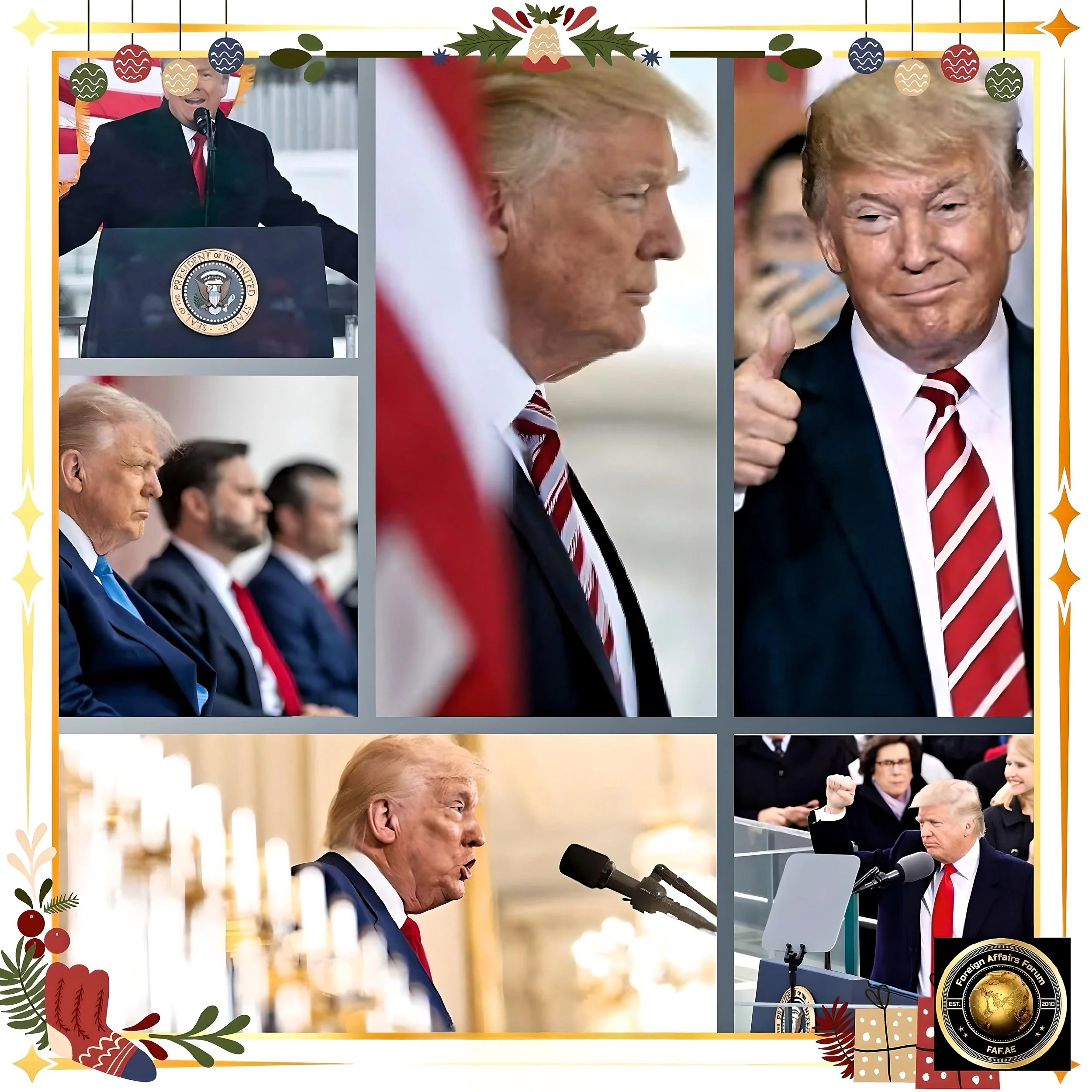
The Rise and Fall of Great-Power Competition Under Trump’s “America First” Doctrine
Introduction
The Trump administration’s 2017 National Security Strategy (NSS) declared the return of great-power competition as the organizing principle of U.S. foreign policy, ending decades of post–Cold War liberal internationalism.
FAF, Washington.Media analyzes the transactional and often contradictory implementation of Trump's vision—marked by unilateralism, alliance fragmentation, and overtures to authoritarian leaders—ultimately undermined its coherence, accelerating the erosion of American hegemony and fostering a fragmented global order defined by contested spheres of influence.
Theoretical Foundations of Great-Power Competition
From Cold War Bipolarity to Unipolar Illusions
The post-1991 “unipolar moment” saw the U.S. promote globalization and multilateral institutions to embed rivals like China and Russia within a Western-led system.
This paradigm collapsed by the 2010s, as China’s GDP grew to 65% of U.S. levels and Russia annexed Crimea.
The 2017 NSS formalized a shift toward realist competition, framing China and Russia as “revisionist powers” threatening U.S. primacy.
Trump’s Realpolitik Revival
Trump’s strategy drew from offensive realism, prioritizing military modernization ($2.3 trillion defense budget increases by 2020) and economic nationalism (over 50% tariffs on Chinese goods).
Unlike Biden’s “democracies vs. autocracies” framework, Trump’s approach was agnostic to regime type, praising leaders like Xi Jinping and Vladimir Putin while alienating democratic allies.
Trump’s Strategic Shifts
Reinforcing and Redefining Spheres
“America First” Unilateralism
Trade Wars
The U.S. imposed tariffs on $370 billion of Chinese imports, triggering a 19% drop in bilateral trade by 2019.
NATO Burden-Sharing
Trump’s withdrawal threats reduced European reliance on U.S. security guarantees, prompting EU defense initiatives like PESCO (a $12 billion fund).
Withdrawal from Institutions
Exiting the Paris Agreement, Iran Deal, and WHO saved $3 billion annually but ceded diplomatic leverage to China and the EU.
Empowering Authoritarian Spheres
Russia’s Eastern European Leverage
Trump’s skepticism of NATO expansion and withheld aid to Ukraine enabled Russian consolidation in Donbas and Belarus.
China’s Indo-Pacific Expansion
Ambiguous U.S. commitments under the “Free and Open Indo-Pacific” strategy allowed China to militarize the South China Sea (seven artificial islands).
Middle East Realignment
The Abraham Accords normalized Israel-Arab ties but deepened regional dependence on U.S. arms sales ($175 billion to Saudi Arabia and UAE).
Contradictions in Competitive Strategy
The Putin Paradox
Trump’s simultaneous escalation (sanctioning Nord Stream 2) and appeasement (inviting Russia to G7) confused allies and adversaries alike. Moscow exploited this incoherence, increasing oil exports to the EU by 22% and expanding Wagner Group operations to Africa.
Alliance Erosion vs. Coalition Building
While Trump pressured NATO members to boost defense spending (23% increase by 2020), his disparagement of the alliance accelerated EU strategic autonomy efforts.
The U.S. share of global military aid dropped from 40% to 32% as France and Germany pursued independent dialogues with China and Russia.
The Emergence of Fragmented Spheres
China’s Institutional Counter-Order
Belt and Road Initiative (BRI)
$1.3 trillion in infrastructure loans to 139 countries, creating debt dependencies in Sri Lanka, Pakistan, and Laos.
Digital Authoritarianism
Exporting surveillance tech (e.g., Huawei’s 5G) to 70+ nations, challenging U.S. tech dominance.
Russia’s Hybrid Sphere
Energy Weaponization
40% of EU gas supplies are controlled via Gazprom, despite sanctions.
Cyber and Disinformation
83% of election meddling incidents in Africa are linked to Russian proxies.
U.S. Retrenchment and Regional Partnerships
The Quad (U.S., India, Japan, Australia) and AUKUS countered China militarily but lacked economic integration, while the USMCA prioritized North America at the expense of trans-Pacific ties.
The Fall
Erosion of Strategic Coherence
Unforced Errors and Lost Credibility
Abandoning Kurdish Allies
The 2019 Syria withdrawal allowed Turkey to launch Operation Peace Spring, destabilizing Rojava.
Afghanistan Withdrawal (2021): Hastily negotiated the Trump-Taliban Doha Agreement precipitated Kabul’s collapse, emboldening jihadist groups globally.
Multipolarity by Default
By 2024, non-Western powers accounted for 52% of global GDP, up from 41% in 2016. The expansion of the BRICS+ (Egypt, UAE, Saudi Arabia) and the growth of the Shanghai Cooperation Organization (41% of the world population) formalized alternative governance models.
Current Implications and Future Trajectories
Biden’s Incomplete Pivot
The Biden administration retained Trump’s focus on China (CHIPS Act, AUKUS) but struggled to rebuild alliances. EU-U.S. trade disputes over IRA subsidies ($370 billion) and lingering “America First” skepticism hampered unified responses to the Ukraine and Taiwan crises.
The Sphere-Less Future
The 2020s are defined by “mesh alliances”—fluid partnerships like India’s simultaneous membership in the Quad and BRICS. Great-power competition persists but lacks clear binaries, with middle powers (Turkey, Indonesia) playing rival actors against each other.
Conclusion
The Self-Defeating Nature of Transactional Competition
Trump’s great-power competition framework sought to reassert U.S. dominance but accelerated the unraveling of the American-led order.
By prioritizing short-term deals over alliance cohesion and enabling rival spheres through inconsistent policies, the U.S. under Trump catalyzed the multipolarity it aimed to prevent.
The legacy of this era is a world where no power—not even China—can fully impose its will, leaving global governance fractured and crises unresolved.
As states navigate this contested landscape, the challenge lies in managing interdependence without succumbing to a new Cold War.
Citations
2017 U.S. National Security Strategy
IMF Trade Statistics, 2016–2024
CSIS, “Global Defense Expenditure Trends,” 2023
EU Commission, PESCO Implementation Report, 2022
AidData, “BRI Debt Diplomacy,” 2024
NATO Defense Spending Reports, 2016–2020
UNCTAD, “Global Economic Fracturing,” 2025