Dubai’s Economic Miracle: Balancing Rapid Development with Long-Term Risks
Introduction
Dubai’s transformation from a modest fishing village to a global metropolis represents one of the modern era's most remarkable urban development stories.
The emirate has achieved extraordinary economic growth through ambitious construction projects, strategic diversification, and aggressive foreign investment policies.
However, this rapid development raises serious questions about sustainability, environmental impact, and economic stability over the next 50-100 years.
While Dubai continues to break records in construction and economic growth, it faces significant challenges from climate change, potential market volatility, and the sustainability of its artificial landscapes.
Dubai’s Economic Evolution and Current Growth
Dubai has undergone a profound economic transformation in recent decades.
Once heavily dependent on oil, which previously accounted for 50% of its GDP, the petroleum sector now contributes less than 1% to Dubai’s economic output.
The emirate’s 2023 GDP reached AED 429 billion (approximately USD 116.779 billion), demonstrating its successful pivot to a diversified economy.
Dubai's economic structure now relies on various sectors, with wholesale and retail trade representing 26% of GDP, transport and logistics 12%, banking and financial services 10%, manufacturing 9%, real estate 7%, construction 6%, and tourism 5%.
This diversification has created resilience against oil price fluctuations and positioned Dubai as a commercial hub.
Recent growth figures reinforce Dubai’s economic momentum. In the first nine months of 2024, Dubai’s economy expanded by 3.1% compared to the same period in 2023, reaching AED 339.4 billion.
Key sectors driving this growth include transportation and storage (up 5.3%), financial and insurance activities (up 4.5%), and information and communications (up 4.1%).
In the first quarter of 2024 alone, GDP exceeded AED 115 billion, reflecting a 3.2% growth rate compared to Q1 2023.
This growth occurs within the broader context of the UAE’s economic performance, which saw a 3.40% GDP growth rate for 2023, though this represented a decline from the robust 7.85% growth in 2022.
Nevertheless, Dubai’s consistent economic expansion demonstrates its ability to maintain growth despite regional and global economic challenges.
Construction and Urban Metamorphosis
Dubai’s skyline serves as a testament to its ambitious construction agenda. The emirate ranks fourth globally for the number of skyscrapers taller than 150 meters, with an impressive 265 such structures.
Even more notably, Dubai leads the world in skyscrapers exceeding 300 meters in height, boasting 31 such buildings.
This vertical growth continues unabated, with 13 additional skyscrapers over 150 meters currently under construction.
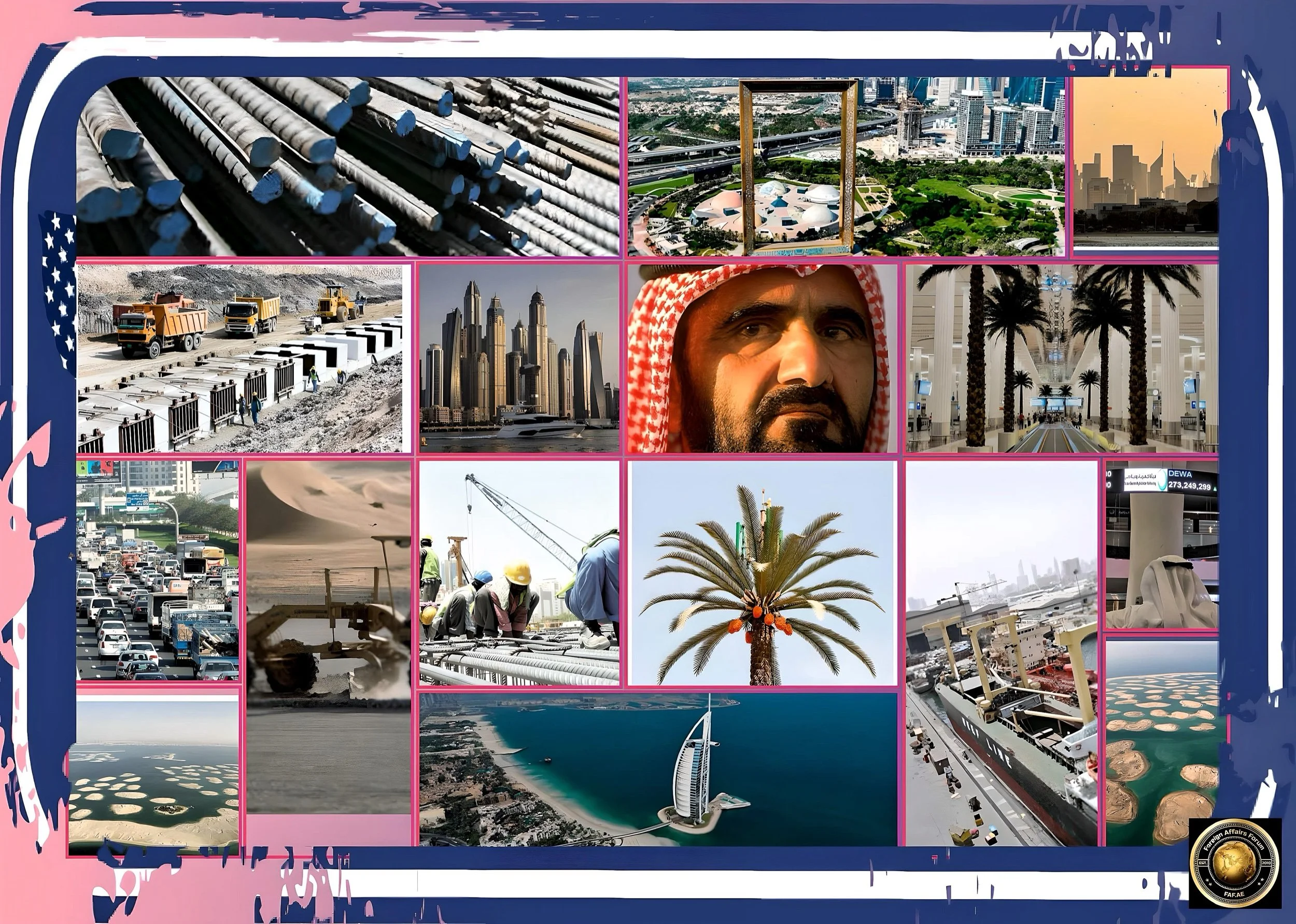
Perhaps most emblematic of Dubai’s construction ambitions are its land reclamation projects, which have reshaped the emirate’s geography.
The Palm Islands, World Islands, Dubai Marina, and the area surrounding the Burj Al Arab all represent significant artificial extensions to Dubai’s limited natural coastline.
Palm Jumeirah alone, completed in 2003, extended 5 kilometers into the Persian Gulf, added 72 kilometers to Dubai’s coastline, and required the dredging and relocation of 110 million cubic meters of sand to create 700 hectares of new land.
These projects were initiated as part of a strategic vision to reduce dependency on oil and develop tourism as a new income source.
With Dubai’s original coastline spanning just 72 kilometers, these artificial islands significantly expanded the emirate’s capacity for beachfront development.
The creation of Palm Jumeirah took just two years (2001-2003) and utilized sand and rocks exclusively, without concrete or steel, to the Sheikh’s specifications.
Benefits of Dubai’s Development Model
Dubai’s aggressive development strategy has yielded significant benefits, transforming the emirate into a global business and tourism destination.
Economic Diversification and Growth
The most notable achievement has been Dubai’s successful transition from oil dependency to a diversified economy. With less than 1% of GDP now derived from oil, Dubai has effectively insulated itself from the volatility of fossil fuel markets.
This diversification has created a robust economic foundation that supports sustainable growth across multiple sectors.
Investment Attraction and Global Position
Dubai has established itself as a foreign direct investment (FDI) magnet. In 2023, the emirate attracted an estimated AED 39.26 billion (USD 10.69 billion) in FDI capital.
On the global stage, Dubai secured a 6% share of greenfield FDI projects and ranked as the 5th leading city for greenfield FDI capital investment globally in 2023. Regionally, Dubai’s dominance is even more pronounced, attracting 54% of all projects for the Middle East.
Logistics and Trade Hub
The strategic development of logistics infrastructure has positioned Dubai as a critical node in global trade networks.
DP World’s Jebel Ali Port achieved record cargo volumes in 2024, handling 15.5 million TEUs, representing the highest throughput since 2015.
This marked a significant increase of 1 million TEUs from the previous year, accounting for nearly 18% of DP World’s total global container throughput. Breakbulk cargo also saw remarkable growth, surging by 23% year-on-year to reach 5.4 million metric tonnes.
Tourism and Global Recognition
Dubai’s ambitious construction projects have transformed it into one of the world’s premier tourist destinations.
With its numerous hotels, resorts, shopping centers, and luxury homes, the iconic Palm Jumeirah has become a major tourist hotspot, helping to reduce the emirate’s dependency on oil revenues.
These developments have made Dubai a luxury destination, attracting visitors from around the globe.
Risks and Challenges
Despite Dubai’s remarkable success in its development model, the emirate faces significant risks and challenges that could undermine its long-term sustainability.
Environmental Vulnerabilities
Climate Change and Sea Level Rise
Perhaps the most existential threat to Dubai’s future is climate change-induced sea level rise. Studies indicate that up to 85% of the population and 90% of the infrastructure in coastal zones throughout the UAE are at risk from climate change.
Recent research predicts increased sea levels across all locations along Dubai’s coast by 2030, with some areas identified as high-risk zones.
The stakes are extraordinarily high. One extreme projection suggests that with a sea level rise of 30 feet (nine meters), nearly all of Dubai’s infrastructure could be underwater by 2100.
Even a more modest rise of three meters would cause Abu Dhabi to lose more than 800 square kilometers to flooding, and Dubai would lose critical infrastructure.
This threat is particularly acute for Dubai’s artificial islands and coastal developments, many of which sit just above current sea levels.
Environmental Degradation
The construction of Dubai’s artificial islands has already caused significant environmental damage.
The dredging and redeposition of sand has clouded the typically crystalline waters of the Persian Gulf, damaging marine habitats and burying coral reefs, oyster beds, and subterranean fields of seagrass.
These changes threaten local marine species and the broader ecosystem.
Environmental studies have documented specific impacts from the Palm Jumeirah construction, including increased water-soluble materials, changed water spectral profiles, and elevated water surface temperatures around the island.
The World Wildlife Fund noted in 2006 that the “UAE’s human pressure on global ecosystems (its ecological footprint) is the highest in the world.”
Economic Vulnerabilities
Real Estate Market Instability
Dubai’s property market has shown concerning signs of volatility. The emirate experienced a devastating housing crash in 2009 when house prices fell by 40% in just three months following the global financial crisis.
This crash was attributed to oversupply, speculative buying, and easy credit factors that some analysts warn may resurface in the current market.
Current development patterns raise concerns about potential oversupply.
With numerous new projects being announced and constructed simultaneously, there’s a risk that demand may not keep pace with the overwhelming supply entering the market.
Areas like Dubai South, Mohammed Bin Rashid City, and Jumeirah Village Circle are seeing particularly high concentrations of new units.
External Economic Factors
Dubai’s economy, despite its diversification, remains vulnerable to global economic conditions.
Rising interest rates and global economic uncertainty could impact property investments, making borrowing more expensive and potentially shrinking the pool of buyers.
As borrowing costs increase, existing mortgage holders may struggle with higher monthly payments, potentially leading to distressed sales that could further depress property prices.
The 50-100 Year Outlook: Balancing Risk and Reward
Looking ahead to the next 50-100 years, Dubai must balance continuing its remarkable development trajectory and addressing substantial sustainability challenges.
Climate Adaptation Imperatives
The most pressing issue for Dubai’s long-term future is how it will adapt to climate change, particularly rising sea levels.
Rising waters within the century could threaten much of Dubai’s impressive infrastructure without significant adaptation measures.
This existential challenge will require enormous investment in protective infrastructure and potentially rethinking coastal development patterns.
Unlike historic cities built with resilience over centuries, Dubai’s rapid development means much of its infrastructure lacks the robustness to withstand long-term environmental changes.
As one analysis notes, except for iconic buildings like the Burj Khalifa, many structures in Dubai are built on sand with shifting foundations, focusing on short-term rewards rather than long-term sustainability.
Economic Reinvention and Adaptability
Dubai’s economic history demonstrates remarkable adaptability. It has already transformed from a fishing village to a pearl diving center, an oil producer, and a diversified global hub.
This capacity for reinvention may be its greatest asset in facing future challenges.
The Dubai Economic Agenda D33 and other strategic plans indicate awareness of the need for continued economic evolution.
The emirate’s focus on developing sectors like technology, logistics, and sustainable tourism could provide paths for continued growth that are less dependent on physical expansion and construction.
Creating industry-specific free zones and investment in digital infrastructure points toward possible future directions.
Balancing Development with Sustainability
The fundamental question for Dubai’s next century will be whether it can balance continued development with environmental and economic sustainability.
The current model of constant expansion, artificial land creation, and luxury development has created impressive short-term gains but raises serious questions about long-term viability.
A shift toward more sustainable construction practices, renewable energy (already beginning in parts of the UAE), and development patterns that work with rather than against natural systems could help address these concerns.
Some environmentalists suggest that, if managed appropriately, even projects like the artificial islands could create new marine habitats.
Conclusion
Dubai’s economic development represents one of modern history's most remarkable urban transformations. In just a few decades, it has transformed from a modest fishing village to a global metropolis, demonstrating extraordinary vision and ambition.
Its successful diversification away from oil dependency, strategic infrastructure investments, and bold construction projects have created a unique global position.
However, this rapid development has significant risks shaping the emirate’s prospects over the next 50-100 years.
Environmental challenges, particularly the rise of sea level, pose existential threats to much of Dubai’s infrastructure.
The economic model, heavily dependent on real estate development and constant expansion, faces questions of long-term sustainability. Previous market crashes demonstrate the potential volatility of Dubai’s growth trajectory.
Dubai's path forward will require balancing continued innovation with greater attention to sustainability and resilience.
The emirate’s demonstrated capacity for reinvention suggests it may be capable of adapting to these challenges, but doing so will require a fundamental rethinking of development patterns and priorities.
The next century will determine whether Dubai’s remarkable rise represents a sustainable new model of urban development or a cautionary tale of ambition outpacing long-term viability.