Comparative Analysis of Huawei Ascend 910D and Nvidia H100 AI Accelerators
Introduction
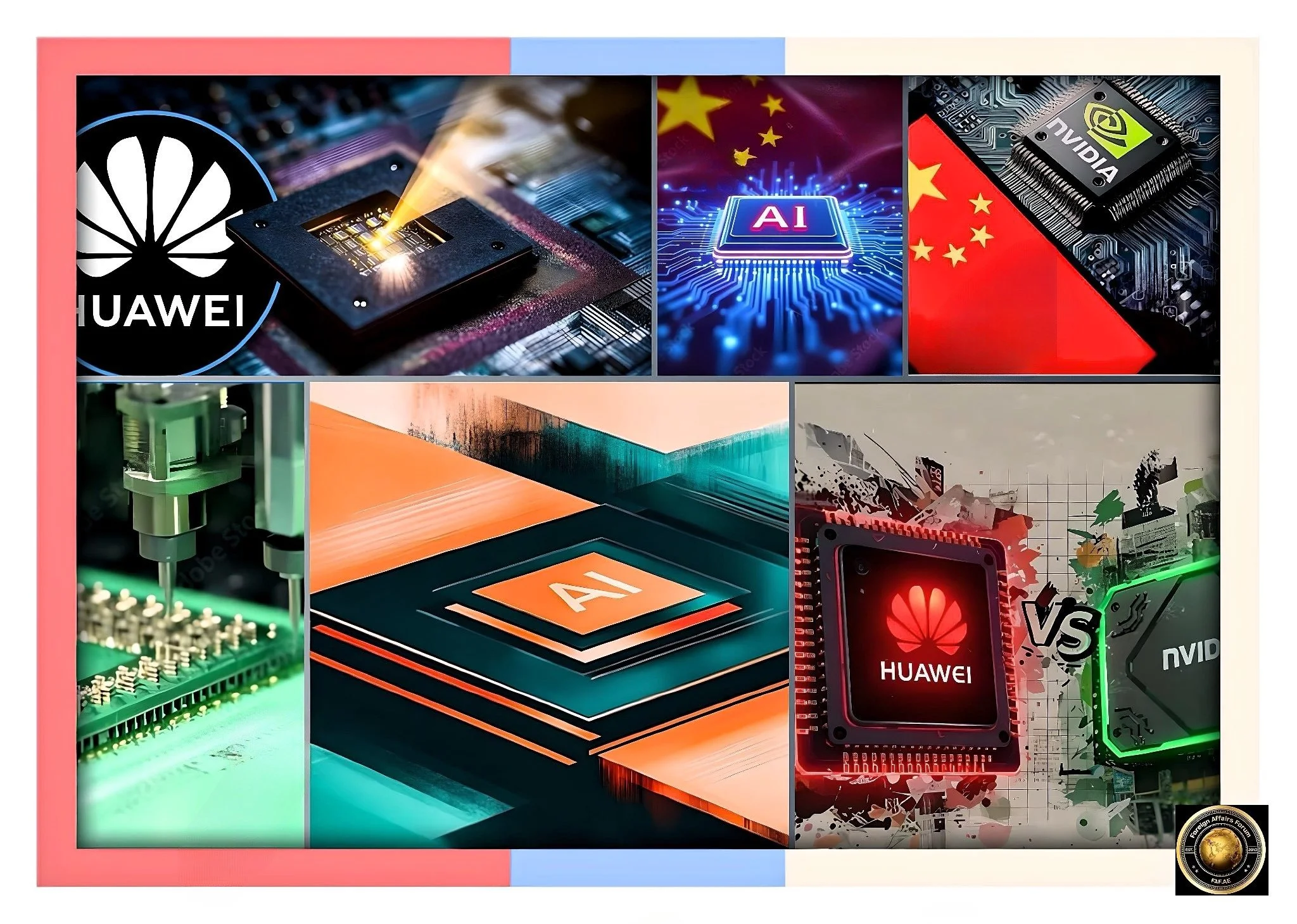
The technological rivalry between Huawei’s Ascend 910D and Nvidia’s H100 GPUs encapsulates the broader U.S.-China semiconductor competition.
FAF dissects their technical specifications, architectural innovations, and strategic implications for AI development, drawing on verified data from industry benchmarks and manufacturer disclosures.
Manufacturing and Process Technology
Ascend 910D
Process Node
Fabricated on SMIC’s 7nm N+2 process, constrained by U.S. export bans on EUV lithography tools.
Yield Rates
Estimated at 40–50%, significantly lower than TSMC’s ~90% for H100.
Packaging
Employs 3D chiplet integration to combine multiple dies, compensating for node limitations.
Nvidia H100
Process Node
Built on TSMC’s 4N (4nm-class) node, enabling 80 billion transistors and superior transistor density.
Yield Rates
~90%, ensuring cost-effective mass production.
Key Insight
The H100 delivers 2.8× higher FP16 performance and 2.6× higher BF16 performance than the 910D in raw compute. However, Huawei’s dual-chiplet design enables competitive INT8 throughput for inference tasks.
Power Efficiency and Thermal Design
Ascend 910D
350–450W TDP, achieving ~0.8 TFLOPS/W in FP16.
Nvidia H100
700W TDP (SXM variant), delivering ~1.0 TFLOPS/W.
Analysis
Despite lower absolute power draw, the 910D’s performance-per-watt lags by 20–25% due to SMIC’s mature node.
Architectural Innovations
Ascend 910D
Da Vinci 3.0 Cores
Enhanced vector units improve throughput by 25% over the 910C.
Hybrid Memory
Combines HBM2e with on-chip RoCE v2 networking for scalable multi-chip systems.
MindSpore Ecosystem
Emerging alternative to CUDA, though developer adoption remains limited.
Nvidia H100
Hopper Architecture
4th-gen Tensor Cores with FP8 precision, accelerating transformer models by 30×.
NVLink Interconnect
900 GB/s GPU-to-GPU bandwidth, enabling exascale AI clusters.
CUDA Dominance: Mature software stack supports 90% of AI frameworks.
Strategic Gap
While Huawei claims MindSpore can translate CUDA code via tools like Musify, real-world adoption lags due to inferior debugging and profiling tools.
Market Positioning and Geopolitical Impact
Ascend 910D
Domestic Focus
Priced at ~$15,000 (half the H100’s $30,000), it targets Chinese AI firms barred from U.S. chips.
Scalability Workaround
Huawei’s CloudMatrix systems use 384×910D chips to offset individual GPU limitations.
Nvidia H100
Global Dominance
Powers 80% of large language models (LLMs) globally, including ChatGPT and Meta’s Llama.
Export Restrictions
U.S. bans on H100 sales to China have accelerated Huawei’s R&D but fragmented AI ecosystems.
Strategic Implications
For China
The 910D enables ~60% of H100’s training performance at the system level, sufficient for domestic needs.
SMIC’s 7nm yields remain a bottleneck, risking supply shortages for China’s 1,037 EFLOPS compute target.
For the U.S.
Nvidia’s H100 maintains a 2–3-year lead in process technology and software, but export controls risk pushing China toward irreversible self-reliance.
Conclusion
The Ascend 910D and H100 represent divergent paths in AI acceleration:
Performance
H100 leads in raw compute (2.8× FP16) and memory bandwidth (2.1×), critical for training billion-parameter models.
Efficiency
Despite lower TDP, the 910D’s performance-per-watt trails by 20% due to node limitations.
Ecosystem
CUDA’s maturity vs. MindSpore’s nascence creates a “good enough” vs. “best-in-class” divide.
While Huawei’s 910D ensures China’s AI progress continues under sanctions, Nvidia’s H100 remains the global benchmark-for now.
The true test will be whether China can bridge the software gap before next-gen U.S. chips (e.g., Blackwell, Rubin) widen the hardware divide.