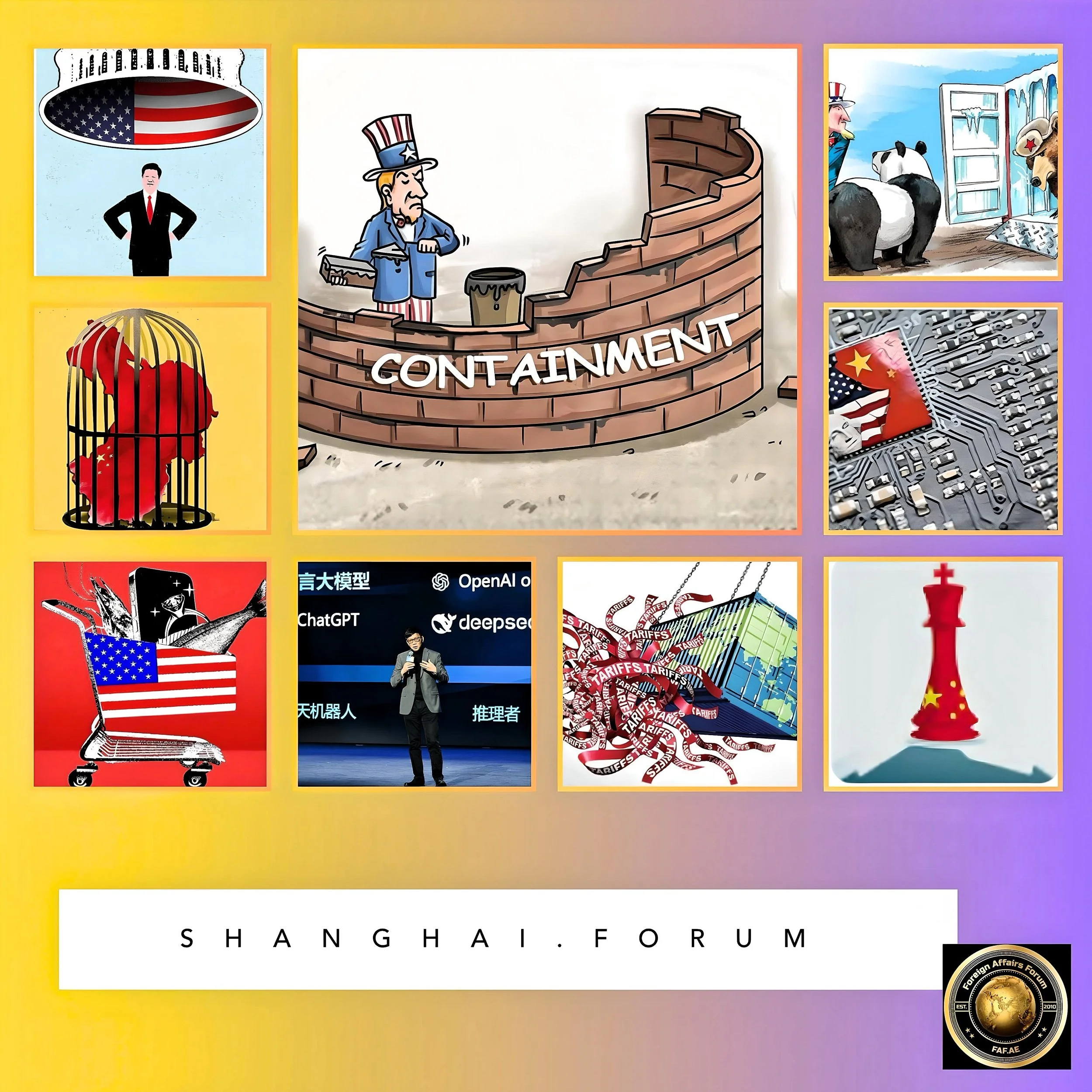
Containment Can’t Win the U.S.-China Tech Race Alone: The Need for Innovation-Led Strategy
Introduction
As the technological rivalry between the United States and China intensifies, mounting evidence suggests that America’s heavy reliance on containment measures—export controls, sanctions, and restrictions—is insufficient to maintain long-term technological leadership.
While these defensive measures can delay China’s progress, they must be complemented by aggressive innovation policies to secure America’s competitive edge in critical technologies.
The Limitations of U.S. Containment Strategies
Since 2018, the United States has implemented increasingly stringent technological containment measures against China.
Both the Trump and Biden administrations have deployed various restrictive tools, including:
Commerce Department “entity list” designations for companies like Huawei and SMIC
Comprehensive semiconductor export controls announced in October 2022
Bans on advanced AI chips such as Nvidia’s A100 and H100 GPUs imposed in October 2023
These containment efforts initially appeared effective, creating significant disruptions in China’s semiconductor ecosystem and slowing progress in AI development.
However, their long-term effectiveness faces three critical challenges:
Diminishing Returns and Unintended Consequences
While preventing China from acquiring the most advanced chip technology makes sense from a national security perspective, export restrictions alone cannot substitute for comprehensive industrial and research policy measures necessary to ensure U.S. leadership.
Moreover, these restrictions have produced several concerning unintended consequences:
Substantial revenue losses for U.S. and allied semiconductor manufacturers, potentially undermining their ability to fund critical R&D activities
Reduced visibility into China’s technological developments as U.S. companies lose market presence
The strengthening of China’s commitment to technological self-sufficiency
One analysis notes, “Restricting access to technology is a delaying action at best.
Winning the long-term contest over who shapes the future of AI depends on something more fundamental: who can develop talent, deploy infrastructure, and democratize innovation.”
The Third-Party Intermediary Challenge
As global supply chains become increasingly complex, opportunities for sanctions evasion multiply.
China has leveraged alternative pathways to access restricted technologies through:
Legal loopholes in existing regulations
Third-party intermediaries in countries not subject to the same restrictions
Sophisticated smuggling networks and transshipment points
The U.S. has recognized this challenge, with the Bureau of Industry and Security extending controls to intermediary jurisdictions in April 2024 to prevent China from “setting up cloud or data servers in other countries” to circumvent restrictions.
Similarly, the G7 published joint guidance in September 2024 to help industries identify evasion tactics and red flags.
Despite these efforts, the cat-and-mouse game continues, with malign actors consistently finding new methods to obscure the true identities of end users and circumvent controls.
China’s Accelerated Innovation Response
Perhaps most significantly, U.S. containment strategies have spurred China to double down on domestic innovation.
The restrictions have prompted an all-out, government-backed effort to improve the country’s self-sufficiency in semiconductor design and production.
A striking example is DeepSeek, whose latest V3 and R1 AI models appear to have closed the performance gap with leading U.S. models.
While DeepSeek’s founder has acknowledged facing significant challenges due to chip restrictions, the company’s success demonstrates that determined innovation can partially overcome hardware limitations.
China’s Innovation Offensive
Rather than deterring innovation, U.S. export controls have catalyzed an unprecedented Chinese push for technological self-sufficiency and leadership.
Strategic Investment at Scale
Beijing has accelerated the technological arms race by increasing science spending by 10% consecutively.
For 2025, China has allocated 398 billion yuan (US$54 billion) in central government spending for science, making it the top growth sector in government spending for two consecutive years—surpassing defense, diplomacy, and education.
These funds are strategically weighted toward basic research, applied basic research, and China’s strategic scientific and technological endeavors, indicating a long-term commitment to innovation leadership.
Broadening Technological Dominance
The Australian Strategic Policy Institute reports that China has surpassed the United States in becoming the leader in 57 of 64 tracked critical technologies across artificial intelligence, defense, energy, biotechnology, robotics, and cyber.
This dramatically shifts from China’s previous leading position in three technology areas.
China now leads in
Quantum sensors
High-performance computing
Gravitational sensors
Space launches
Advanced semiconductor chip design and fabrication
The U.S. continues to lead only in select areas, including quantum computing, vaccines and medical countermeasures, genetic engineering, and natural language processing.
Breakthrough Achievements Despite Restrictions
Despite export controls, China has achieved several technological breakthroughs that many in Washington thought were beyond its capabilities.
In 2023, Huawei produced a smartphone processor that surprised U.S. officials, demonstrating China’s growing ability to innovate around restrictions.
Similarly, the rise of DeepSeek has challenged the idea of a U.S. monopoly over advanced AI models.
While AI leaders like Dario Amodei and Miles Brundage have argued that DeepSeek’s success demonstrates the need for stronger restrictions, the development raises serious questions about the long-term viability of containment policies.
The Innovation Imperative for U.S. Strategy
The United States must pivot from a predominantly restrictive approach to a comprehensive strategy targeting containment with aggressive innovation policies to win the technological competition with China.
Fixing the Innovation Pipeline
Research from the Information Technology and Innovation Foundation indicates that China has surpassed the United States in total innovation output and is getting close proportionally.
To regain leadership, America must address critical weaknesses in its innovation ecosystem:
Immigration Reform to Retain Global Talent
Over 57% of doctoral candidates and 46% of master’s candidates in computer science and mathematics in the U.S. are foreign-born, yet many struggle to remain in the country after graduation.
A strategic immigration system aligned with national security and economic growth is essential.
STEM Education and AI Literacy Investment
OECD research finds that higher levels of STEM education directly correlate with greater national productivity and innovation.
Comprehensive educational initiatives from K-12 through doctoral programs are needed to build the next generation of innovators.
Research Infrastructure Development
Investment in cutting-edge research facilities and equipment is necessary to maintain America’s competitive edge.
Public-Private Collaboration Enhancement: Fostering stronger partnerships between government, industry, and academia can accelerate technological innovation and commercialization.
Defense Through Innovation
The most effective defense against China’s technological rise isn’t simply restricting access—it’s outpacing their innovation. As one analysis concludes:
“The United States will not win the AI competition by restricting others from accessing technology. It will win by making sure more of its citizens and institutions can build, understand, and govern emerging technologies like AI.”
Export controls are blunt instruments of a defensive posture. The offensive strategy—the one that wins—must be built on education, inclusion, and infrastructure.
Conclusion
Toward a Balanced Approach
The technological competition between the United States and China represents a defining challenge of the 21st century, with profound implications for global economic leadership, military supremacy, and the international order.
To prevail in this competition, America must develop a balanced approach combining targeted containment and aggressive innovation.
Containment strategies remain essential in the U.S. foreign policy arsenal but cannot substitute for a comprehensive plan prioritizing American innovation.
Export controls and sanctions can buy time by delaying China’s technological advancement. Still, they cannot prevent it entirely—especially as supply chains become more complex and opportunities for evasion multiply.
To win the tech race with China, the United States must complement its containment strategy with substantial investments in innovation, talent development, and research infrastructure.
This balanced approach—combining targeted restrictions with a renewed commitment to American ingenuity—offers the best path forward for maintaining U.S. technological leadership in the decades to come.
The famous saying goes, the best defense is a good offense.
In the technology race with China, America needs both.