The Weaponization of the Dollar: How Trump’s Policies Threaten America’s Reserve Currency Status
Introduction
The U.S. dollar has maintained its position as the world’s dominant reserve currency for over seven decades, weathering economic fluctuations, global market turmoil, and shifting political landscapes.
This remarkable stability has given the United States considerable economic and geopolitical advantages.
However, recent aggressive economic policies implemented by the Trump administration, particularly the wide-ranging tariffs announced in April 2025, have created unprecedented challenges to the dollar’s reserve status.
FAF examines how the weaponization of U.S. economic power could dethrone the dollar and the far-reaching implications of such a shift for the United States and the global economy.
The Dollar’s Reserve Status: Foundation and Benefits
The U.S. dollar has been the world’s primary reserve currency since the Bretton Woods agreement following World War II. J.P. Morgan Wealth Management states, “Central banks and financial institutions hold reserve currencies to facilitate international trade, investment, or domestic exchange.
The U.S. dollar has functioned as the world’s dominant reserve currency since the end of World War II”.
Central banks worldwide hold nearly 60% of their foreign exchange reserves in dollars, though this share has been gradually declining over the past two decades.
This privileged position offers significant advantages to the United States. The dollar’s reserve status allows America to borrow at lower interest rates, pay for imports in its currency, and exert substantial influence over the global financial system.
However, this status does not come without costs. As experts Myron Scholes and Ashwin Alankar noted, “The benefits of the U.S. dollar’s reserve currency status do not come for free; the costs are paid for with a trade deficit.”
This highlights a fundamental economic tension the Trump administration has failed to reconcile in its policy approach.
The dollar’s dominance has persisted despite previous challenges because global economic systems operate with significant inertia.
Major financial players—from governments to banks to multinational corporations—prefer established mechanisms for conducting trade and finance. This preference for stability has historically insulated the dollar from serious threats to its position.
The Foundations of Dollar Supremacy
The dollar maintains its reserve currency status due to several key factors:
It’s the currency of the world’s largest economy
The deep liquidity of U.S. financial markets
America’s strong legal institutions and property rights
The dollar’s widespread use in international transactions
The network effects of its universal acceptance
Trump’s Tariff Policies and Market Turmoil
On April 2, 2025, President Trump announced steep new tariffs on almost every U.S. trading partner in what he described as a “declaration of economic independence.”
These measures included a baseline 10% tax on all imports, with additional “reciprocal” tariffs targeted at specific nations. The announcement triggered immediate market turmoil, with stock markets plummeting across the U.S., Europe, and Asia.
These punitive tariffs have significantly disrupted the global financial landscape.
A viral clip depicted the stock market plummeting following the announcement while fears of a potential “Black Monday” loomed over Wall Street.
According to some estimates, the worst-case impact of Trump’s tariffs on the S&P 500 Index could be a fall to 4,650, approximately 16% lower than previous levels.
Although Trump partially retreated on April 9, announcing a 90-day pause on the “reciprocal” tariffs for some trading partners, the baseline 10% duty on imports remains intact.
Additionally, tariffs on China were increased to 124% following Beijing’s decision to raise duties on American imports to 84%. While temporarily calming markets, this partial retreat has not resolved the fundamental concerns about U.S. economic policy direction.
Weaponizing Economic Power: Mechanisms and Motives
“weaponizing the US dollar” refers to using America’s dominant position in the global financial system to exert pressure on other countries or entities.
This strategy leverages economic power rather than traditional military might to achieve political or strategic objectives.
How Currency Weaponization Works
The weaponization of the U.S. dollar typically involves several mechanisms:
Sanctions
Restricting access to the U.S. financial system and dollar-denominated transactions
Control over international payment systems: Leveraging systems like SWIFT
Secondary sanctions
Penalizing third parties that do business with sanctioned entities
Tariffs and trade restrictions
Using America’s market power to influence other nations’ behavior
Trump’s approach represents a particularly aggressive form of this weaponization.
As noted by three senior scholars in Foreign Affairs, Trump has “clumsily attempted to weaponize Washington’s advantages, posing a threat to the dollar’s status as a reserve currency.”
This weaponization extends beyond typical financial sanctions, including broad-based tariffs that disrupt global trade patterns.
The Administration’s Motives
The Trump administration has offered various justifications for its tariff policies, including:
Generating government revenue
Protecting American industries
Addressing trade deficits
Enhancing economic security
However, these stated goals often conflict with one another and global economic realities.
For instance, Trump’s top economic advisor, Stephen Miran, has revealed that Washington is using tariffs as leverage to try to force countries to “pay tribute” to help maintain America’s global empire.
Miran argued that the United States provides two main “global public goods”—a security umbrella overseen by the U.S. military and dollar/Treasury securities as the main reserve assets—and that other nations should help “bear the costs” of these arrangements.
Trump’s Contradictory Currency Objectives
A fundamental contradiction lies at the heart of Trump’s currency policy. The president “has long been of two minds about the dollar.
He has said he wants it weaker to make American products cheaper in global markets, but he also wants it strong so it remains the world’s dominant reserve currency”. These two objectives are fundamentally incompatible.
Trump’s desire for a weaker dollar to promote exports directly conflicts with maintaining reserve currency status, which typically requires a strong, stable currency that other nations trust.
Ignacio Dolz de Espejo, Director of Investment Solutions at Mutuactivos, warns: “We must be prepared for a weak dollar policy.”
However, a persistently weakening dollar undermines its attractiveness as a reserve asset.
The administration has proposed a so-called “Mar-a-Lago Accord” in which trading partners would help bring down the dollar’s value while maintaining its reserve status.
This proposal, championed by CEA Chairman Stephen Miran, reflects the administration’s contradictory objectives. Miran has acknowledged that cutting trade deficits would typically put upward pressure on the dollar, not weaken it.
International Response and Dollar Alternatives
The global reaction to Trump’s economic policies has been decidedly adverse, with various nations and institutions expressing concern about the future of the dollar-centered financial system.
Francois Villeroy de Galhau, the head of the Bank of France and a member of the ECB, cautioned that Trump’s actions had caught the attention of international investors, stating: “The enduring aspect of U.S. policy over the decades has been the commitment to the dollar’s central role.
The Trump administration shares this perspective, yet its implementation is highly inconsistent. Recent developments undermine trust in the U.S. currency”.
Emerging Alternatives
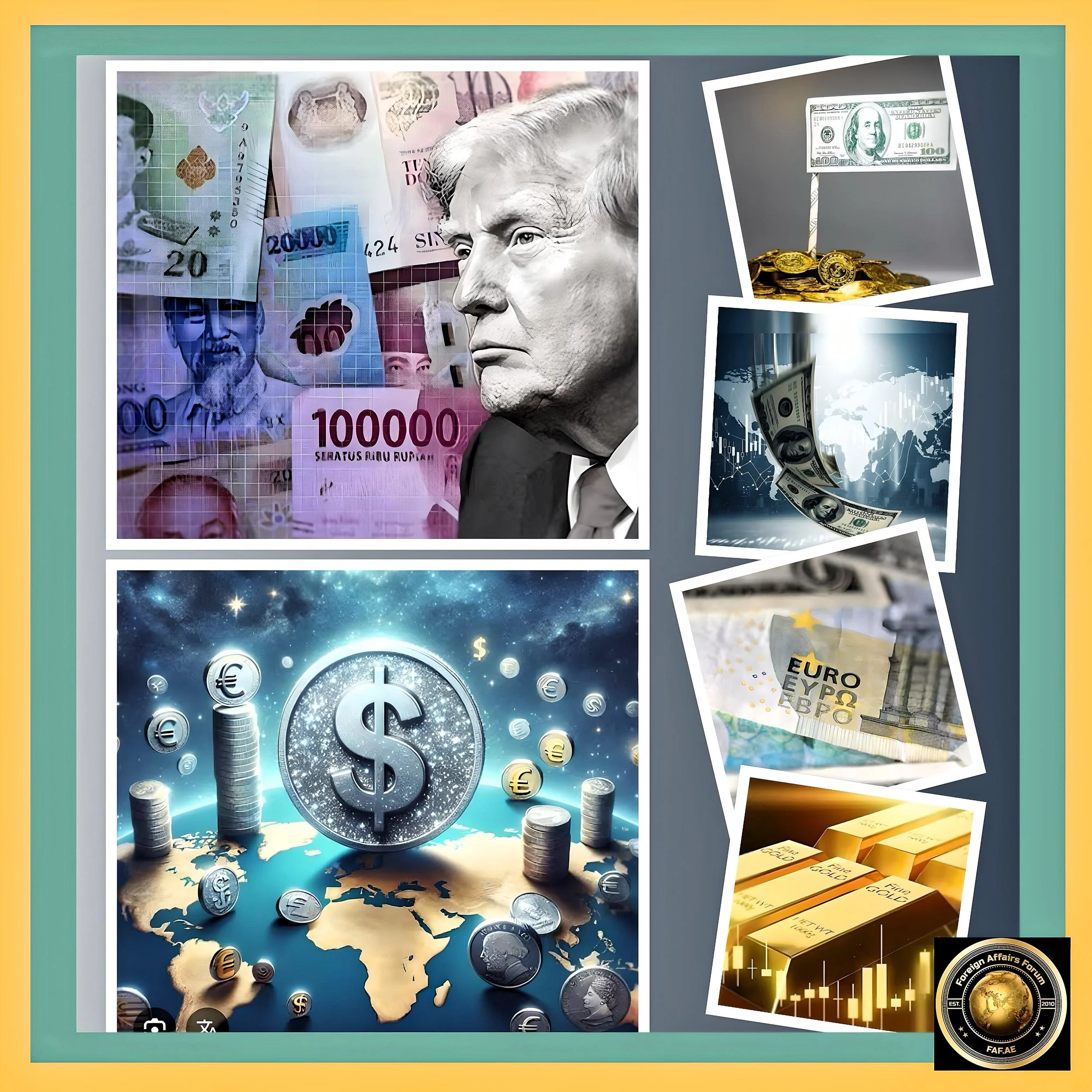
While no single currency currently presents a viable alternative to the dollar, several possibilities are emerging:
The Euro
Identified as the “closest competitor” to the dollar, though “lack of a eurozone policy” and “geopolitical threats posed by Russian imperialism” have prevented it from usurping the dollar’s position.
Gold
Benjamin Dubois, Head of Hedge Management at Edmond de Rothschild AM, notes “the vertiginous rise in the price of gold, which has become the main reserve asset in the absence of a currency that can offer a true alternative to the dollar. The price of gold has gained more than 60% to exceed $3,000 per ounce”.
Alternative payment systems
Russia and China have created fallback systems to counter U.S. attempts to block access to SWIFT.
Since Trump took office, the euro has appreciated against the Dollar, potentially benefiting from his isolationist tendencies.
As Villeroy noted, “Thankfully, Europe established the Euro 25 years ago. We have achieved monetary independence, allowing us to manage interest rates differently from the Americans, which was impossible before”.
Consequences of Dethroning the Dollar
If Trump’s policies do succeed in undermining the dollar’s reserve status, the implications would be far-reaching and potentially severe.
Economic Consequences
Without the dollar to ease trade and financial flows, global economic growth would likely slow, making people everywhere poorer. For the United States specifically, the consequences would include:
Higher borrowing costs as demand for Treasury securities decreases
Reduced ability to run large budget deficits
More expensive imports, potentially fueling inflation
Difficulties financing trade deficits
Paradoxically, the manufacturing revival that Trump claims to pursue would be threatened as imported raw materials become more expensive and capital markets less accessible.
As the authors of the Foreign Affairs article warned, “the true result of a declining dollar will be the demise of the very economic power Trump is attempting to wield.”
Geopolitical Implications
The dollar’s reserve status has given the United States significant geopolitical leverage. Losing this status would diminish America’s global influence and ability to use financial tools to advance its interests.
Per Jansson, deputy governor of Sweden’s central bank, remarked: “If (the dollar’s status) were to change, it would significantly alter the world economy and create considerable chaos. I sincerely hope the U.S. does not reach that point”.
Conclusion
The Self-Defeating Nature of Economic Weaponization
Trump’s aggressive tariff policies represent a dangerous gamble on America’s most valuable economic asset, the dollar’s status as a reserve currency.
By attempting to weaponize U.S. economic advantages through unpredictable and disruptive policies, the administration risks undermining the very foundations of American economic power.
As scholar Carla Norrlof observed, “While leveraging global economic choke points to advance one’s interests is undoubtedly preferable to deploying tanks or launching missiles, such leveraging of interdependence is not without costs.
Eventually, the dependencies it exploits will collapse, leaving everyone worse off”.
The contradictions in Trump’s approach—seeking both a weaker dollar to boost exports and a strong dollar to maintain reserve status, pursuing both trade surpluses and the benefits of reserve currency status—reveal a fundamental misunderstanding of global economic dynamics.
Combined with the erratic policy implementation, these contradictions create precisely the kind of uncertainty that threatens the dollar’s position.
Columbia University experts summarized the situation as follows: “Trump’s return to office has created a genuine threat to the dollar’s status for the first time in generations.”
While the dollar’s reserve currency status won’t disappear overnight, given the absence of immediate alternatives, “the likelihood and pace of a terminal decline have escalated.”
The ultimate irony may be that in seeking to leverage America’s economic advantages through weaponization, Trump may end up destroying them instead.