Bosnia and Herzegovina in 2025: Navigating Political Turmoil, EU Aspirations, and Socioeconomic Challenges
Introduction
Bosnia and Herzegovina (BiH) is at a critical juncture in 2025, grappling with intersecting crises that threaten its stability, sovereignty, and future integration into the European Union.
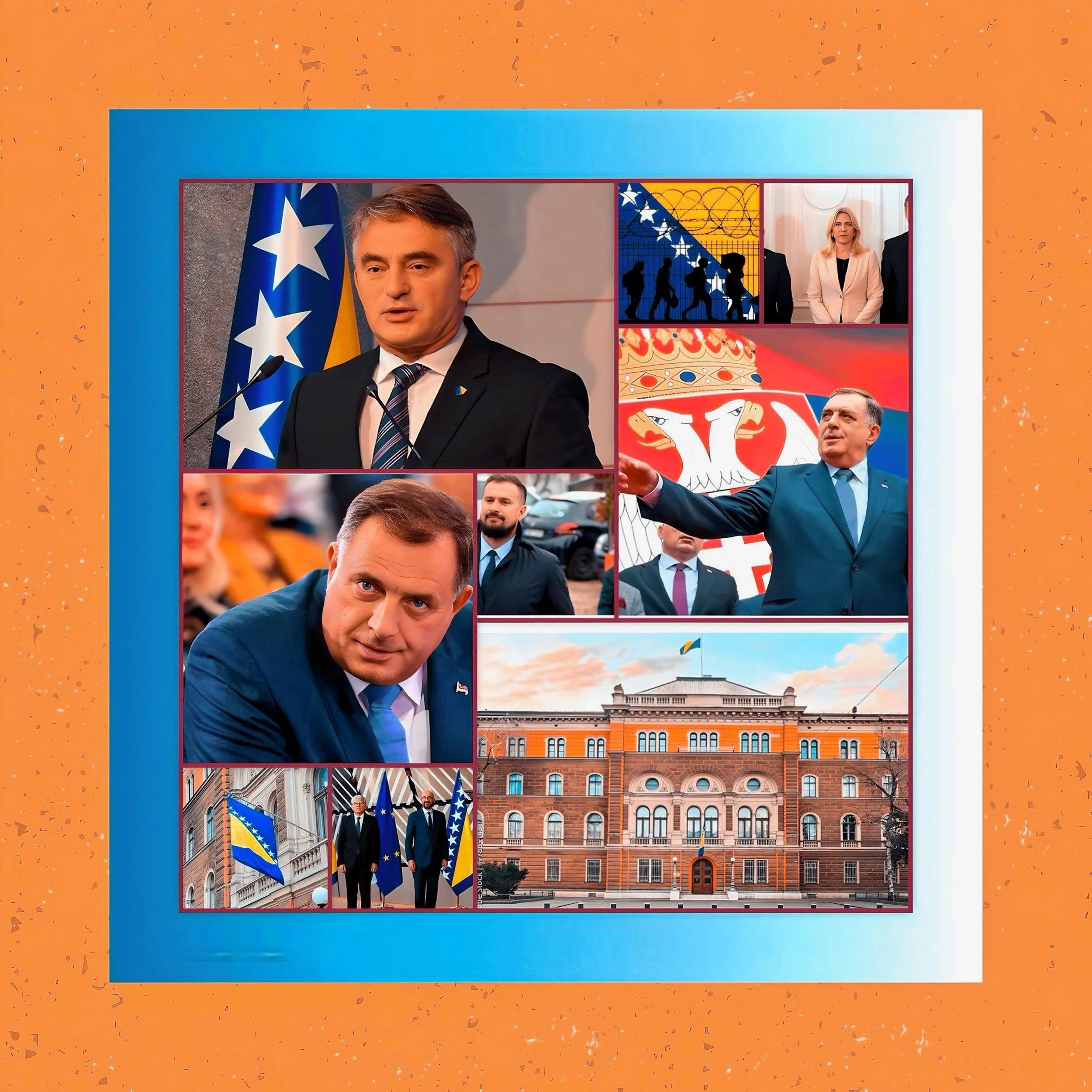
The year has been marked by escalating political tensions following a landmark court ruling against Republika Srpska (RS) President Milorad Dodik, renewed separatist rhetoric, and institutional paralysis exacerbated by ethnonationalist agendas.
Simultaneously, the country faces structural economic challenges, systemic corruption, and societal anxieties amplified by the 30th anniversary of the Dayton Peace Agreement.
FAF examines the multifaceted issues shaping BiH’s trajectory, analyzing the constitutional, geopolitical, and socioeconomic dimensions of its ongoing struggles.
Political Instability and Constitutional Challenges
The Dodik Verdict and Republika Srpska’s Defiance
The first-instance verdict by the Court of Bosnia and Herzegovina in February 2025, which sentenced RS President Milorad Dodik to one year in prison and barred him from political office for six years, has intensified longstanding tensions between RS and state institutions.
Dodik was convicted of refusing to implement decisions by High Representative Christian Schmidt, including laws criminalizing genocide denial. The ruling triggered an immediate backlash from RS leadership, which denounced the verdict as “politically motivated” and “anti-Serb.”
In response, the RS National Assembly passed the Law on Non-Application of Laws and Prohibition of Activities of Non-Constitutional Institutions of BiH, effectively banning state judicial and security agencies—including the State Investigation and Protection Agency (SIPA) and the Prosecutor’s Office—from operating within RS territory.
This legislation, adopted alongside a controversial “foreign agents law” targeting NGOs and media, represents a challenge to the constitutional order established under the Dayton Agreement.
Constitutional Implications of RS’s Unilateral Moves
Legal experts emphasize that RS’s laws lack constitutional validity, as entity legislatures cannot override state-level legislation under BiH’s constitutional framework.
Vehid Šehić, President of the Forum of Tuzla Citizens, notes that only the Parliamentary Assembly of BiH holds the authority to amend or annul state laws.
The Constitutional Court of BiH temporarily suspended RS’s laws on March 8, 2025, pending a full review, but Dodik has vowed to ignore the suspension.
This standoff underscores the fragility of BiH’s institutional architecture, which relies heavily on entity-level compliance with state authority.
Regional and International Reactions
Serbian President Aleksandar Vučić convened an emergency National Security Council meeting following Dodik’s conviction, declaring the ruling “unlawful” and pledging support for RS’s autonomy.
Meanwhile, High Representative Schmidt condemned RS’s actions as “destabilizing” and urged adherence to the Dayton framework.
NATO Secretary General Mark Rutte’s scheduled visit to Sarajevo on March 10, 2025, signals heightened international concern, with NATO reiterating support for BiH’s territorial integrity.
EU Accession Process: Progress and Persistent Obstacles
Candidacy Status and Reform Stagnation
BiH attained EU candidate status in December 2022, but progress toward accession negotiations has stalled due to unmet reform benchmarks.
The European Commission’s 2024 progress report highlighted deficiencies in judiciary independence, anti-corruption measures, and electoral reforms.
Despite adopting a Strategy for the Fight Against Corruption 2024–2028, implementation remains sluggish, with political elites resisting measures threatening patronage networks.
The €1 Billion Growth Plan and Conditionalities
The EU’s Growth Plan for the Western Balkans, offering €1 billion in conditional funding, has been jeopardized by BiH’s failure to adopt a credible reform agenda. Key prerequisites include:
Overhauling fiscal policies to redirect resources from public wage bills to infrastructure.
Reforming electricity pricing to eliminate subsidies distorting the energy market.
Aligning entity-level judicial systems with EU standards to combat political interference.
However, the RS leadership’s recent defiance has further eroded trust, with EU officials warning that separatist actions contradict commitments under the Stabilization and Association Process.
Economic Fragility and Structural Barriers
Chronic Unemployment and Emigration Pressures
BiH’s economy remains the weakest in Europe, with unemployment at 16% (youth unemployment exceeds 30%) and a labor participation rate of just 40%.
The World Bank estimates that over 500,000 citizens—primarily young professionals—have emigrated since 2013, depriving the economy of skilled labor. Remittances, constituting 10% of GDP, provide a lifeline but entrench dependency on diaspora inflows.
Investment Climate and Corruption
A fragmented regulatory environment deters foreign direct investment (FDI), which averaged 3.2% of GDP in 2023.
Transparency International ranks BiH 110th globally in corruption perception. Public procurement scandals and judicial bribery are commonplace.
The EBRD identifies electricity pricing reforms and fiscal decentralization as critical to unlocking growth, but entity-level disputes over revenue sharing persist.
Rule of Law and Human Rights Concerns
Judicial Inefficiency and Politicization
BiH’s four parallel judicial systems—state, Federation, RS, and Brčko District—create jurisdictional conflicts and case backlogs averaging 595 days per dispute.
The acquittal of RS official Miloš Lukić in Dodik’s trial exemplifies selective enforcement, while wartime crime prosecutions proceed at a glacial pace, with only 15% of cases resolved since 2005.
Minority Rights and Societal Divisions
Discrimination against Roma, Jews, and LGBTQ+ communities remains pervasive. The UN documented 91 ethnoreligious hate crimes in early 2025, while LGBTQ+ activists face systemic harassment despite a landmark 2023 court ruling against discrimination.
Political exclusion persists, with minorities barred from the presidency under ethnonational quotas.
International Engagement and Geopolitical Dynamics
The High Representative’s Diminished Authority
High Representative Christian Schmidt’s mandate, contested by RS and Russia, has struggled to enforce compliance with Dayton provisions. The Office of the High Representative (OHR) faces criticism for focusing on technical reforms while ignoring structural governance flaws, such as the Federation’s 14-layer administrative bureaucracy.
NATO and EU Security Roles
NATO’s Headquarters in Sarajevo (NHQSa) continues coordinating defense reforms, but RS’s refusal to participate in state-level security initiatives hampers progress. The EU’s EUFOR Althea mission, reduced to 1,100 troops, remains a symbolic presence, lacking a mandate to address political crises.
Social Dynamics and Public Sentiment
Anxiety and Polarization
Surveys indicate that 68% of citizens fear renewed conflict, with 12% of households in RS reporting plans to emigrate following the February 2025 crisis. Trust in institutions is at historic lows: 81% distrust the judiciary, while 74% view politicians as corrupt.
Youth Disillusionment and Civic Activism
Youth-led movements like Pod Lupomq (Under the Magnifying Glass) have mobilized against ethnonationalism, advocating constitutional reforms. However, entity-level education systems perpetuate segregation, with 94% of schools operating under mono-ethnic curricula.
Conclusion
Pathways Forward in a Divided State
BiH’s survival hinges on reconciling competing visions of statehood. Immediate priorities include:
Constitutional Reforms
Transitioning from Dayton’s ethnic power-sharing model to civic equality, as urged by the Venice Commission.
Anti-Corruption Measures
Implementing the EU-sponsored Pakt za BiH (Pact for BiH) to unify judicial appointments and audit public contracts.
Economic Integration
Leveraging the EU’s Growth Plan to harmonize entity economies and attract FDI in renewable energy and transport.
As NATO and the EU recalibrate their engagement, BiH’s leaders face a stark choice: confront vested interests driving division or risk irreversible fragmentation.
The 30th anniversary of Dayton in November 2025 offers a symbolic deadline for recommitting to multiethnic democracy—or acknowledging its failure.