Montenegro’s Path to EU Membership: History, Timeline, and International Perspectives
Introduction
Historical Background and EU Accession Timeline
Montenegro’s Journey to Independence and European Integration
Montenegro’s relationship with Europe has been defined by its historical struggles for sovereignty and contemporary commitment to Western integration.
As part of the Ottoman Empire from 1496 to 1878, Montenegro later became a kingdom and eventually joined Yugoslavia in 1918.
During the Yugoslav conflicts of the 1990s, Montenegro remained part of the federation (first as the Federal Republic of Yugoslavia from 1992, then as the State Union of Serbia and Montenegro from 2003).
Following an independence referendum on May 21, 2006, in which 55% voted in favor, Montenegro declared independence on June 3, 2006.
The country’s European integration began quickly after independence.
Montenegro signed a Stabilisation and Association Agreement (SAA) with the EU on October 15, 2007, which entered into force on May 1, 2010.
On December 15, 2008, Montenegro formally applied for EU membership.
The European Commission issued a favorable opinion on November 9, 2010, and the country was granted candidate status on December 17, 2010.
Accession negotiations formally began on June 29, 2012.
New Montenegro
The current president of Montenegro is Jakov Milatović, who has been in office since May 20, 2023.
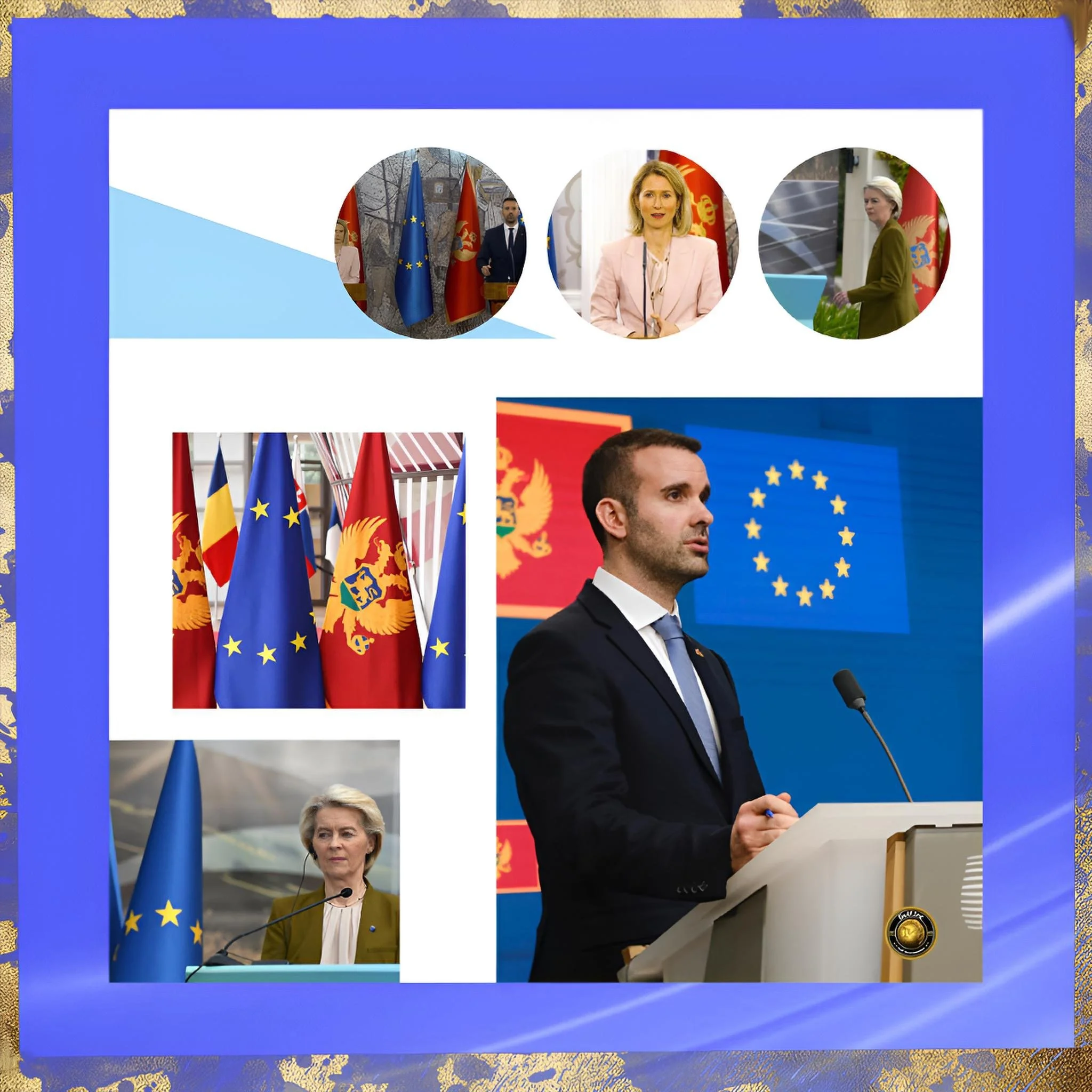
The current prime minister is Milojko Spajić, who became prime minister on October 31, 2023.
President of Montenegro
Jakov Milatović is the youngest president of independent Montenegro and a strong advocate for European Union integration.
He assumed office after winning the 2023 presidential elections in a landslide victory.
Current Accession Status and 2028 Target
Montenegro is currently the frontrunner among all EU candidate countries.
As of November 2025, all 33 screened chapters have been opened, with six provisionally closed
(1) Intellectual Property Law
(2) Digital Transformation and Media
(3) Enterprise and Industrial Policy
(4) Science and Research
(5) Education and Culture
(6) External Relations).
In December 2024, Montenegro provisionally closed three additional chapters, bringing the total to six—more than any other candidate country.
Montenegro aims to join the EU and simultaneously adopt the euro by 2028.
Prime Minister Milojko Spajić has stated that if backed by all 27 EU member states, the country is “optimistic about joining the EU in 2028.”
The European Commission’s Enlargement Commissioner Marta Kos has indicated that if current progress continues, Montenegro could complete negotiations by the end of 2026 or 2027, with membership technically possible by 2028.
The EU Commission’s November 2025 enlargement report states that Montenegro is “on track” to meet ambitious goals and could conclude accession negotiations in 2026.
Montenegro’s accession to the European Union (EU) is a major political goal, but there are several ongoing arguments and debates about its progress, timing, and implications for both Montenegro and the EU itself.[europeanwesternbalkans +2]
Arguments in Favor of Montenegro Joining the EU
Strengthening EU Enlargement Credibility
Montenegro’s accession is seen as a way to show that EU enlargement conditionality still works and that reforms can yield results, restoring credibility to the EU’s integration process.
Economic and Political Stability
Joining the EU is expected to bring greater economic growth, investment, and political stability to Montenegro, as well as improve infrastructure and governance.
Alignment with European Values
Montenegro’s government has committed to meeting EU standards on the
(1) rule of law
(2) fighting corruption
(3) supporting European foreign and security policy, including EU sanctions against Russia.
Public Support
Recent polls show that a strong majority of Montenegrins favor EU membership, with net support at +45% (64% in favor, 19% opposed as of late 2025).
Key Arguments and Challenges Against or Raising Concerns
Need for Internal Reforms
Some EU member states and analysts stress that Montenegro must complete crucial internal reforms—especially in the
(1) judiciary
(2) anti-corruption
(3) and public administration—before accession.
The heterogeneity of Montenegro’s coalition government and the presence of parties with pro-Russian leanings raise concerns about full commitment to EU values among some political factions.
Stringent Ratification Process
The accession treaty must be ratified by all current EU member states, some of which could potentially veto Montenegro’s entry due to their own domestic or political concerns.
Implementation vs. Legislation
While Montenegro has opened all 33 negotiation chapters, some critics argue that merely passing laws is not enough—implementation and enforcement of reforms are essential and sometimes lag behind.
Geopolitical Considerations
The EU faces broader debates about the pace and sequencing of enlargement, with some advocating for a gradual process rather than a rapid expansion, especially given the EU’s internal challenges and the need for deeper integration.
Regional and Administrative Issues
Montenegro’s administrative capacity and the ability to coordinate reforms remain a point of concern, especially as the country tries to close remaining negotiation chapters by targeted deadlines.
Montenegro is widely expected to conclude its accession negotiations by the end of 2026 and could potentially join the EU by 2028 or 2029, depending on the pace of reforms and the broader EU political context.
French Macron’s Stance and International Support
Evolution of Macron’s Position on Enlargement
Emmanuel Macron’s approach to EU enlargement has undergone significant transformation.
Historically, Macron was skeptical of eastward expansion. In 2019, he infamously blocked North Macedonia’s accession by insisting the EU focus on internal reforms first.
However, since Russia’s 2022 invasion of Ukraine, Macron’s position has shifted markedly toward supporting enlargement as a geopolitical investment in European security and stability.
Current French Support for Montenegro
Today, France explicitly supports Montenegro’s EU accession.
In May 2025, during a visit to Tirana, Macron called Montenegro and Albania’s 2027 accession timeline “realistic,” marking a significant endorsement.
French officials have clearly repositioned themselves as advocates for Montenegro’s membership process.
During a March 2025 visit to Paris, Montenegro’s Minister of European Affairs, Maida Gorčević, reported that “French officials clearly see Montenegro as the next EU member and strongly support the merit-based process.”
France has also provided technical support, cooperating with Montenegro’s prosecutor’s office and providing expertise to the administration.
Ambassador Christian Thimonier stated in 2022 that “France sees Montenegro as a serious candidate for EU membership and is ready to support it on that path.”
International Views and EU Perspective
Broad International Support
The European Parliament passed a resolution in June 2025 with 470 votes in favor, 102 against, and 77 abstentions welcoming Montenegro’s objective to join the EU in 2028, with MEPs stressing that “Montenegro remains the leading candidate in the EU enlargement process.”
The rapporteur on Montenegro, Marjan Šarec, noted that both coalition and opposition parties cooperated on necessary legislation, demonstrating “high level of awareness that the European path is the only right one for Montenegro.”
The broader EU institutional consensus supports acceleration.
EU High Representative for Foreign and Security Policy Kaja Kallas has stated that “an enlargement can likely take place by 2030,” with Montenegro positioned as the earliest candidate.
European Council President António Costa emphasized the EU’s commitment to enlargement as “the biggest geopolitical investment for peace and security.”
Geopolitical Context: Security and Stability
The international push for Montenegro’s accession reflects broader geopolitical concerns about regional stability.
Following Russia’s invasion of Ukraine, the EU has intensified efforts to incorporate Western Balkan countries, emphasizing the risks of “grey zones” bordering the bloc lacking firm ties to the West.
Montenegro’s NATO membership (joined in 2017), its full alignment with EU sanctions against Russia, and support for the international rules-based order have positioned it as strategically aligned with the West.
However, challenges persist regarding pro-Russian influence within Montenegro’s political system, complicating the geopolitical picture.
Montenegro’s Socioeconomic and Political Situation
Economic Performance and Outlook
Montenegro has demonstrated notable economic resilience and growth.
The economy expanded by 3.0% in 2024, and Moody’s forecasts 3.8% growth for 2025, with GDP growing 3.5% in the second quarter of 2025.
The International Monetary Fund projects 3.2% growth in 2025, with inflation expected to ease toward 2% over the medium term.
According to the World Bank, growth is primarily driven by private consumption, improving labor market conditions, and rising household incomes.
Montenegro’s per capita GDP reached approximately $8.07 billion USD in 2024.
The country has diversified beyond traditional tourism dependence, though tourism remains significant, and is actively developing sectors including IT, green energy, and modern technology.
Private consumption is the main growth driver, supported by declining unemployment, rising minimum wages, and improved lending conditions.
Human Development Progress
Montenegro has made impressive human development gains.
According to the UN Development Programme, Montenegro retained its “very high human development” status for the eighth consecutive year, with a Human Development Index (HDI) of 0.862, ranking 48th out of 193 countries.
Between 2003 and 2023 HDI increased from 0.749 to 0.862 (a 12.8% jump), with life expectancy at 77 years, expected years of schooling at 15.5, and mean years of schooling at 12.8 for adults aged 25 and older.
Critical Governance and Political Challenges
Despite economic progress, Montenegro faces severe governance challenges that directly threaten EU accession.
Political instability marked 2024, with major tensions within the ruling coalition, particularly between the Movement Europe Now (PES) and coalition partners.
Key figures, including the Vice President and Justice Minister, resigned, reflecting deeper internal discord.
President Jakov Milatović has faced escalating pressure from political rivals seeking to weaken the presidency and restrict institutional independence.
The ruling coalition’s ideological fragmentation and slim parliamentary majority have created an unstable governing environment, hindering effective policymaking. Opposition factions and entrenched interests actively exploit coalition vulnerabilities.
Rule of Law and Corruption—The Central Problem
Rule of law remains Montenegro’s most significant vulnerability for EU accession.
Public trust in the judiciary has collapsed, with only 26% of citizens rating courts and judges as “fairly” or “very” independent in 2025, with government and political pressure cited as the primary cause.
Montenegro scores 46/100 on Transparency International’s Corruption Perceptions Index, ranking 65th globally.[kas]
Despite legislative frameworks addressing anti-corruption (including a 2024-2028 anti-corruption strategy), enforcement remains inconsistent.
Anti-corruption bodies are understaffed, and work plans lack clarity.
A 2025 Eurobarometer survey found widespread corruption in the public sector, yet only 21% believe prosecutions are sufficient deterrents.
The European Commission noted that corruption in high-level cases remains particularly problematic, with prosecutors and defence lawyers frequently delaying trials.
Constitutional amendments are still needed to fully meet Venice Commission recommendations, particularly regarding the Minister of Justice’s role in the Judicial Council and the structure of the Prosecutorial Council.
The 2024 GRECO Report highlighted failures to implement anti-corruption recommendations fully, with limited results in prosecuting high-level corruption cases.
Organized Crime and Security Threats
Montenegro faces entrenched organized crime problems that undermine state institutions.
Two dominant mafia-style groups—the Kavač and Škaljari clans—maintain significant influence and are believed to control approximately 30% of cocaine trafficking from Latin America to Europe.
Despite law enforcement efforts and arrests of key figures, these clans continue recruiting new members and operating with relative impunity through political connections and corruption.
External Influence and Pro-Russian Elements
A significant concern for EU accession involves pro-Russian political elements within Montenegro.
Pro-Russian parties like the Za budućnost Crne Gore (For the Future of Montenegro) movement and the Democratic People’s Party garnered approximately 15% of votes in the 2023 parliamentary elections.
There is evidence of direct Kremlin funding for these parties.
Some pro-Russian politicians were convicted (though convictions were overturned on procedural grounds) for alleged participation in a 2016 coup attempt.
Russia exploits ethnic tensions and identity divisions, using support for pro-Russian organizations and the Serbian Orthodox Church to solidify influence and facilitate anti-NATO and anti-EU sentiment.
Serbia amplifies Russian influence operations by funding pro-Serbian political parties, expanding media ownership in Montenegro, and establishing cultural institutions that reinforce Kremlin narratives.
Conclusion
Challenges to the 2028 Target
Despite optimistic timelines, significant obstacles remain.
Former Deputy Prime Minister Jovana Marović cautioned that while 2028 or 2029 accession is “hopeful,”
Montenegro must demonstrate “tangible results and a steadfast commitment to EU values,” particularly given “stringent ratification processes” in some member states requiring referendums.
Some EU member states emphasize the necessity of internal reforms before admitting new members—a position that cannot be overlooked since accession requires unanimous approval from all existing members.
Pro-Russian coalition partners within Montenegro create risks that an acceded state might contain government figures “that do not fully embrace EU values,” potentially creating veto power dynamics resembling Hungary and Slovakia.
The path forward requires implementing priority reforms by the end of 2026, setting realistic reform deadlines, and establishing efficient post-accession monitoring mechanisms.
As European analysts note, while legislative alignment may occur, substantive progress in the rule of law will likely remain slow without fundamental changes in political will and institutional practice.
Strategic Importance to the EU
Montenegro’s accession holds geopolitical significance for European security.
EU leadership views Western Balkans integration as a crucial response to Russian hybrid warfare, Serbian destabilization attempts, and Chinese geoeconomic expansion in the region.
Montenegro, as a small but strategically positioned country with its NATO membership and Adriatic coastline, represents a keystone in securing Europe’s southeastern flank amid resurgent geopolitical competition.