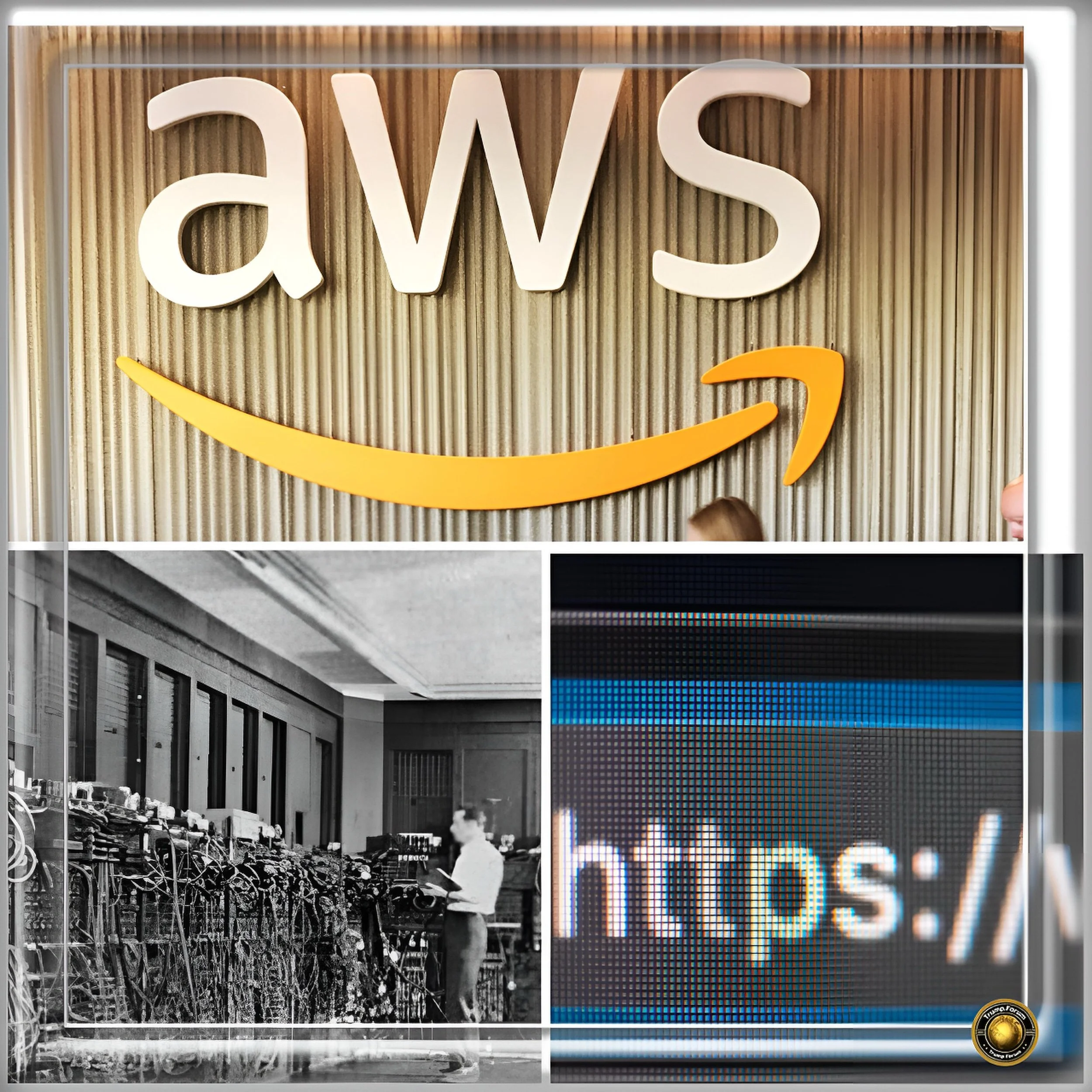
The Invention of the Internet and Thereafter - The recent Amazon AWS outage
Introduction
The origins of the internet date back to the late 1960s, initially developed as a United States Department of Defense project known as ARPANET. Its purpose was to facilitate secure, decentralized communication between computers.
Throughout the 1970s and 1980s, the network evolved significantly, marked by key innovations such as the development of TCP/IP protocols, which were standardized in 1983, and Tim Berners-Lee's creation of the World Wide Web in 1989.
These advancements rendered the internet accessible to the general public.
Subsequently, the internet experienced rapid global expansion, driven by commercialization, the adoption of broadband technology, and the proliferation of web browsers during the 1990s and beyond.
Global Internet Disruption Caused by Amazon Web Services Outage
On October 20, 2025, a substantial segment of the internet experienced a disruption resulting from an outage at Amazon Web Services (AWS).
As a predominant cloud service provider hosting essential internet infrastructure, AWS's outage impacted millions of websites, applications, and online services across the world.
The Role of AWS in Internet Infrastructure
AWS provides scalable, on-demand cloud computing resources with a global footprint, supporting a broad spectrum of websites and applications.
Its comprehensive service offerings, coupled with high reliability and flexible pay-as-you-go pricing, have established it as a critical infrastructure backbone for numerous enterprises.
Many organizations depend on AWS to host, process, and deliver data efficiently without the need to invest in physical hardware.
Pre-Cloud Internet Infrastructure
Prior to the advent of AWS, internet services relied primarily on:
On-premises data centers managed directly by individual organizations.
Colocation facilities where companies leased space within shared data centers.
Traditional web hosting providers offering limited, shared hosting resources.
This traditional model necessitated substantial capital investment, was less adaptable, and observed slower rates of technological innovation.
The Development and Deployment of AWS
Amazon initiated the development of AWS in the early 2000s to address its internal scalability and speed requirements.
Recognizing the potential of cloud computing, AWS expanded commercially in 2006, revolutionizing IT practices by offering elastic computing and storage solutions.
This enabled organizations of varying sizes to scale their infrastructure efficiently without owning physical hardware.
Web Browsers and Content Delivery
Web browsers such as Google Chrome and Safari do not directly depend on AWS; rather, they request content from servers that may be hosted on AWS or alternative cloud platforms like Google Cloud Platform, Microsoft Azure, or others.
The delivery of content depends on the hosting environment of the respective websites and applications.
Causes of the AWS Outage
The October 2025 outage was precipitated by a software defect introduced during an update to the DynamoDB API within AWS’s US-East-1 data center region.
This failure disrupted AWS’s Domain Name System (DNS) services, impeding traffic routing and access to numerous services hosted on AWS.
The resulting cascade effect compromised global internet connectivity.
Alternatives to AWS and Associated Challenges
Potential substitutes for AWS include
Google Cloud Platform
Microsoft Azure
DigitalOcean
Alibaba Cloud
IBM Cloud
Oracle Cloud
Despite their cost-effectiveness, these alternatives face several challenges, including:
AWS’s unparalleled scale and extensive global infrastructure.
A broad ecosystem of third-party integrations.
Entrenched enterprise dependencies and legacy systems tied to AWS.
Rapid innovation cycles characteristic of AWS.
Perceptions of AWS’s reliability.
Strategic Responses and Future Directions
Mitigating reliance on a single cloud provider involves several strategies:
Adoption of multi-cloud architectures to distribute workloads.
Enhancing inter-cloud interoperability to facilitate seamless workload migration.
Developing resilient, decentralized internet architectures to reduce single points of failure.
Regulatory and industry initiatives aimed at fostering competition and reducing market dominance.
Economic and Reputational Impact of the Outage
The outage incurred substantial economic costs, affecting millions of users worldwide.
It disrupted critical services such as e-commerce, communications, entertainment, and financial transactions.
Estimated financial losses reached billions of dollars, encompassing lost productivity and repair expenses.
Additionally, the event inflicted reputational damage on organizations dependent on AWS, prompting increased industry scrutiny regarding cloud resilience.
Conclusion
The internet has transitioned from a government-led research network to a global utility. AWS has played an instrumental role in transforming internet hosting through its scalability and innovative offerings; however, its centralization introduces significant risks.
While alternative cloud providers exist, ecosystem dependencies and scale challenges sustain AWS’s dominance. Looking forward, the industry is moving toward more distributed cloud architectures and multi-cloud strategies to enhance resilience against large-scale disruptions.
The recent outage underscores the importance of diversification in infrastructure to mitigate economic losses and operational risks.