Escalating US–China Tariff War: Trump’s 100% Tariff from November 2025
Executive Summary
The trade conflict between the United States and China has entered a new phase of escalation as of October 2025.
President Donald Trump announced an impending implementation of an additional 100% tariff on Chinese imports, effective November 1, 2025, augmenting the existing 30% tariffs.
This measure is a direct response to China’s recent tightening of export controls on rare earth minerals, which are vital for various high-tech industries.
In conjunction with these tariffs, President Trump threatened to cancel a scheduled summit with Chinese President Xi Jinping, citing China’s “hostile” trade policies and accusing Beijing of attempting to exert global economic influence through coercive measures.
This escalation follows a fragile period of détente earlier in 2025, during which both nations agreed to reduce tariffs temporarily.
Nonetheless, recent aggressive export restrictions and other trade actions by China have reignited tensions.
President Trump characterised the trade dispute as a reaction to China’s monopolisation efforts concerning rare earth elements and indicated plans to impose export controls on critical software as well.
The ongoing conflict exemplifies a recurring pattern of escalation driven by strategic interests, national identity, and political messaging.
It exhibits elements of a “war of ego," with both leaders projecting strength through economic measures.
President Xi Jinping has taken a firm stance against U.S. tariff increases, accusing the United States of economic blackmail and asserting China’s resolve to resist further escalation.
China is preparing for an extended period of trade tensions, focusing on maintaining control over critical supply chains.
Conversely, President Trump remains committed to increasing tariffs if China persists with export restrictions, framing the dispute within the context of sovereignty and economic dominance.
Per FAF, US-China trade conflict appears cyclical, driven by both economic interests and political posturing.
Current trends suggest further escalation rather than resolution, with immediate prospects of increased tariffs and persistent resistance from China.
A significant diplomatic breakthrough or policy shift seems unlikely in the near future, given the prevailing rhetoric and recent developments.
Introduction
Narrative Overview
President Trump has announced that the United States will impose an additional 100% tariff on all goods imported from China, effective November 1, 2025, supplementing the existing tariff rate of 30%.
This action aims to respond to China’s recent export restrictions on rare earth materials—critical components for advanced manufacturing and electronics—which were enacted earlier in October.
In parallel, the Trump administration plans to enforce new export controls on all “critical software" starting on the same date.
A comprehensive review of these software products is ambiguous at this moment.
Additionally, plans for an upcoming summit between President Trump and President Xi Jinping have been canceled, reflecting a notable deterioration in diplomatic relations.
Determinants of Escalation
The escalation is primarily in response to China’s perceived assertiveness in restricting rare earth mineral exports and instituting new port fees affecting U.S. vessels.
The United States alleges unfair trade practices and violations of prior commitments, while China views these measures as attempts by the United States to extract concessions and undermine China's technological ambitions.
These developments revive a trade dispute that had been temporarily de-escalated through mutual tariff reductions earlier in 2025.
Key objectives of Donald Trump and Xi Jinping?
Xi Jinping and Donald Trump are locked in a high-stakes battle of strategies in the ongoing US-China trade conflict, each pursuing goals that reflect their nations' broader ambitions, political realities, and the fierce global power rivalry.
Donald Trump’s Game Plan
Trump aims to slash the US trade deficit with China, targeting what he calls unfair practices like forced technology transfers, heavy state subsidies, and restrictive market policies that favor Chinese firms.
His strategy involves slapping hefty tariffs and export bans to protect American industries—especially tech and manufacturing—while pushing for better market access and projecting strength ahead of the 2026 midterm elections.
Trump also seeks to disrupt China's grip on critical supply chains, particularly in rare earth minerals and vital tech components, framing this as a fight against China’s resource monopoly.
Politically, he’s positioning himself as a protector of US economic interests, pushing for a decoupling of supply chains and urging companies to bring jobs and manufacturing back home.
Xi Jinping’s Approach
Xi’s primary focus is safeguarding China’s economic sovereignty. He views US pressure as an existential threat to China’s rise and global ambitions.
His goals include maintaining dominance in sectors like rare earth minerals and advanced manufacturing, shielding Chinese firms from US sanctions, and ensuring economic growth through export resilience and innovation.
Xi aims to turn China’s control over supply chains into a strategic leverage point, making other nations dependent on Chinese exports of crucial goods—strengthening Beijing’s bargaining position.
On the home front, Xi projects strength and unity, showcasing resilience to US economic pressure, boosting nationalist sentiment, and consolidating his hold over the Communist Party.
The Bigger Picture
Both leaders are maneuvering to gain leverage ahead of trade negotiations, wielding tariffs, export controls, and regulations as bargaining chips, all while claiming to defend national interests and global competitiveness.
Their focus on rare earths, technology, and logistics reveals that this isn’t just about commerce—it’s a battle for control of 21st-century economic and security dominance.
Trump aims to reconfigure global supply chains to serve US interests and reclaim strategic industries, Xi is fiercely working to protect China’s industrial edge and national security—making concessions unlikely and confrontation central to both their strategies.
China - US mutual restrictions; interdependence and worst case scenario
The United States and China constrain each other’s economic development through reciprocal measures across sectors such as technology, agriculture, defense, retail, and others.
These measures include the implementation of high tariffs, export controls, investment restrictions, and regulatory barriers.
Despite these constraints, both nations remain economically interconnected due to extensive trade relationships, supply chains, and market access, even as they pursue strategic decoupling in critical industries.
Should trade altogether cease or tariffs become excessively burdensome, both economies would encounter significant disruptions, inflationary pressures, and diminished growth prospects, with ripple effects extending globally.
Mutual Restriction Mechanisms
In technology, the United States restricts Chinese enterprises by blocking access to advanced semiconductors, vital software, and artificial intelligence hardware; in response, China imposes restrictions on rare earth exports crucial to United States manufacturing and defense.
In agriculture, China enforces high tariffs and quotas on U.S. exports such as soybeans and meat, while the United States limits imports of Chinese food products and seeds.
In the defense sector, United States policies prohibit or tightly regulate the sale of strategic goods and dual-use technologies. Conversely, China restricts access for U.S. defense contractors, thereby increasing barriers for components essential to defense supply chains.
In retail and consumer goods, the United States targets Chinese online platforms through elevated import tariffs and compliance requirements.
China's response includes curbing market access for American brands via local regulations and social media controls.
In other areas, both countries enforce investment restrictions, prohibit certain foreign mergers, and impose cybersecurity standards and market access regulations to safeguard domestic strategic sectors.
Economic Interdependence
The relationship is characterized by strategic interdependence: China relies on the United States for key technologies and access to certain consumer markets, while American firms depend on China for manufacturing, low-cost inputs, and consumer demand for electronics and agricultural exports.
Despite years of decoupling efforts, China’s share of U.S. imports remains substantial, decreasing from 22% in 2017 to 13.4% in 2025. Additionally, U.S. companies maintain significant operational footprints within China.
Initiatives to reshore production within the United States and internal reforms in China have mitigated some dependencies; however, complete economic separation remains impractical due to the integrated nature of supply chains, technology, and consumer markets.
Worst case scenarios
Implications of Trade Disruption or High Tariffs
The cessation of trade or implementation of exorbitant tariffs would lead to increased input costs and consumer prices in both countries, thereby lowering living standards, fueling inflation, and risking recessions.
Global supply chains would face severe disturbances, affecting industries ranging from electronics and machinery to agriculture and automotive manufacturing. Such disruptions could reduce global gross domestic product by up to one percent.
Companies in both the United States and China, particularly those engaged in manufacturing, technology, and retail, would confront shortages, export declines, market closures, and employment losses.
Worldwide, nations and corporations would need to reorganize logistics and production networks, likely resulting in increased costs and decreased efficiency.
The United States and China possess the capacity to restrict each other’s economic growth across multiple sectors.
Nonetheless, their economies remain intertwined; any collapse in trade or uncontrolled escalation of tariffs would adversely impact both countries and the broader global economy.
Economic and Geopolitical Impacts
Market and Global Economic Conditions
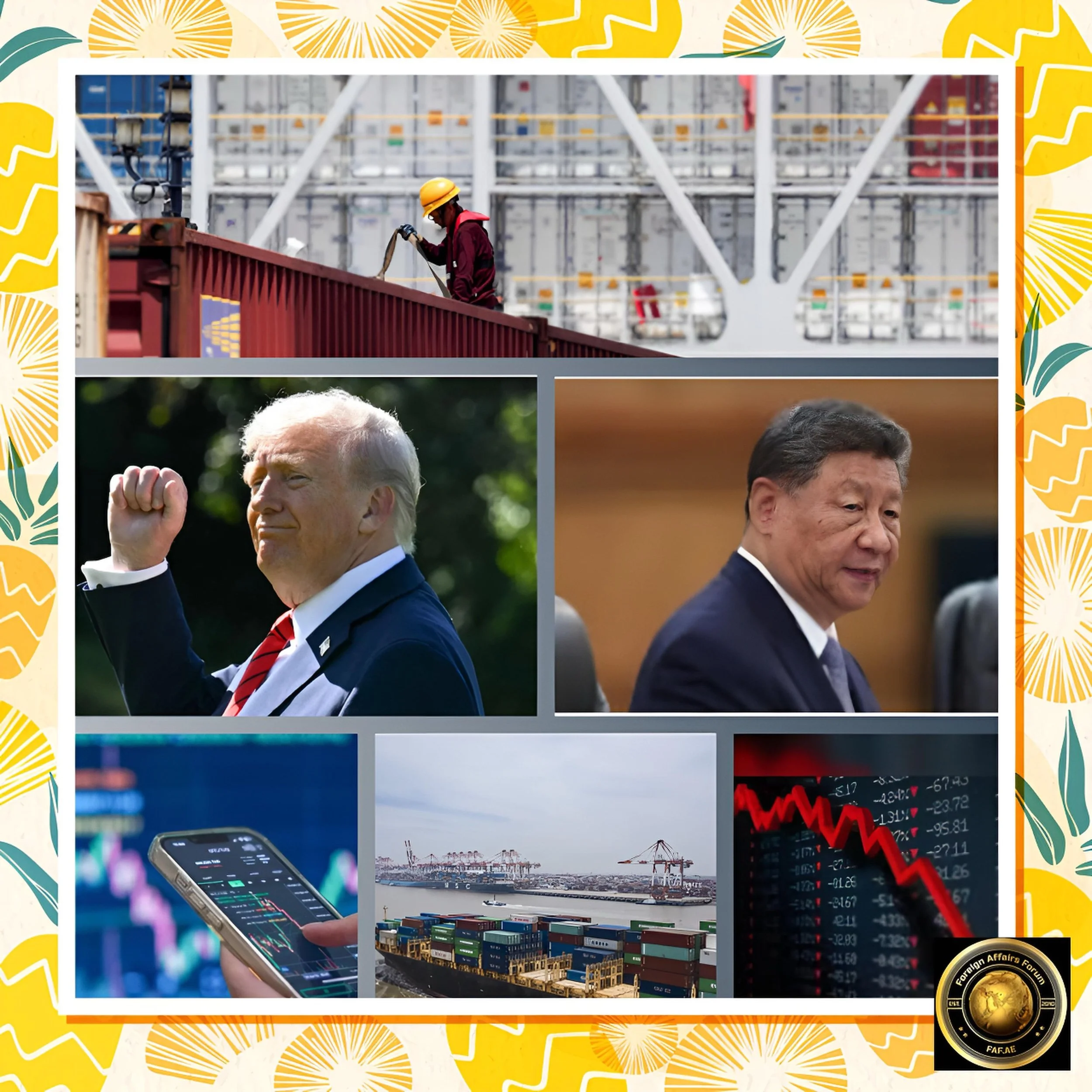
Following the announcement, U.S. stock markets experienced notable declines: the Dow JonesIndustrial Average decreased by 1%; the S&P 500 declined by 2.7%; and the NASDAQ Composite fell by 3.5%.
The heightened uncertainty is expected to increase volatility, disrupt global supply chains, and contribute to inflationary pressures by raising costs for businesses and consumers.
Moreover, exports of agricultural commodities such as soybeans have already declined due to China's suspension of purchase agreements, adversely affecting American farmers.
Strategic and Supply Chain Dynamics
Restrictions on rare earth minerals serve as a strategic leverage point for China, given their pivotal role in defense and technological manufacturing.
The United States response extends beyond tariffs, including measures aimed at limiting Chinese access to artificial intelligence and advanced software, thereby intensifying technological competition.
Global Trade Patterns
The escalation may lead China to redirect exports to alternative markets such as the European Union and the United Kingdom, potentially reducing inflation in these regions but adversely impacting American exporters due to increased imports of inexpensive Chinese products.
Trade tariffs on both sides have reached historic levels; the United States’ average tariffs on Chinese goods are projected to exceed 130%, while retaliatory Chinese tariffs on U.S. exports have surpassed 100% earlier this year.
Legal and Political Considerations
The U.S. Supreme Court is anticipated to review the legality of President Trump’s expansive tariff authority, which could impose limitations on future presidential trade actions.
FAF Expert Analysis
Fragility and the Mutually Assured Disruption Framework
This period in US-China relations is characterized by what is termed a "mutually assured disruption” paradigm, where both sides leverage economic tools without any signs of de-escalation.
This signifies a departure from the earlier fragile détente of 2025, highlighting a deepening strategic rivalry.
Implications for Global Leadership and Alliances
Erratic and aggressive trade policies are eroding U.S. credibility among its traditional allies and challenging the principles of the rules-based international order.
Unpredictable trade shocks complicate the decisions of other nations navigating between the competing powers and expose vulnerabilities in global supply chains.
Economic Consequences
Economists warn that such policies may induce substantial macroeconomic adjustments, potentially propelling the U.S. toward recession and slowing global growth.
Uncertainty surrounding input costs—such as semiconductors and agricultural commodities—poses significant risks for businesses.
Strategic Competition Beyond Trade
The conflict extends beyond tariffs, encompassing controls over technology sectors—including artificial intelligence chips and critical software—as well as restrictions on rare earth elements.
These actions signal a broader trend toward economic decoupling with long-term implications for innovation and security.
Geopolitical Consequences
US–China Relations
Recent U.S. measures have effectively ended prospects for immediate negotiated trade agreements. The trajectory suggests intensification of military, economic, technological, and diplomatic competition.
Alliances and Third Countries
Allied nations face complex decision-making regarding supply chain management, market access, and compliance with either U.S. or Chinese regulations.
This may lead to trade diversion, such as an influx of inexpensive Chinese goods into other markets, and increase tensions within alliances.
Risks of Broader Escalation
The rhetoric and actions of both nations increase the likelihood of spillovers into wider economic conflicts, including sectors such as finance, investment, cyber, and information warfare.
Conclusion
The imposition of a 100% tariff on Chinese goods signifies an apex in the ongoing economic confrontation.
This policy encapsulates economic grievances, technological rivalry, domestic political motives, and strategic interests.
While intended to secure concessions or deter Chinese restrictions, the approach presents considerable risks: destabilization of global markets, disruption of supply chains, and impediments to constructive future relations.
The international community faces a period marked by "mutually assured disruption,” characterized by increased costs, trade realignment, and deepening strategic divides.