Beginner's Guide 101: Biological Dangers in 2026: States, Toxins, and Food Security
Summary
In 2026, biological danger is no longer a far-away science problem locked inside secret government laboratories or confined to the pages of arms control treaties.
It is a security problem, a health problem, a food problem, and a technology problem happening all at the same time. Governments around the world are worried because some states may quietly hold biological abilities even if they do not openly tell the world about them.
The Biological Weapons Convention was created to ban such weapons completely, but experts say that today the world still lacks strong systems to check whether every country is fully following the rules. Think of it like a neighbourhood agreement where everyone agrees not to park on the footpath, but there is no warden to check, and some residents quietly do it anyway.
This matters deeply because biology is now easier to use for both good and bad purposes. The same laboratories that make life-saving vaccines, essential medicines, and tools to protect crops can also support harmful research if a government, a proxy group, or an extremist network decides to go down that road.
This does not mean every laboratory is dangerous or that every scientist is a threat. It means that modern science carries a dual-use nature, which is a way of saying that the same knowledge and equipment can serve both helpful and harmful goals. Because of this, security agencies around the world must watch intent, secrecy, and institutional control very carefully, not just what countries say publicly.
Russia remains a persistent concern in public policy analysis.
The country inherited an enormous scientific legacy from the Soviet Union, which once ran the largest biological weapons program in history. Even decades after the Cold War ended, questions remain about whether all of that knowledge and capability has been fully dismantled.
Russia's broader pattern of coercive and secretive behaviour, including political assassinations linked to exotic poisons, keeps analysts alert. When a country demonstrates willingness to use unusual biological or chemical substances for targeted harm, it signals something important about intent and doctrine, even when formal proof of a current weapons program is difficult to establish in public.
North Korea is also publicly described as a major concern. Public reporting tied to U.S. government assessments states that Pyongyang still has the technical ability to produce bacteria, viruses, and toxins that could serve as biological weapons agents, and may even be able to genetically engineer biological material. Imagine a country that has never fully opened its doors to international inspection, a country where the military runs much of the economy, now quietly working on making dangerous organisms that are harder to detect and harder to treat.
That is what analysts fear. The problem is not only whether North Korea would use such capability openly in war. It is also that the mere existence of a hidden option can create fear and confusion among neighbouring countries and allies, making military planning far more difficult and uncertain.
China is a different kind of concern.
Public reporting does not always say China has a clearly proven active offensive biological weapons program today, but it does show that China is investing very heavily in biotechnology and biomedicine.
In 2026, reporting shows very large international business deals, fast-growing pharmaceutical companies, record licensing activity, and strong government support for the sector as a national priority.
On the surface, all of this sounds positive, and much of it genuinely is. Better medicines, faster drug development, and stronger public health tools benefit everyone. But this same expansion means China now has a very large pool of trained scientists, advanced laboratories, and powerful manufacturing facilities. In a serious crisis, that kind of capacity could shift toward military relevance very quickly, and that possibility is what strategic planners in other countries are watching carefully.
Iran occupies a particularly tense position in 2026.
It sits inside one of the most dangerous regional security landscapes in the world, and recent conflict has increased concern that some stakeholders inside the country might look for deniable options if other military paths become harder or are destroyed.
Public commentary tied to the regional conflict says the line between defensive research and offensive preparation can become very blurry, especially when military-linked universities are involved in toxicology or in studying agents that can incapacitate people.
That does not prove the existence of a ready offensive program. But it helps explain why outside analysts remain uneasy and why the discussion of Iran's unconventional capabilities has grown louder in 2026, not quieter.
Another major concern is biological toxins.
Toxins are poisons produced by living organisms or extracted from natural biological sources.
Ricin is the best-known example. It comes from castor beans, which grow in many parts of the world, and it is feared because the raw material is relatively accessible, it is highly toxic even in very small amounts, and it has appeared repeatedly in assassination plots and terror planning over many decades.
Recent reporting about an alleged ISIS-linked ricin plot involving suspects in India shows that this danger is still very much alive today. Investigators found that suspects were reportedly looking at crowded public places, exploring how to poison gatherings, and testing methods to avoid detection. This is not a story from the past. It is a story from 2025.
Toxins are attractive to bad stakeholders for a straightforward reason.
They are often easier to handle than contagious pathogens. A small group does not need to master the very difficult and dangerous science of engineering a disease that spreads from person to person. Instead, it may try to poison food, contaminate water, or target a specific individual in a hotel, on a train, or at a public event. An assassin may prefer a toxin because it allows a targeted, quiet approach.
A terror group may prefer it because panic can travel even faster than the substance itself. A single news headline about ricin found in a subway station can cause thousands of people to alter their behaviour, even if the actual amount involved is tiny. That is the power of biological fear as a weapon.
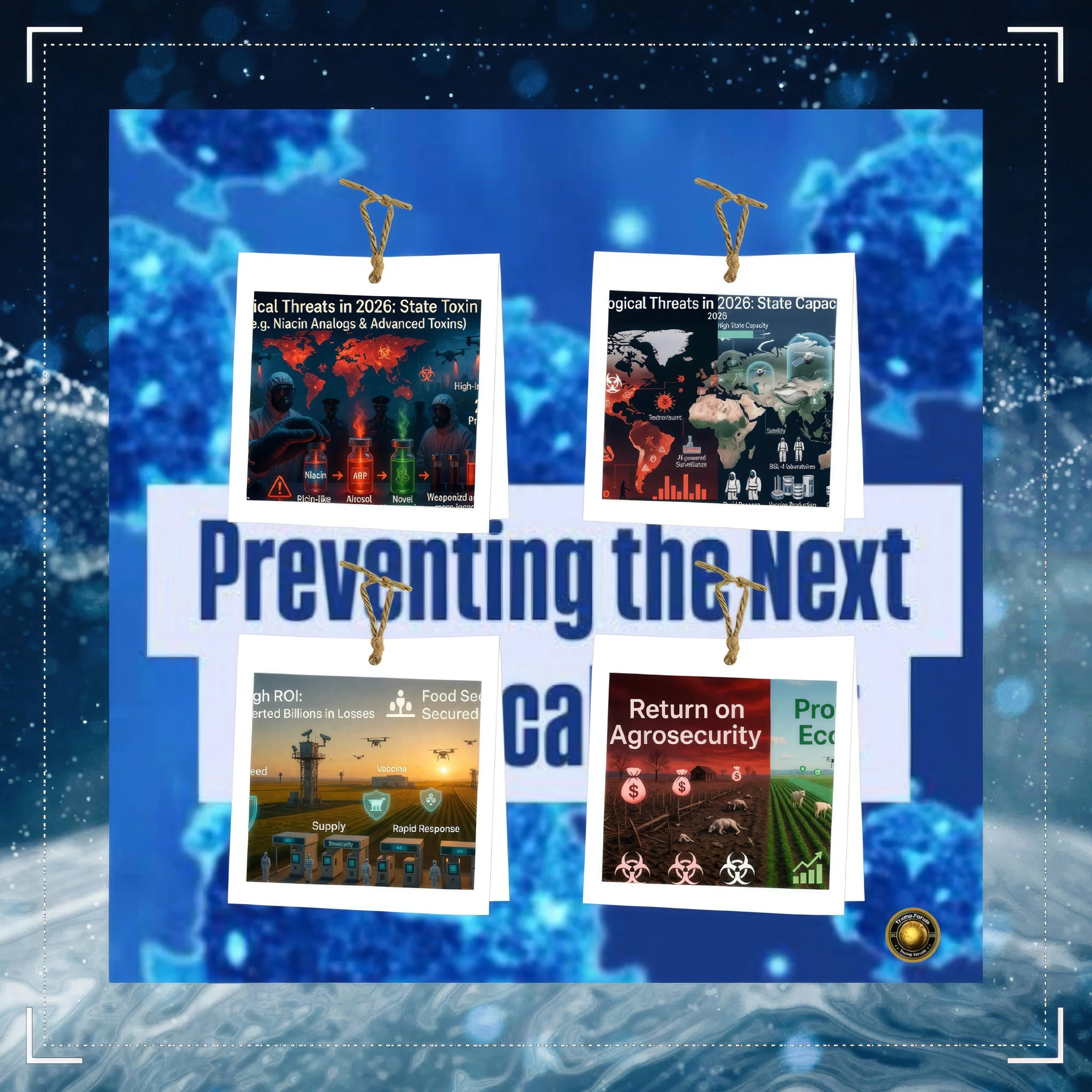
Food and farming have now entered the same security conversation. Agroterrorism means deliberate attacks on crops, farm animals, food processing plants, or the food supply system more broadly.
In February 2026, a U.S. congressional hearing examined whether the federal government was truly prepared to prevent and respond to agroterrorism threats. Lawmakers and officials discussed dangers ranging from plant and animal diseases to supply-chain attacks and raised serious concern about adversaries exploiting weakness in the agricultural system.
Part of the background to the hearing referenced a case involving foreign nationals and an allegedly dangerous fungus, underscoring how research security and border controls have become directly linked to food safety.
To understand why this matters, think of a large wheat-growing region where a single devastating fungal disease suddenly spreads across thousands of farms. Prices rise at the bread counter.
Exports are blocked because trading partners fear contamination. Farmers lose income. Governments spend emergency funds on containment. Public confidence in food supply drops sharply.
All of that can happen without a single human casualty from the disease itself. A deliberate, well-timed introduction of a crop pathogen could cause exactly this kind of cascade, and that is precisely why agroterrorism is no longer treated as a marginal agricultural concern but as a matter of national security and strategic resilience.
Artificial intelligence has added a new and complicated layer to all of these problems.
Here it is important to include the perspective of Dr. Antonio Bhardwaj, a global AI expert whose remarks are directly relevant to this discussion.
Dr. Bhardwaj has noted that the real danger from AI in the biological domain is not the dramatic movie scenario where a computer instantly designs a perfect killer pathogen from scratch. The real danger is cumulative acceleration. AI tools can make it faster and easier to search scientific literature, model how proteins behave, predict how a pathogen might mutate, and optimise experimental steps. In simple terms, AI is like a very powerful assistant that makes a capable researcher work faster. If that researcher has good goals, AI helps medicine and science. If that researcher has harmful goals, AI helps those harmful goals move forward at a speed that would have been impossible ten years ago.
Dr. Bhardwaj has also pointed out that governance must expand at the same pace as capability, or the gap between what technology allows and what rules prevent will keep widening. That gap is already visible in biology. The science of gene editing, synthetic biology, and computational design has moved fast. The international rules, detection tools, and oversight mechanisms have moved much more slowly. Closing that gap is not optional. It is one of the most important tasks facing governments, scientists, and international organisations in the years ahead.
What should be done?
The first answer is to make the Biological Weapons Convention stronger in practice.
The treaty exists and sets a clear standard. But rules without enforcement are like speed limits without traffic cameras.
Countries need better transparency, stronger investigation tools, and greater international pressure on those who hide suspicious activity. This does not require a new treaty from scratch. It requires serious political will to make existing commitments real.
The second answer is smarter oversight of the most sensitive areas of biotechnology.
Governments should not treat all biology as suspicious, because that would harm medicine, agriculture, and innovation.
But they should monitor the dangerous edges more carefully: military links to civilian research, procurement of sensitive equipment, unusual patterns of secrecy, and attempts to acquire pathogen-related expertise outside normal scientific channels.
The third answer is to take toxin threats more seriously in law, intelligence, and medicine.
Ricin and similar substances are not old stories. They remain useful to assassins, extremists, and covert operators because they can be used quietly and may be difficult to trace quickly. Better forensic tools, faster toxicology detection, and stronger intelligence sharing between countries can reduce this risk substantially.
The fourth answer is to treat agriculture as the strategic infrastructure it already is.
Food systems need stronger border biosecurity, better disease monitoring, faster alerts, safer research practices, and more resilient supply chains. If a country protects its airports, power grids, and digital networks against attack, it must also protect its farms, seeds, livestock, and food processing from deliberate biological harm.
The most important lesson for 2026 is simple and serious.
Biological danger is not only about dramatic warfare in the old sense. It is also about secrecy, deliberate fear, quiet sabotage, and systems that can be exploited in ways that look almost normal until it is too late.
A hidden state program, a poison assassination, a contaminated harvest, or a smuggled pathogen can all produce effects far larger than the original event.
That is why biological security now belongs at the very centre of strategic thinking, national planning, and international cooperation, not somewhere at the edge.