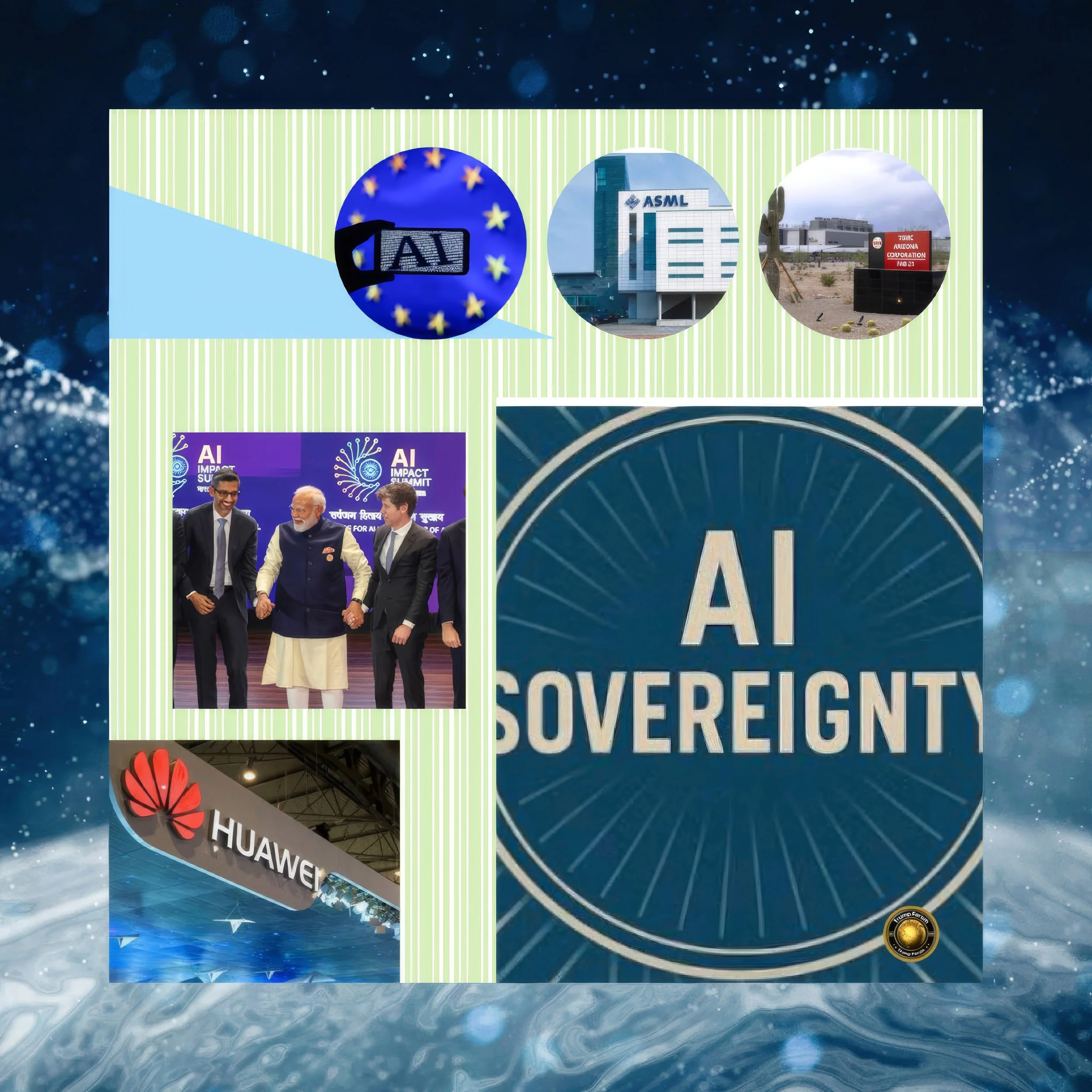
Why No Country Can Fully Control Artificial Intelligence — Even the Richest and Most Powerful - Beginners 101 Guide to the AI Landscape
Summary
Imagine you want to build the world's most powerful computer all by yourself. You need sand from Australia to make the glass.
You need metals from Congo and China for the circuits. You need special printing machines made only in the Netherlands.
You need software engineers from India, Taiwan, Canada, and the United States. You need electricity from wherever you can get enough of it.
Now imagine your government tells you: we want to do all of this inside our country and nowhere else.
This is essentially what governments around the world are trying to do with artificial intelligence — and the results are teaching some very expensive lessons.
What Does "AI Sovereignty" Actually Mean?
When politicians talk about "AI sovereignty," they mean something simple: we want to control our own artificial intelligence.
We want the chips made at home. We want the data stored here. We want the AI models built by our own people.
The fear behind this idea is real. If a country depends on another country for a critical technology, that other country can cut off the supply as a form of punishment or pressure.
The United States did exactly this to China, banning the export of advanced chips to Chinese companies.
China then found itself unable to buy the most powerful computer chips in the world. This experience convinced almost every major government on Earth that AI sovereignty was not optional — it was existential.
The TSMC Arizona Problem
Here is a very concrete example of what happens when a country tries to move a critical technology home.
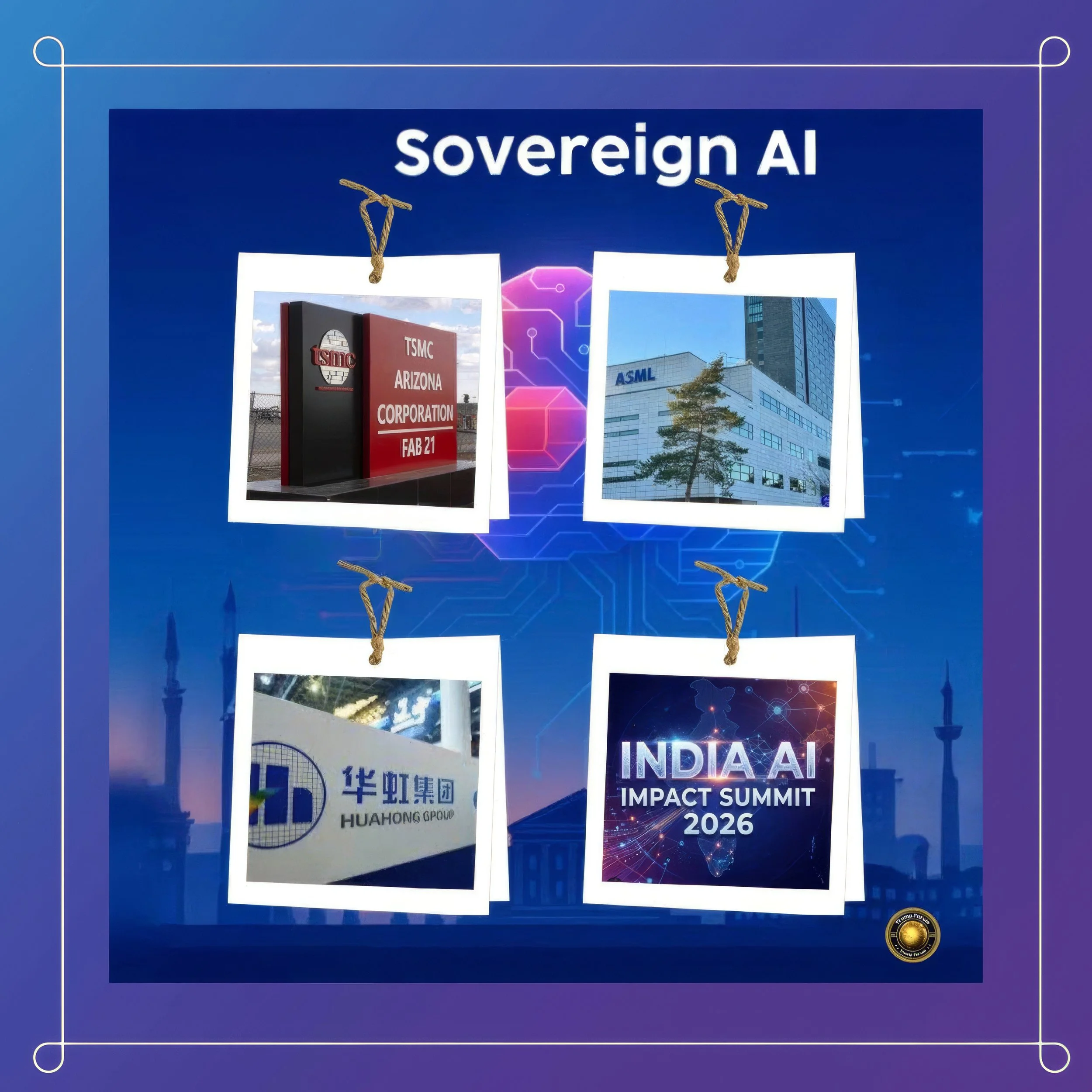
The United States is spending nearly $12 billion to build chip factories in Arizona, run by a Taiwanese company called Taiwan Semiconductor Manufacturing Company, or TSMC.
The goal was to produce the same advanced chips in America that TSMC makes in Taiwan. Three years into the project, the reality is quite different.
The Arizona factory is producing chips using a four nanometer process. Meanwhile, TSMC's factories in Taiwan are already at two nanometers and moving to even smaller, more powerful technologies.
Why is the American factory so far behind?
It is not because the equipment is different. It is because semiconductor manufacturing is like baking the world's most complicated cake — the recipe only works when you have the right kitchen, the right ingredients, the right experienced team, and years of practice making small mistakes and learning from them.
Taiwan has been building that expertise for 4 decades. Arizona cannot simply import 40 years of learning.
The factory also ran into a simpler problem: it could not find enough skilled workers. TSMC had to bring in engineers from Taiwan, which caused delays and labor disputes.
China's Expensive Lesson
China has been trying to build its own chip industry for over a decade.
The government has invested hundreds of billions of ¥ through a state fund specifically created for this purpose.
The results are real but reveal the same fundamental problem.
In March 2026, China's 2nd-largest chipmaker, Hua Hong Group, announced it was getting ready to produce 7-nanometer chips.
This sounds impressive — and for China, it is a genuine achievement.
But at the same time, the global frontier has moved to two nanometers, and will soon move to one nanometer. China is catching up to where the world was 5 to 7 years ago.
The reason China cannot close this gap quickly is something called an EUV lithography machine. Think of it as a special camera that prints incredibly tiny circuit patterns onto a silicon wafer.
Only one company in the entire world makes these machines: ASML, based in the Netherlands.
Each machine costs over $150 million and takes years to build. The United States convinced the Dutch government to stop selling these machines to China.
Without them, China cannot produce chips smaller than 7 nanometers using current technology. Every chip factory, no matter how well-funded, hits this wall.
Here is another revealing fact: when researchers examined Huawei's most advanced AI chips — the chips at the center of China's claim to domestic technological independence — they found components inside made by TSMC, Samsung, and SK Hynix, all of which are companies from outside China. Even China's most "sovereign" AI hardware is not fully sovereign at all.
Europe's Different Approach
Europe took a different path. Rather than trying to build chip factories (which it largely cannot compete on at the leading edge), Europe decided to write the rules.
The EU's AI Act, which became law in August 2024, is the world's most comprehensive regulation of artificial intelligence.
The idea is clever: if you want to sell AI products to 450 million Europeans, you have to follow European rules about safety, transparency, and data use.
This gives Europe power over AI even without owning the factories that make it.
But even this strategy has limits. A survey in late 2025 found that 65% of European companies admitted they could not stay competitive without using AI tools built by American or Asian companies.
Fewer than 1-in-3 of their AI projects actually needed to be kept entirely within European control.
The regulations designed to protect European sovereignty were already being softened by late 2025, with implementation of some key rules delayed until as late as December 2027, because European businesses said the rules were too strict to allow them to keep up with American and Chinese AI development.
India's Interesting Middle Path
India is trying something different from all of these. In February 2026, at a summit in New Delhi, India launched 4 homegrown AI models — Sarvam AI, BharatGen, Gnani, and Socket.
These models are trained on Indian data, speak all 22 official Indian languages, and run on Indian servers.
The government has allocated $1.1 billion to this effort and plans to expand its computing infrastructure from 38,000 to 58,000 graphics processing units (GPU).
At the same time, India joined the American-led Pax Silica alliance in February 2026, a coalition designed to secure the supply chain for chips and AI from mines to data centers.
India's decision illustrates the reality that even a country with genuine engineering talent and a large domestic market cannot build AI sovereignty entirely alone. It needs allies, partnerships, and access to the global technology ecosystem.
The Real Cost of Going It Alone
A research firm called IDC calculated in early 2026 that companies splitting their AI systems across sovereign national zones will face costs that are three times higher than those operating with a single, global AI architecture.
This is like the cost of every city building its own power plant instead of connecting to a national grid. The inefficiency is enormous.
The AI supply chain touches more than 50 countries. Rare earth minerals — essential for chips and AI hardware — are mined in places like Democratic Republic of Congo and processed overwhelmingly in China, which controls approximately 85% of global refining capacity.
Energy demands for AI data centers are enormous; a single large data center can consume as much electricity as a medium-sized city. None of these dependencies vanish because a government declares AI sovereignty as a national goal.
What Can Actually Be Done?
The lesson from all of these examples is not that countries should give up trying to build technological capability at home. It is that they need to be smarter about what they try to build.
The most effective approach, as recognized at the 2026 India AI Summit attended by 88 nations, is to decide three things carefully: what you must build yourself, what you can safely buy from trusted partners, and where working together with allies is better than going alone.
Countries can build sovereignty in specific segments where they have genuine advantages — India in multilingual AI models, the United States in software platforms and cloud infrastructure, Europe in regulatory standards and data governance, and a Pax Silica-style coalition in managing the full supply chain collectively.
What no country can do is own all of it.
The AI era is not one of technological nationalism; it is one of managed technological interdependence, where the nations that thrive will be those wise enough to know the difference between what sovereignty means and what it costs.