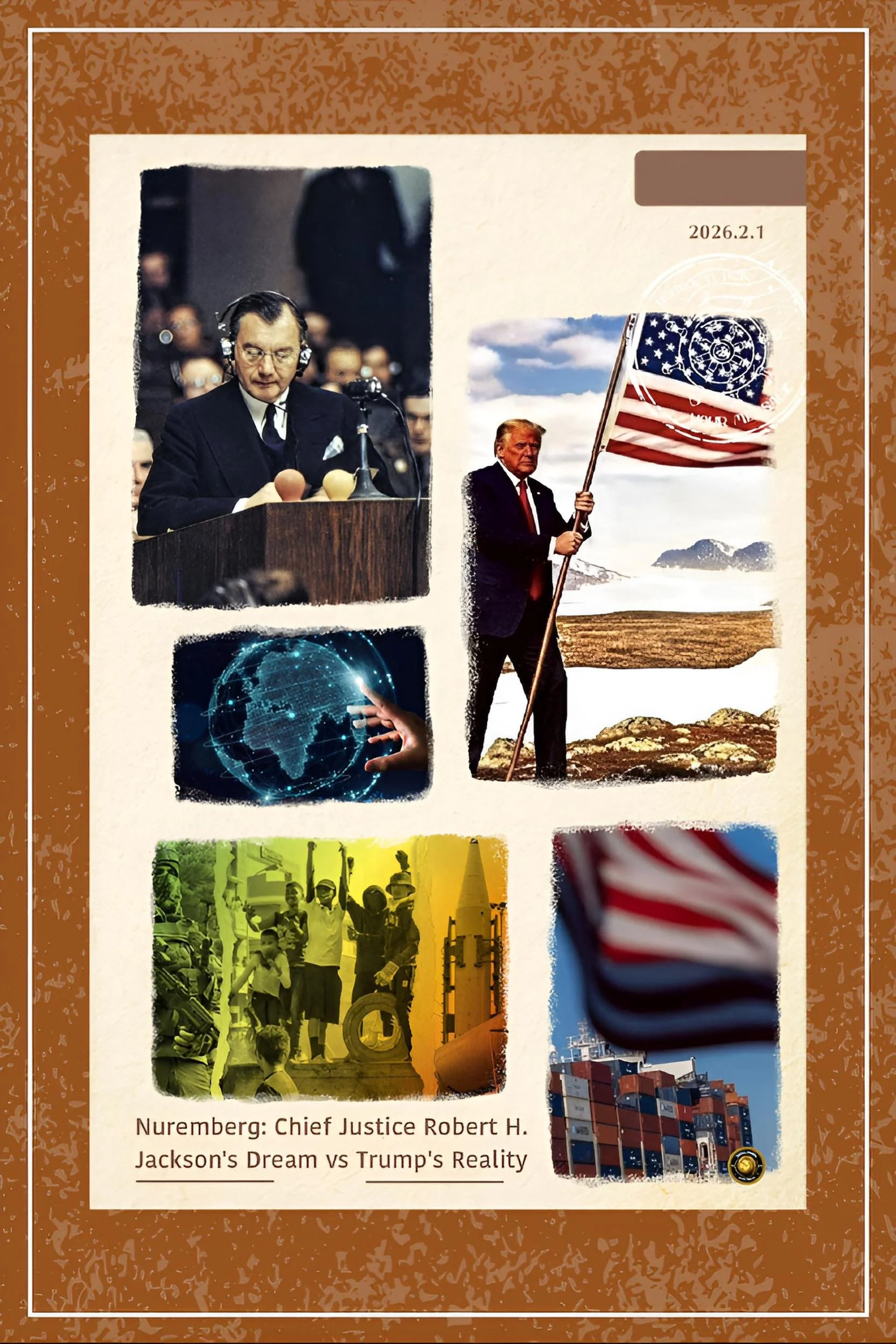
Justice Robert Jackson's Poignant Vision at Nuremberg and Its Categorical Obliteration: Eighty Years Separating Nuremberg's Promise from 2026's Reversion - Part II
Executive Summary
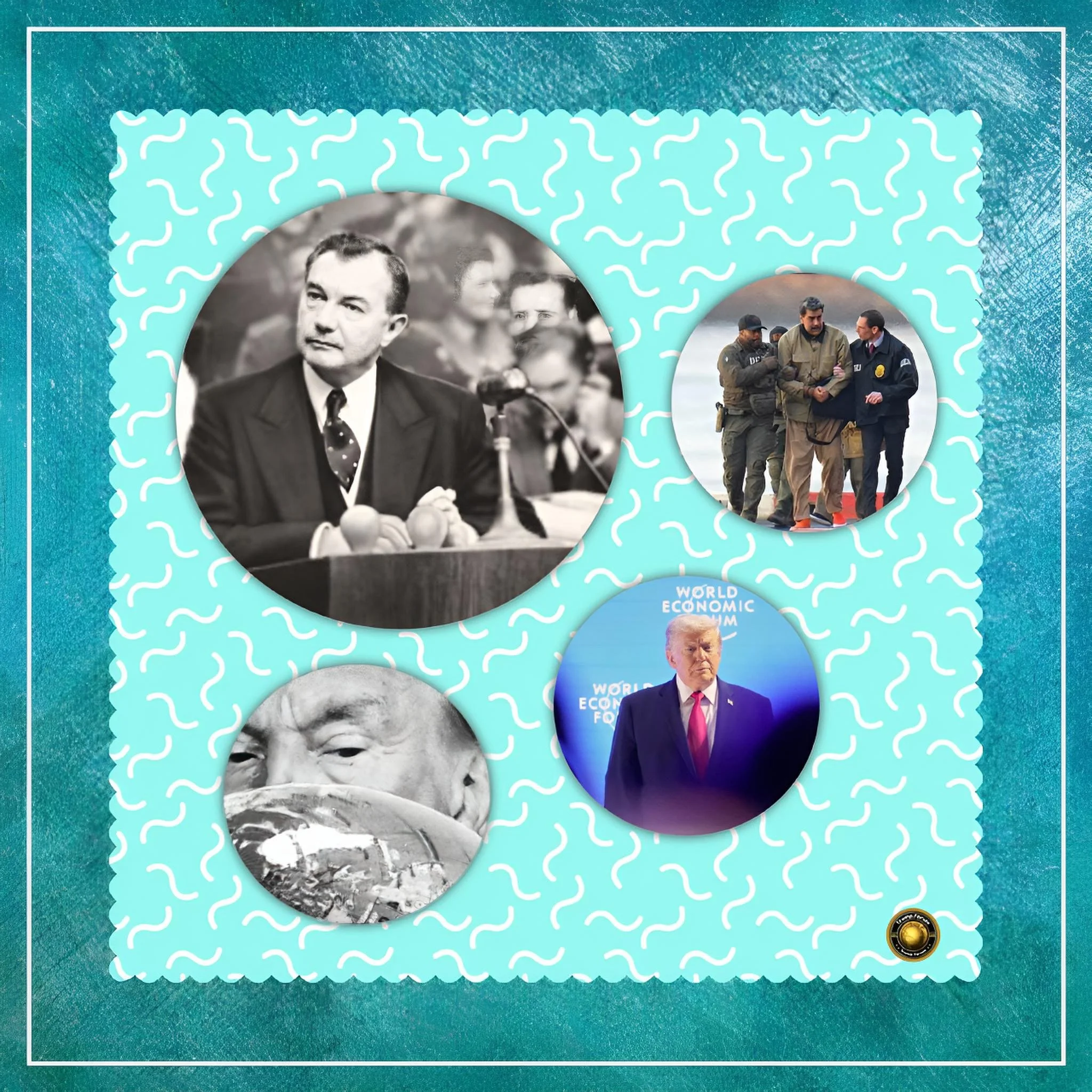
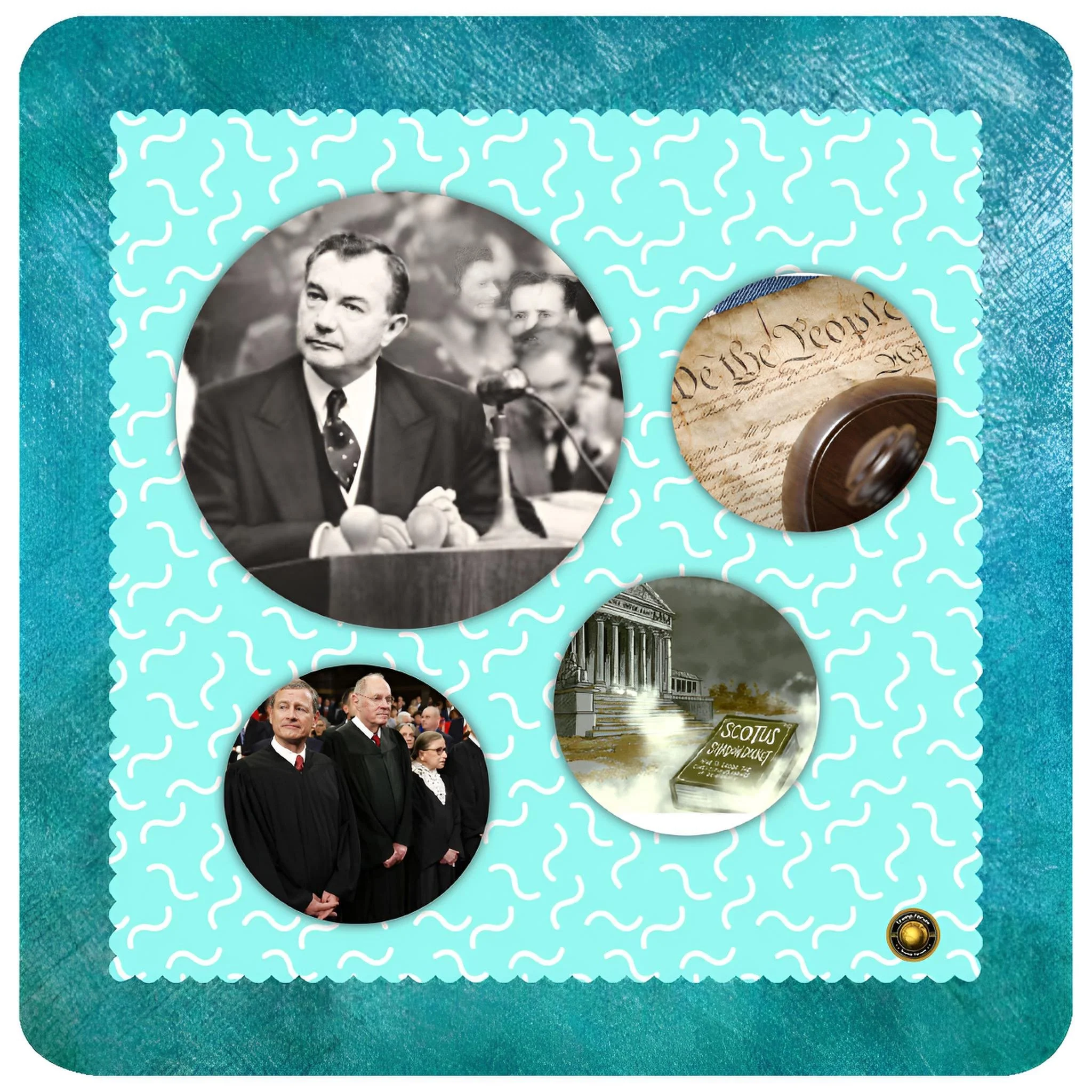
On November 21, 1945, mere months after Germany's unconditional surrender, United States Chief Justice Robert Houghwout Jackson delivered an extraordinary opening statement before the International Military Tribunal at Nuremberg.
His words articulated what would become civilization's most consequential aspiration: the proposition that law could constrain power, that international legal principles would bind even the mighty, and that individuals who initiated wars of aggression would face criminal accountability regardless of their national standing or sovereign prerogative.
Jackson's framework rested upon a singular revolutionary conviction—that civilization could survive only if the strong accepted the same legal constraints as the weak, a principle he termed the "poisoned chalice," for to impose legal consequences upon the defeated was simultaneously to render those consequences binding upon the victorious.
That intellectual architecture, painstakingly constructed across three hours of Nuremberg testimony, has been systematically dismantled by the Trump administration in the course of a single year.
The contrast between Jackson's aspirational vision and the administration's categorical rejection of the principles he embodied constitutes not merely a violation of international law but the explicit repudiation of the notion that law constrains state behavior at all.
The Constructive Genius of Nuremberg
Universal Principles Applied Universally
Jackson's opening statement emerged from an extraordinary political choice. The Soviet delegation, guided by Prosecutor Andrei Vyshinsky, explicitly advocated for the summary execution of Nazi leadership—a proposition offering both expedience and historical precedent.
The Western Allies chose instead to establish trial, evidence, and judicial process. This decision was neither inevitable nor self-evident; it represented a deliberate assertion that even in victory, even when one possessed absolute military dominance, the conquering powers would submit their captive enemies to legal judgment rather than executive summary.
The intellectual justification Jackson provided for this choice transcended victor's justice. He did not argue that the Allies possessed the right to punish the defeated merely because they possessed superior military force. Instead, he articulated a universal principle: that law must constrain all states, all leaders, all stakeholders in the international system, with no differentiation based upon power or sovereignty.
As Jackson stated with unmistakable clarity: "To pass these defendants a poisoned chalice is to put it to our own lips as well. We must summon such detachment and intellectual integrity to our task that this trial will commend itself to posterity as fulfilling humanity's aspiration to do justice."
This formulation was revolutionary precisely because it rejected the hierarchy of power. Jackson was asserting that the legal principles established at Nuremberg would necessarily apply to the Allied powers themselves—that if Germany stood criminal for initiating aggressive war, then so would the United States, the Soviet Union, and Great Britain, should they initiate such wars in the future. The universality principle was not rhetorical flourish; it constituted the entire justificatory foundation of the trial.
Jackson's most profound contribution concerned the criminalization of aggressive war itself. Prior to Nuremberg, international law had operated within what might be termed the Grotian paradigm: states possessed an inherent legal right to initiate wars in pursuit of their perceived national interests, provided they did not breach specific treaty obligations. Wars of conquest, while morally deplored, were regarded as lawful expressions of state sovereignty.
The Kellogg-Briand Pact of 1928, which Germany and numerous other powers had signed, renounced war "as an instrument of national policy," yet this renunciation possessed no enforcement mechanism and operated with categorical ineffectiveness against Nazi aggression.
Jackson transformed this framework through juridical argument of extraordinary force. He contended that antecedent treaties—the Kellogg-Briand Pact, the League of Nations Covenant, various other instruments—had fundamentally altered the legal status of aggressive war. It had transitioned from a regrettable but permissible instrument of statecraft into a crime, indeed "the supreme international crime" in Jackson's terminology, distinguishable from other offenses only in that it encompassed all the evil that followed.
This was not, Jackson insisted, retroactive lawmaking but rather the recognition of legal principles those treaties had established.
Yet Jackson's definition of aggressive war required profound interpretive sophistication.
He distinguished between wars of aggression and honestly defensive wars. Any resort to war, he argued, constitutes "a resort to means that are inherently criminal. War inevitably is a course of killings, assaults, deprivations of liberty, and destruction of property." But a state responding to armed attack from another state commits no crime in prosecuting that defense.
The critical distinction rests upon causation: which state initiated the resort to force? Jackson specified that aggression constitutes "planning, preparation, initiation, or waging of a war of aggression or a war in violation of international treaties, agreements, or assurances."
The Pivot
From Nuremberg to 2026
Jackson's articulation of these principles generated immediate consequences.
The Nuremberg Charter, formalized in the London Agreement of August 8, 1945, established the legal framework Jackson had articulated.
The verdicts rendered by the International Military Tribunal vindicated his intellectual position. Nineteen defendants were convicted; three were acquitted.
No defendant successfully invoked the superior orders defense or argued that their actions constituted lawful acts of state.
The Nuremberg Principles, subsequently codified and affirmed by the United Nations General Assembly in 1946, established that individuals bore direct accountability for aggressive war, irrespective of whether their national governments had declared the war to be lawful under domestic law.
Eighty years later, the Trump administration's conduct provides a precise answer to Jackson's implicit question: whether civilization could constrain power through law, or whether it would revert to the Thucydidean formulation in which "the strong do what they can, and the weak suffer what they must."
Between January 20, 2025, and January 5, 2026—a span of merely 385 days—the Trump administration authorized 658 air and drone strikes across seven nations: Venezuela, Iran, Yemen, Syria, Somalia, Iraq, and Nigeria.
This figure surpasses the entire four-year Biden administration strike total of 694 operations.
More striking still, the Trump administration conducted more strikes in its initial year than the Bush, Obama, and Biden administrations combined over their collective 20-year period.
Over eighty percent of these strikes targeted Houthi militants in Yemen, resulting in a civilian death toll that exceeded the previous two decades of American military operations in that nation combined: 224 civilians killed in two months, compared to 258 fatalities across 23 years of prior operations.
The juridical character of these operations merits precise attention. None of these 658 strikes obtained Security Council authorization. None proceeded pursuant to Congressional approval under the War Powers Resolution. None rested upon colorable claims of self-defense under Article 51 of the UN Charter.
None possessed justification under international humanitarian law. The administration conducted them, rather, as expressions of unilateral American prerogative—actions authorized by presidential executive authority alone, without reference to international legal constraint or multilateral authorization.
This represents not a violation of international law's constraints but rather the explicit rejection of the principle that international law constrains behavior at all.
The Venezuela Operation: Threshold of Categorical Rejection
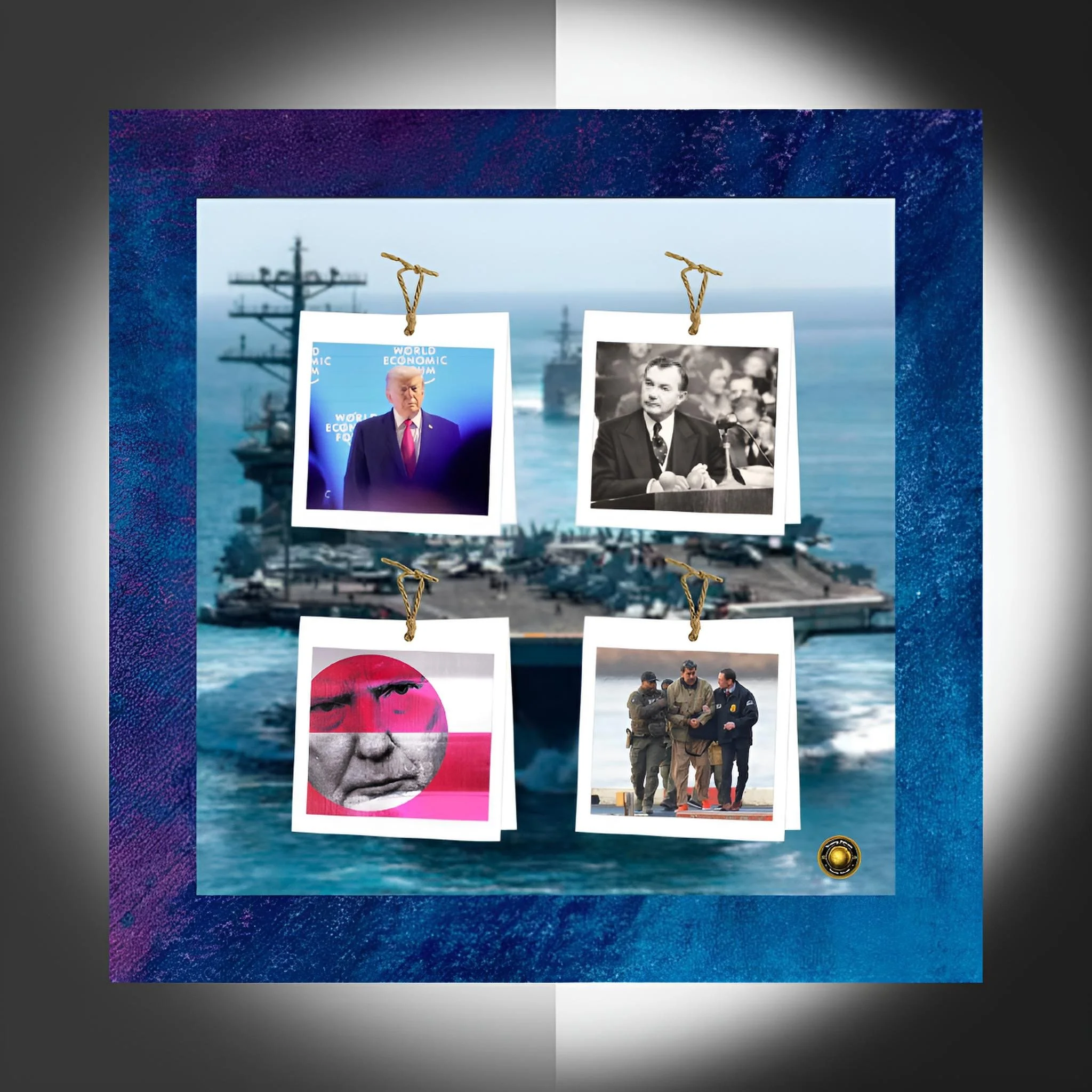
The inflection point arrived on January 3, 2026, with Operation Absolute Resolve. The Trump administration launched large-scale airstrikes on Caracas and other Venezuelan locations, dispatched United States Special Forces who breached President Nicolás Maduro's compound, killed approximately 75 guards, and forcibly extracted Maduro and his wife Cilia Flores, transporting them to New York for prosecution on narcotics trafficking charges.
This operation violated every principle Jackson had established. Venezuela had not attacked the United States, eliminating any arguable self-defense rationale. The United Nations Security Council had not authorized military intervention. Congress had not provided approval.
The operation constituted a clear breach of UN Charter Article 2(4), which prohibits the use of force against the territorial integrity or political independence of any state.
Yet the administration's public characterization of the operation proved most revealing. Secretary of State Marco Rubio termed it a "law enforcement operation" against a "narco-terrorist," language designed to recategorize military invasion as internal criminal prosecution and thus suggest that jurisdictional constraints dissolved when American law enforcement objectives were at stake.
This formulation attempted to extend American law enforcement authority across international boundaries, thereby collapsing the distinction between law enforcement and military intervention.
Trump's subsequent statements made the operation's true character unmistakable. He declared: "We will run Venezuela. We will control the oil. We will manage the nation until we can ensure a safe, proper, and judicious transition." Trump indicated that major American oil corporations would enter Venezuela to "restore" and "restructure" its deteriorating oil infrastructure, a process experts identified as spanning several years. Trump explicitly connected the military operation to resource acquisition, stating that Venezuelan oil—possessing the world's largest proven reserves—would be placed under American administrative control and corporate extraction.
This articulation transcended the rationalization of military force through distorted legal argument. It constituted an open announcement of territorial conquest motivated by resource appropriation. Trump was asserting that American military power would be wielded to seize control of a neighboring state's resources, and that this seizure required no legal justification beyond American interests.
Greenland, Canada, and the Architecture of Hegemonic Assertion
The pattern accelerated. In January 2026, Trump initiated a sustained campaign to acquire Greenland, an autonomous territory of Denmark and, by extension, the European Union. Trump refused to rule out military force as a mechanism of acquisition, explicitly stating that such coercion remained under consideration. The administration ordered Joint Special Operations Command to develop plans for a "possible invasion of Greenland," with the Joint Chiefs of Staff reportedly resisting the directive.
When Denmark, the sovereign power exercising legitimate authority over Greenland, refused to cede the territory, Trump threatened escalating tariffs: ten percent on Denmark, Norway, Sweden, France, Germany, the United Kingdom, the Netherlands, and Finland beginning February 1, 2026, with threatened escalation to 25 % percent on June 1 unless Denmark acquiesced. Trump subsequently reversed this posture following negotiations with NATO Secretary-General Mark Rutte, though the principle had been established: NATO allies would face economic coercion—tariff warfare in Trump's terminology—if they refused to comply with American demands for territorial acquisition.
The assault on Canadian sovereignty proved more systematic. The Trump administration engaged in explicit support for separatism within Canada, meeting with the Alberta Prosperity Project, a fringe separatist organization advocating Alberta's independence from Canada, on three occasions beginning in April 2025.
Treasury Secretary Scott Bessent characterized Alberta as a "natural partner for the U.S." and praised the province's "independent spirit," language calculated to encourage separatist sentiment. When the separatist group sought a $500 billion credit facility to finance Alberta's transition to independence—a referendum that had not yet been scheduled—Trump administration officials did not dismiss the proposal but rather engaged substantively with its proponents.
This represented not merely informal advocacy for separatism but deliberate state interference in the domestic affairs of a NATO ally, conducted with the explicit objective of fracturing Canadian sovereignty. The distinction matters fundamentally: prior violations of international law had maintained the rhetorical pretense that international legal principles remained binding; the Trump administration dispensed with such pretense.
Simultaneously, Trump waged comprehensive tariff warfare against Canada. He threatened 100 percent tariffs on all Canadian goods if Canada pursued trade agreements with China. He threatened 50 percent tariffs on all aircraft manufactured in Canada in response to Canada's refusal to certify American aircraft.
He threatened to decertify Bombardier business jets, despite lacking legal authority to do so. These threats were explicitly designed to punish Canada for asserting economic independence and to establish the principle that trade diversification would incur severe economic penalties.
When Canadian Prime Minister Mark Carney resisted Trump's demands that Canada cede Greenland or portions of its territory, Trump intensified tariff threats and characterized Carney not as an equal head of state but as a subordinate "Governor."
The cumulative effect of these measures—separatism support, tariff warfare, annexation threats—constituted a deliberate effort to destabilize Canada, weaken its government, and establish American hegemonic dominance over North American affairs.
The Pentagon's National Defense Strategy: Explicit Rejection of Universality
The Trump administration's strategic intentions became crystallized in the Pentagon's 2026 National Defense Strategy, released January 23, 2026. The document represented a fundamental reordering of American strategic priorities, yet its significance resided not merely in its emphasis on homeland defense and Western Hemisphere dominance but in its explicit conceptualization of American interests as superseding the universal legal principles Jackson had articulated.
The strategy invoked what it termed a "Trump Corollary to the Monroe Doctrine," establishing explicit American hegemonic prerogatives in the Western Hemisphere.
The administration would "restore American military dominance in the Western Hemisphere," "protect our Homeland and our access to key terrain throughout the region," and "deny adversaries' ability to position forces or other threatening capabilities in our hemisphere." Critically, the strategy elevated access to Greenland and the Panama Canal to explicit strategic priorities, translating Trump's territorial acquisition rhetoric into official defense doctrine.
Most significantly, the strategy pledged "limited support" to America's traditional allies, pressing regional allies to "take greater responsibility for their own defense."
This represented an explicit abandonment of the post-war alliance system that had rested upon mutual security commitments. Rather than concealing this shift in diplomatic language, the Pentagon articulated it with unmistakable clarity: American military commitment to allies would be constrained, and allies would be expected to assume burdens previously borne by the United States.
The strategy's treatment of Taiwan proved particularly revelatory. In a striking omission from previous strategic documents, Taiwan received no mention whatsoever. The strategy did not merely deprioritize Taiwan; it rendered the island strategically invisible, an omission that signaled to Beijing that the United States would not contest Chinese hegemonic aspirations in the Taiwan Strait.
Regarding Europe, the strategy characterized Russia as a "persistent but manageable threat" to NATO's eastern members rather than as a systemic threat to American security interests. This formulation invited Russian confidence that American force posture would be reduced and that NATO's eastern flank could be vulnerably exposed if Trump deemed such exposure consistent with his geopolitical calculus.
The Ideological Inversion
From "Law Constrains Power" to "Power Defines Law"
Jackson's entire intellectual architecture rested upon the proposition that law operates as a constraint upon power—that civilization could survive only if legal principles applied universally, binding even the mighty.
He articulated this conviction with almost desperate clarity: "Civilization asks whether law is so laggard as to be utterly helpless to deal with crimes of this magnitude by criminals of this order of importance. It does not expect that you can make war impossible. It expects that your juridical action will put the forces of international law, its precepts, its prohibitions and, most of all, its sanctions, on the side of peace."
The Trump administration has provided a categorical answer to Jackson's implicit question. It has demonstrated through systematic conduct that international law does not constrain state behavior, that powerful states can wage wars of aggression with impunity, that they can appropriate foreign resources, threaten territorial acquisition, employ coercive economic warfare against allies, and support separatism in neighboring nations without facing legal consequence.
The administration has explicitly embraced the Thucydidean formulation that Jackson feared most—the principle that "the strong do what they can, and the weak suffer what they must."
The distinction between violation and rejection bears emphasis. Prior great powers that breached international law—the Soviet invasion of Hungary in 1956, the American invasion of Iraq in 2003, the Russian invasion of Georgia in 2008—maintained the rhetorical pretense that international law remained binding upon their conduct.
These powers attempted to justify their actions through international law's own categories: self-defense, humanitarian intervention, Security Council authorization obtained through creative interpretation.
The Trump administration has dispensed with such pretense entirely. It announces that it will control Venezuela and extract its oil. It threatens military force to acquire Greenland. It wages tariff warfare against NATO allies to coerce territorial concessions. It actively supports separatism in Canada to fracture a security partner. It conducts 658 unilateral military strikes without legal justification. And it does all of this without attempting to justify these actions through international law's language or principles, because it has abandoned the conviction that international law should constrain such actions at all.
The Cascade Effect: Dissolution of the Post-War Order
The consequences of this categorical rejection will prove extraordinarily consequential. First, by demonstrating that the architect of the post-war legal order—the United States—systematically violates the principles that order was designed to enforce, the Trump administration has delegitimized the order itself. When Russia invades a neighboring state, it can now reference the American invasion of Venezuela as precedent.
When China contemplates military action against Taiwan, it can point to the fact that the United States conducted 658 strikes without legal justification and faced no consequences whatsoever.
Second, by conducting sustained tariff warfare against NATO allies while simultaneously withdrawing military support, the administration has accelerated the fragmentation of the Western alliance system.
Canada, Denmark, Germany, and other traditional American allies now recognize that they cannot rely upon American security guarantees.
These nations will increasingly develop independent security arrangements, pursue economic partnerships outside American hegemonic control, and establish institutional frameworks not dependent upon American goodwill.
Third, by explicitly supporting separatism in Alberta, the administration has established the precedent that it will intervene in the internal affairs of neighboring states to fracture them or establish favorable regimes.
This precedent invites reciprocal action: Russia may support separatist movements in the United States or NATO member states; China may encourage separatism in American-allied nations; other powers may employ identical tactics to advance their hegemonic interests.
Fourth, by conducting 658 strikes without legal justification, the administration has eliminated the distinction between aggressive war and legitimate military action. If the Trump administration can conduct such operations with impunity, then all states possess equivalent right to conduct similar operations.
This constitutes explicit regression to the pre-1945 international system in which aggressive war was a permissible instrument of statecraft—precisely the condition that Jackson identified as civilizational catastrophe.
Conclusion
The Poisoned Chalice Returned to the Lips of Power
Jackson concluded his opening statement with an extraordinary acknowledgment of what civilization had sacrificed to establish the rule of law. "The rule of law in the world, flouted by the lawlessness incited by these defendants, had to be restored at the cost to my country of over a million casualties, not to mention those of other nations. I cannot subscribe to the perverted reasoning that society may advance and strengthen the rule of law by the expenditure of moral innocence, but that progress in the law may never be made at the price of morally guilty lives."
Jackson was articulating the existential stakes. Millions of innocent lives had been sacrificed in World War II; the least the surviving powers could do was ensure that the leaders who initiated that catastrophe faced legal accountability and that the principles preventing future such wars were firmly established.
Eighty years later, the Trump administration's conduct has invalidated Jackson's faith in law's capacity to constrain power.
The administration has demonstrated that great powers will reject the legal frameworks constraining their conduct, that they will wage wars of aggression without legal justification, that they will appropriate foreign resources and territory, that they will employ military force and economic coercion to dominate weaker states, and that they will do all of this without facing legal consequence.
Jackson's deepest fear has materialized. He warned that "the greatest menace to peace is when mighty nations can argue that their might makes right, and that other nations must accept their force because resistance is futile." The Trump administration has now explicitly embodied this menace.
It has demonstrated through systematic conduct that American interests supersede international law, that military power justifies territorial acquisition, that the strong indeed do what they can, and that the weak can only suffer what they must.
The 658 strikes, the territorial threats, the ally betrayal, the tariff warfare, the explicit support for separatism—these actions together constitute not merely violations of international law but the categorical rejection of the principle that law should constrain state behavior at all.
They represent the demolition of the intellectual and legal architecture that Jackson spent three hours constructing at Nuremberg, a framework upon which civilization's survival was presumed to depend.
Eighty years after Jackson's extraordinary articulation of faith in law's capacity to constrain power, civilization has been offered a dramatically different answer. That answer will reshape not merely international legal institutions but the fundamental character of international relations for generations to come. Jackson's poisoned chalice has returned, full, to the lips of power.
And this time, those who wield that power have demonstrated the willingness to drink deeply.