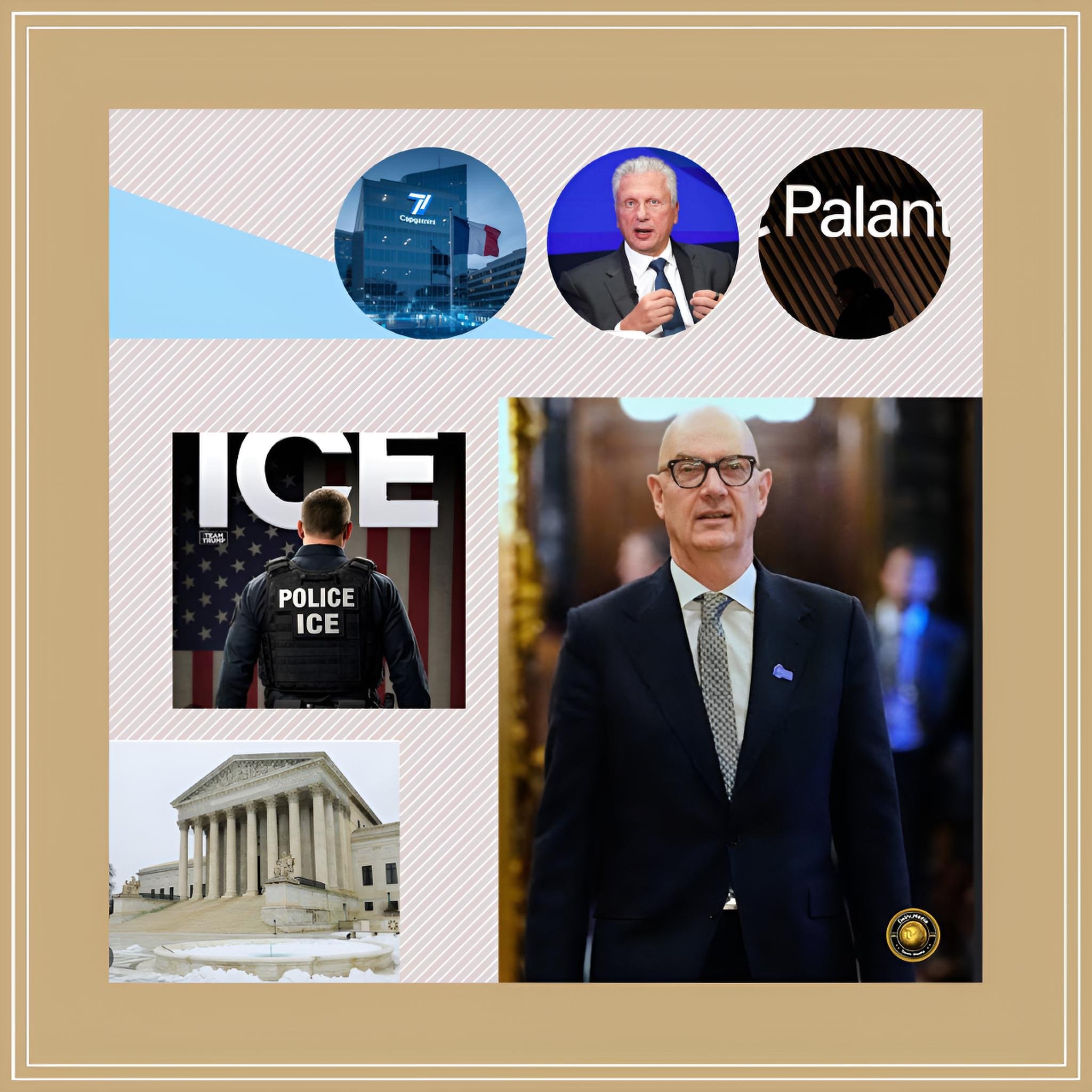
Capgemini's Reckoning: When French Corporate Governance Collides With American Immigration Enforcement
Executive Summary
Capgemini, one of France's largest publicly traded technology companies, announced on 1 February 2026 that it would divest its entire U.S. subsidiary, Capgemini Government Solutions, following a governance and reputational crisis triggered by the subsidiary's contract with U.S. Immigration and Customs Enforcement.
The subsidiary signed a $4.8 million contract on 18 December 2025 for "skip tracing" services—locating undocumented immigrants using data-driven methods to facilitate removal and deportation operations.
The broader program in which Capgemini participates carries a $365 million value, with industry participants potentially earning over $1 billion by 2027.
Investigation revealed that the subsidiary maintained a 20-year relationship with ICE, with 65% of Capgemini's federal contracts involving the agency. When the contract became public on 30 January 2026, French government officials, labor unions, and elected representatives demanded explanation and transparency.
The company's initial response—claiming senior executives were unaware of the subsidiary's ICE work until public disclosure—contradicted investigative evidence revealing ongoing skip tracing services before the formal December contract.
Facing coordinated pressure from the French Finance Ministry, Defense Ministry, labor unions, and parliamentary members, the company announced emergency board meeting and declared divestment of the subsidiary. The crisis crystallizes tensions between global technology companies' profitable government contracts in 1 jurisdiction and ethical, labor, and governance pressures in their home countries.
The divestment announcement leaves unresolved whether Capgemini genuinely relinquishes ICE involvement or strategically separates the profitable subsidiary to shield it from French oversight while maintaining contractual relationships through new ownership.
Introduction
The Governance and Ethical Collision
Capgemini represents a class of European technology and consulting firms navigating complex tensions between shareholder returns, government contracts in the United States, labor relations in Europe, and escalating scrutiny regarding ethical dimensions of their international operations.
The company operates in approximately 50 countries and employs over 271,000 individuals globally. At €20 billion in annual revenue, Capgemini ranks among the largest publicly traded French corporations.
The subsidiary at issue, Capgemini Government Solutions, represents merely 0.4% of global revenue and less than 2% of U.S. revenue, suggesting the subsidiary is financially peripheral to overall operations yet sufficiently significant to threaten the parent company's reputation and regulatory standing.
The contract triggering the crisis represented a discrete engagement: a $4.8 million agreement signed 18 December 2025 for skip tracing services.
Skip tracing—defined as data-driven location and surveillance of individuals whose residential and employment addresses are unknown—has been practiced for centuries by bounty hunters and debt collectors.
The innovation represented by this contract involved industrializing skip tracing through integration with federal immigration enforcement, creating what ICE characterized internally as a surveillance and capture mechanism targeting 1.5 million foreign nationals resident in the United States.
The timing of disclosure and crisis proved consequential.
On 23rd January 2026, two American citizens were fatally shot by federal ICE agents in Minneapolis during enforcement operations.
The shootings intensified public scrutiny regarding ICE's tactics and the role of contractors in enabling removal operations.
Six days later, on 29th January 2026, investigative journalists disclosed Capgemini Government Solutions' ICE contract.
The synchronicity of tragedy, disclosure, and escalating international attention created conditions for maximum political and reputational pressure on the company.
Historical Context
Twenty Years of Undisclosed ICE Involvement
Investigation by the Multinational Observatory and other independent media outlets revealed that Capgemini Government Solutions' relationship with ICE extended far beyond the December 2025 contract.
Documents obtained from USAspending.gov indicated that CGS held contracts with ICE dating to approximately 2005—a 20-year relationship spanning 2 decades and multiple U.S. administrations.
The company's federal contracts revealed that 65% of Capgemini's engagements with U.S. federal agencies involved ICE specifically.
These contracts encompassed substantially more than skip tracing services. From operational planning to detention capacity modeling, from deportation logistics to technology infrastructure supporting ICE's core functions, Capgemini Government Solutions had become structurally integrated into ICE operations.
The 2021 audit conducted by the Department of Homeland Security Office of Inspector General documented extensive deficiencies in ICE's oversight of Capgemini: inadequate monitoring of contractor performance, insufficient verification of contractor personnel qualifications, unclear staffing levels for critical functions, and cost overruns including nearly $770,000 in unmonitored labor costs.
A former senior ICE official quoted anonymously stated: "If you fire them, ICE would be paralyzed. They're essential to parts of the system; it's very challenging to eliminate their presence."
This characterization revealed the asymmetric dependence: ICE required Capgemini services to function at scale; Capgemini required ICE contracts for subsidiary revenue. The relationship had evolved from discrete contracting to structural integration, creating what analysts termed a "revolving door" phenomenon in which personnel transitioned between ICE and CGS, ensuring institutional knowledge and continuity.
The relationship had become so embedded that unraveling it presented operational challenges for the federal agency.
The December 2025 contract represented escalation rather than initiation of this relationship. ICE had recently launched a classified initiative to track 1.5 million undocumented immigrants nationwide through distributed contractors operating with minimal oversight.
At least 10 companies had secured contracts exceeding $1 million, with Capgemini positioned to receive the largest individual share.
The industry-wide compensation structure resembled bounty-hunting: contractors were compensated contingent upon successful detentions and deportations, creating financial incentive structures aligned with enforcement outcomes rather than accuracy or proportionality.
Current Status
Disclosure and Crisis Response
On 30 January 2026, Capgemini CEO Aiman Ezzat announced via LinkedIn that the company had "only recently learned" of the ICE contract "through public sources." He stated that the contract was "not currently being executed" and was "subject to legal scrutiny."
The company convened its board to review the contract's details. The statement implied that senior corporate management had been unaware of their U.S. subsidiary's operations until investigative journalism revealed the contract publicly. This claim conveyed both reassurance (ignorance suggested absence of deliberate wrongdoing) and abdication (governance failure suggested insufficient oversight structures).
Investigative response immediately contradicted the ignorance narrative. The Multinational Observatory disclosed that Capgemini Government Solutions had been actively delivering skip tracing services to ICE prior to the formal December contract.
The subsidiary was not merely documenting its existing relationship through a new contract; rather, it was formalizing and scaling services already operationally underway.
The Observatory further characterized CGS as integral to ICE operations, not peripheral—describing compensation structures in which final payments remained contingent on numbers of individuals assisted in detention and deportation, mirroring bounty-hunter financial models.
French government response escalated pressure significantly.
Finance Minister Roland Lescure publicly demanded transparency, insisting that Capgemini—partially state-owned—clarify the "nature of these activities" and examine their compatibility with the company's stated values and French government interests.
Defense Minister Catherine Vautrin urged thorough ethical scrutiny. Left-wing MPs demanded sanctions against French companies collaborating with ICE.
Labor unions including CFDT and CGT publicly condemned the contract, with CGT calling for "immediate and complete cessation of collaboration" with ICE.
The union coalition emphasized contradiction: Capgemini was simultaneously announcing elimination of 2,400 jobs in France while profiting from U.S. deportation operations.
The pressure proved decisive.
On 1st February 2026, Capgemini announced an extraordinary board decision: the company would divest its entire U.S. Government Solutions subsidiary "immediately."
The statement noted that standard legal limitations applicable to U.S. government contracts involving classified information prevented the parent company from maintaining adequate oversight of the subsidiary's operations.
This explanation revealed an underlying governance challenge: U.S. security regulations segregate classified government contractor operations from parent company supervision, creating structural opacity that prevents parent company accountability for subsidiary conduct.
Key Developments
The Governance Contradiction and Strategic Ambiguity
The divestment announcement generated immediate ambiguity regarding actual consequences. The company did not identify a prospective buyer, specify a sale timeline, clarify whether divestment constituted cancellation or mere separation, or disclose whether the subsidiary's ICE contracts would continue under new ownership.
Standard practice in technology and consulting firm divestitures involves identification of strategic buyer or structured approach to value realization; Capgemini's announcement contained none of these elements. Rather, the company declared divestment would commence "immediately" without specifying operational or financial mechanics.
This ambiguity invited multiple interpretations. Proponents of genuine ethical separation argued that divestment demonstrated responsiveness to French government and labor pressure, that the company was prioritizing alignment with stated values over financial returns from controversial contracts.
Critics countered that divestment represented strategic repositioning: by transferring CGS to alternative ownership, Capgemini could claim disengagement while enabling contract continuation through an American-owned successor company, potentially with even less international oversight than Capgemini's original structure provided.
The governance contradiction proved central to the crisis. CEO Ezzat's explanation that parent company executives were unaware of subsidiary operations because U.S. security regulations prevented access to classified information revealed a fundamental design flaw: Capgemini had created a subsidiary structure in which the parent company could not oversee operations, a configuration enabling plausible deniability while permitting profitable engagement with controversial activities.
The subsidiary's independence was legal constraint, not deliberate governance choice—yet the structural reality remained that Capgemini had accepted operational opacity as acceptable risk in exchange for federal contract revenue.
The broader ICE program context amplified the ethical dimensions. ICE's classified surveillance initiative targeting 1.5 million individuals, implemented through distributed contractors operating with minimal federal oversight, represented significant expansion of immigration enforcement infrastructure.
Multiple American citizens were killed by ICE agents during the January 2026 period, raising questions about enforcement practices and contractor liability.
Capgemini's subsidiary was positioned as the single largest industry participant in this expansion, creating visibility and vulnerability to criticism.
Latest Facts and Concerns
Unresolved Questions and Speculative Trajectories
As of 1st February 2026, multiple critical questions remained unresolved.
First, would divestment genuinely terminate Capgemini's involvement in ICE skip tracing, or would the subsidiary be transferred to American ownership that would continue the contracts without French government influence?
Second, what would be the identity, structure, and values orientation of a prospective buyer?
Third, would labor negotiations in France be affected by the company's apparent need to divest a subsidiary that, while small in revenue terms, represented profitable contract engagement?
Fourth, what precedent would Capgemini's divestment establish for other European technology and consulting firms facing similar pressure regarding U.S. government contracts?
The broader industry pattern suggested that pressure was escalating.
Palantir, the American data analytics firm deeply embedded in ICE operations since Trump's first term, faced ongoing scrutiny from employees, investors, and civil rights organizations.
CEO Alex Karp had defended the contracts vigorously, refusing to relinquish what he characterized as essential national security work.
Deloitte, the consulting giant, faced employee pressure regarding its ICE engagements.
Two Native American-owned businesses cancelled contracts worth $38 million and $29.9 million respectively following objections from tribal leaders and community members.
The pattern suggested a coordinated escalation of pressure on ICE contractors generally, with Capgemini's high profile as a foreign company making it particularly vulnerable to French government intervention.
Cause and Effect Analysis
Cascading Institutional and Market Consequences
The Capgemini crisis operates across multiple causal chains, each generating distinct consequences.
First, at the labor relations level, the company's simultaneous announcement of 2,400 French job losses and revelation of profitable ICE contracts created explosive contradiction.
French labor unions transformed the ICE contract from ethical abstraction into concrete grievance: workers losing employment in France while corporation profits from immigrant deportations in the United States. This contradiction activated labor politics, generating strike threat and pressure on French government to intervene.
Second, at the governance level, the crisis revealed structural deficiency in parent company oversight of subsidiary operations. Capgemini's structure—permitting subsidiary autonomy sufficient to claim ignorance of operations—represented governance failure.
The company had accepted legal constraints on access to classified information as justification for operational opacity, a rationalization that satisfied neither investors, labor unions, nor government officials.
The reputational consequence extended beyond ICE contract to broader questions about whether Capgemini had adequate governance structures to prevent other subsidiaries from undertaking morally or politically controversial operations.
Third, at the market level, the crisis created pressure on other U.S. government contractors with international ownership. Palantir, remaining American-owned despite public company status, faced employee pressure but retained structural insulation from international government intervention that Capgemini lacked.
European-owned firms confronted recognition that profitable U.S. government contracts carried political risk in home countries where governments could exercise ownership influence or labor could organize pressure campaigns.
Fourth, at the geopolitical level, the crisis illuminated tensions between American immigration enforcement expansion and European labor values.
The French government's intervention in Capgemini's corporate decisions reflected implicit claim that French sovereignty extended to governance of companies partially owned by the state, even when subsidiary operations involved U.S. classified contracts.
This assertion of state interest in corporate conduct represented significant constraint on corporate autonomy and suggested potential model for other European governments facing similar subsidiary involvement in controversial U.S. operations.
Fifth, the divestment decision itself generated cascading consequences for ICE operations. While Capgemini's revenue contribution was small, the subsidiary's role in ICE operations was structurally significant.
ICE had developed operational dependence on Capgemini's skip tracing and other services. Divestment—if genuine—would require ICE to either rebuild capabilities internally or identify alternative contractors. The operational disruption could be substantial.
Future Steps
Potential Trajectories and Unresolved Governance Questions
The path forward for Capgemini appears to lead toward 1 of several distinct futures.
The optimistic scenario involves genuine divestment in which a buyer is identified, transition occurs smoothly, and Capgemini reorients toward contracts and operations more compatible with French government and labor values.
This trajectory would represent successful pressure by government and labor to constrain corporate involvement in controversial U.S. operations.
The cynical alternative involves strategic separation in which an American buyer acquires the subsidiary, contracts continue unchanged, and Capgemini escapes French oversight while maintaining indirect profit participation through structured transaction arrangements.
This scenario would represent theatrical responsiveness to pressure while preserving the profitable operation through changed ownership structure.
A third possibility involves extended negotiation and delay. Capgemini might undertake divestment process so slowly that intervening political changes (whether in French government, ICE operations, or Trump administration priorities) alter the pressure landscape. By delaying sufficiently, the company might allow news cycle to move beyond the ICE contract, permitting eventual resolution on more favorable terms.
Fourth, labor and government pressure might intensify sufficiently to produce legislative constraint. French parliament could pass laws restricting French companies' involvement in certain U.S. government operations.
The European Union could establish contractual restrictions limiting member state company engagement with certain American agencies. Such measures would establish binding constraints replacing pressure-based governance.
Conclusions
Corporate Accountability and the Limits of National Sovereignty
The Capgemini crisis illustrates tensions between global corporate structure and national governance capacity. Capgemini operates globally while facing primary governance pressure in France, its home country.
The company's profitability from U.S. government contracts generated pressure in France to constrain those contracts. Yet the company's structural dependence on U.S. security regulations prevented French government from directly overseeing subsidiary operations.
The resolution—divestment—represents a form of national sovereignty assertion: France using leverage over partially state-owned company to influence involvement in foreign operations deemed incompatible with national values.
The outcome remains genuinely uncertain. If Capgemini genuinely exits ICE involvement, the crisis represents successful constraint of controversial corporate operations through coordinated government and labor pressure. If the divestment is strategic separation enabling contract continuation through alternative ownership, the crisis represents theater masking continued profitable engagement.
The next months will reveal whether French pressure constitutes meaningful constraint on corporate conduct or merely reorganization of ownership structures while operations continue.
The precedent established by Capgemini's response will influence other European technology and consulting firms.
Pressure on Palantir, Deloitte, and others will intensify if Capgemini's divestment is perceived as genuine exit from controversial operations.
Conversely, if the divestment enables continued ICE engagement through new ownership, European firms will recognize that divesting to American ownership provides path through reputational and political pressure while preserving profitability.
The crisis ultimately reflects deeper tension: whether national governments and labor movements can constrain corporate operations through pressure on corporate governance and ownership, or whether corporate structure permits sufficient flexibility to accommodate pressure through reorganization while substantively preserving profitable operations.
Capgemini's divestment decision will provide critical evidence regarding the constraints national governance can impose on global corporate conduct.