Britain and Japan Forge Strategic Defense and Economic Alliance in Epoch of Geopolitical Recalibration
Executive Summary
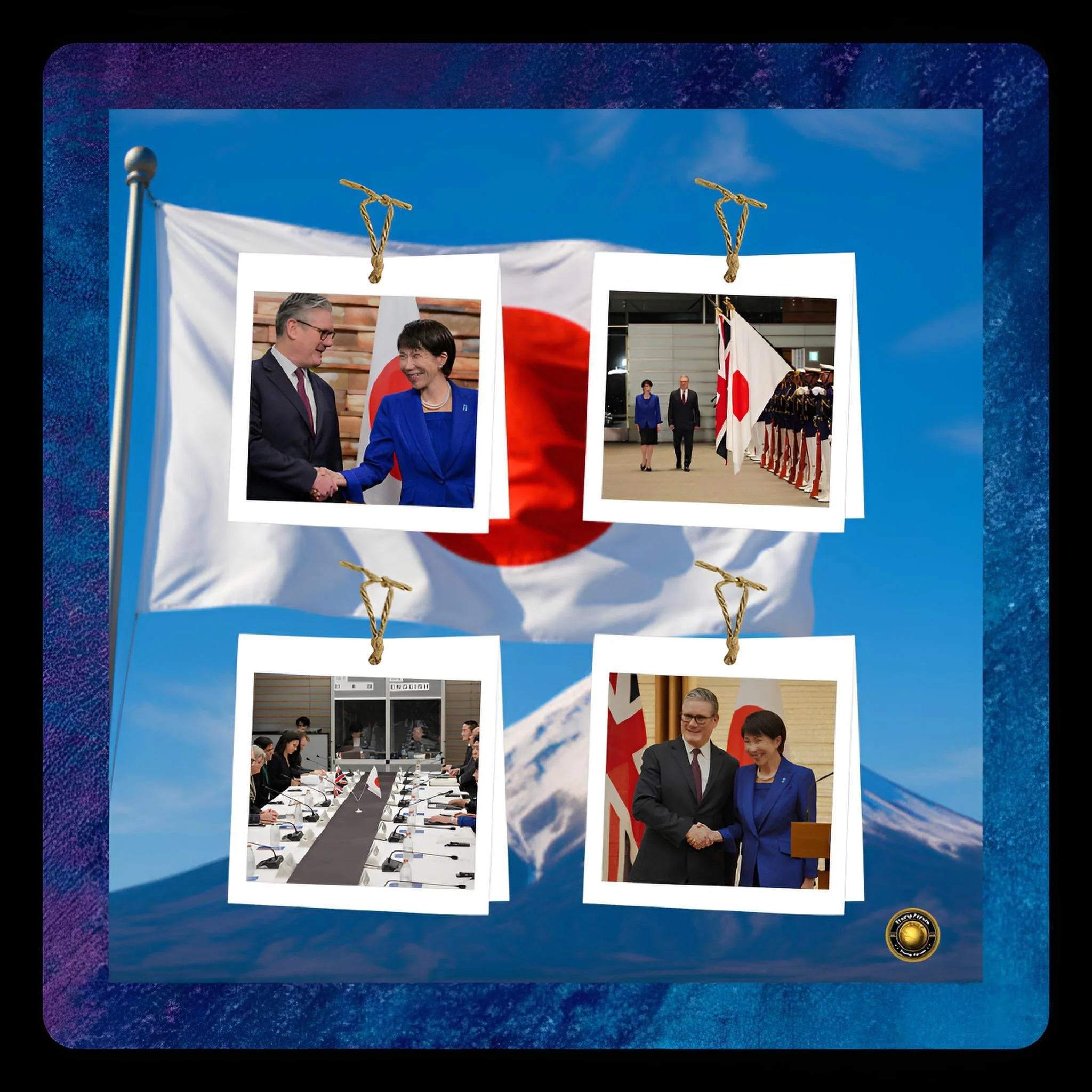
On 31st January 2026, British Prime Minister Keir Starmer completed a historic bilateral summit with Japanese Prime Minister Sanae Takaichi in Tokyo, culminating a geopolitically consequential four-day East Asian sojourn.
The meeting crystallized an unprecedented deepening of security, technological, and economic cooperation between two advanced democracies navigating an era defined by Chinese assertiveness, American strategic ambiguity, and supply-chain fragmentation.
The two leaders elevated their partnership to explicitly strategic status across nine substantive domains, with particular emphasis on accelerating next-generation fighter aircraft development, establishing a formal cybersecurity partnership, and constructing resilient critical minerals supply chains insulated from Beijing's coercive export controls.
Introduction
The Strategic Calculus of Bilateral Partnership
The Starmer-Takaichi summit represented far more than diplomatic ceremony. Rather, it articulated a fundamental strategic recalibration wherein the United Kingdom and Japan, two technologically sophisticated maritime powers increasingly circumspect of Washington's commitment to Indo-Pacific stability, have begun architecting a relationship of mutual strategic dependency.
Starmer's remarks—that this partnership stands "the strongest now that it has been in decades"—carry particular weight when contextualizing contemporary geopolitical fractures: the Trump administration's renewed reciprocal tariff regime, Moscow's unrelenting aggression in Ukraine, Beijing's accelerating military modernization, and systemic vulnerabilities in global supply chains for critical minerals essential to energy transition infrastructure and advanced weapons systems.
Starmer arrived in Tokyo following a 4-day engagement in China wherein he presided over bilateral agreements valued at £2.2 billion in export commitments, secured visa-free travel provisions for British citizens, and negotiated tariff reductions on Scotch whisky.
Concomitantly, Beijing consented to lift sanctions imposed upon British parliamentarians.
This China visit, framed by Downing Street as establishing a "mature" strategic partnership, occasioned sharp criticism from the Trump administration and necessitated, by extensional logic, a demonstrative affirmation of Britain's enduring commitment to Indo-Pacific stability and alliance cohesion.
Starmer's Japanese summit thus constituted a deliberate signal: London's engagement with Beijing, whilst economically pragmatic, carries no implications for its foundational alliance architecture across the Euro-Atlantic and Indo-Pacific domains.
Historical Foundations and Contemporary Trajectory
The historical trajectory of Anglo-Japanese relations provides essential context for understanding the 31st January summit's significance.
The Anglo-Japanese Alliance of 1902-1923 represented one of history's consequential strategic partnerships, enabling Japan's victory over Tsarist Russia and confirming Japan's emergence as a great power.
The subsequent deterioration of bilateral relations—accelerated by Japanese expansion in Manchuria, the Pacific War, and post-war Allied occupation—severed diplomatic continuity for nearly four decades.
Reconstruction of the relationship commenced during Margaret Thatcher's premiership and Yasuhiro Nakasone's tenure, catalyzed by substantial Japanese direct investment in British manufacturing.
However, the contemporary deepening of UK-Japan ties reflects an entirely different strategic imperative.
Unlike the 1980s relationship, which remained primarily economic, contemporary British-Japanese partnership constitutes a multidimensional security entente rooted in shared threat perception regarding Chinese military modernization and strategic coercion.
The foundational documents animating this trajectory include the 2021 Comprehensive Economic Partnership Agreement, the 2023 Reciprocal Access Agreement (of which the UK remains Europe's sole signatory), the 2023 Hiroshima Accord establishing explicit global strategic partnership commitments, and the 2024 accession of the United Kingdom to the Comprehensive and Progressive Agreement for Trans-Pacific Partnership.
The 31st January summit built upon this institutional superstructure, elevating partnership from implicit coordination to explicit, formalized strategic collaboration.
Prime Minister Takaichi's opening remarks, emphasizing that Japan-UK cooperation "symbolizes the inseparability of the security of the Euro-Atlantic and the Indo-Pacific," articulated a profound conceptual reorientation: London and Tokyo increasingly perceive their respective security interests not as geographically compartmentalized, but as systemically integrated.
Key Developments
Nine Pillars of Strategic Cooperation
The bilateral communiqué enumerated nine substantive areas of cooperation, each reflecting contemporary strategic imperatives.
First, cybersecurity collaboration has been formally elevated into a "Strategic Cyber Partnership." Japan has, in recent years, experienced intensifying reconnaissance and probing cyber operations attributable to Chinese state-sponsored actors, particularly targeting defense industrial contractors and critical infrastructure.
Britain, possessing advanced cyber forensic capabilities and institutional experience in countering persistent Chinese intelligence activities, brings complementary technical expertise.
This partnership represents not merely technical collaboration but strategic integration of defensive cyber postures across two nations with increasing operational interdependencies.
Second, the Global Combat Air Programme received accelerated political commitment. This trilateral initiative—encompassing the United Kingdom, Italy, and Japan—targets deployment of a 6th-generation stealth fighter by 2035. Development costs are projected to exceed £20 billion.
The program has, however, experienced organizational turbulence: Italy's Defense Minister Guido Crosetto accused Britain in 2025 of withholding advanced technologies essential to collaborative development, warning that such secrecy constituted an inadvertent strategic gift to Russian and Chinese intelligence services.
Japan, meanwhile, harbors concerns regarding timeline feasibility, particularly given Britain's budgetary constraints and the December 2025 missed development contract milestone.
Starmer's personal elevation of GCAP priority at the 31 January summit—explicitly committing to acceleration—constituted an attempt to ameliorate such organizational friction and signal political resolve to partners increasingly skeptical of British commitment.
Third, a 2+2 foreign and defense ministerial meeting is scheduled for 2026, institutionalizing regular strategic dialogue at the ministerial level. Japan has historically held such forums only with the United States; establishing this mechanism with the United Kingdom reflects confidence in Britain's enduring commitment to regional stability.
Fourth, the critical minerals supply chain initiative addresses one of contemporary geopolitics' most consequential structural vulnerabilities. China controls an estimated 60-70% of global rare earth element processing capacity and has, since 2023, implemented aggressive export controls targeting Western-aligned nations.
The 50% reduction of critical minerals supplies to Western manufacturers would precipitate cascading failures across advanced manufacturing, renewable energy deployment, and modern weapons systems production. Japan, importing 100% of its rare earth elements, confronts acute vulnerability.
Britain, whilst less dependent upon Chinese supplies than nations lacking diversified sourcing, nonetheless recognizes that energy transition targets—decarbonization of electricity generation, expansion of electric vehicle manufacturing, grid modernization—depend upon stable access to lithium, cobalt, nickel, and specialized elements.
The Starmer-Takaichi commitment to collaborate through the Economic Security Partnership to build "more diversified supply chains" and coordinate with "like-minded countries" signals intention to construct alternative sourcing and processing infrastructure, potentially incorporating Australia, South Korea, and Western suppliers. Such infrastructure requires 10-15 years to develop, necessitating immediate political commitment.
Fifth, the nations committed to holding, for the first time in three years, a bilateral Joint Committee Meeting on Science and Technology Cooperation, reflecting both countries' recognition of technological competition as foundational to geostrategic advantage.
Quantum computing, artificial intelligence, and advanced connectivity represent asymmetric domains wherein collaborative development potentially yields multiplicative returns on investment.
Sixth, space cooperation was formalized through establishment of a new bilateral consultation mechanism. Japan possesses advanced satellite reconnaissance and communications capabilities; Britain brings institutional expertise in space-based surveillance and integration of space capabilities into broader military command structures. This cooperation extends beyond civil space exploration into strategic military domains.
Seventh, the nations agreed to strengthen partnership on energy and decarbonization, with particular emphasis upon offshore wind and nuclear power. Japan has invested substantially in British renewable energy projects, positioning itself as the UK's largest inward investor outside Europe and the United States.
Both nations possess advanced nuclear engineering expertise and harbor ambitions regarding next-generation fusion technologies. Clean energy partnership represents not merely environmental commitment but strategic hedge against energy supply disruptions—a vulnerability exposed by Russia's weaponization of energy supplies against European consumers.
Eighth, the comprehensive trade partnership framework received explicit commitment to expansion, with particular emphasis upon the CPTPP and deepened EU-CPTPP cooperation.
The Starmer government, having successfully acceded to CPTPP at year-end 2024, now positions the bloc as counterweight to Chinese hegemonic aspirations regarding global trade architecture.
Japan strongly supported British accession and views the UK's participation as critical to maintaining CPTPP's integrity as a rules-based trading mechanism resisting Chinese encroachment. Both nations perceive CPTPP expansion as central to sustaining free and open Indo-Pacific order.
Ninth, the regional issues discussion—encompassing Ukraine, Middle East, and Indo-Pacific geopolitics—confirmed alignment on foundational principles regarding international order based upon rule of law, sovereignty, and territorial integrity.
Takaichi's recent controversial remarks regarding potential Japanese military response to Chinese coercion of Taiwan, whilst generating domestic Japanese opposition and Chinese condemnation, aligned substantively with British positions emphasizing deterrence and maintenance of the existing security order.
Cause-and-Effect Analysis
Geopolitical Drivers and Strategic Responses
The 31 January summit cannot be adequately understood without examining the cascading geopolitical events precipitating it.
First, China's assertive military modernization and economic coercion have rendered traditional deterrence frameworks obsolete.
The People's Liberation Army Navy now approximates rough parity with the U.S. Navy in certain contested zones; China's nuclear submarine fleet expands relentlessly; hypersonic weapons development accelerates.
Simultaneously, Beijing wields economic statecraft as weaponized coercion: export controls on rare earths, restrictions on agricultural imports, and coordinated sanctions against disfavored political figures. Japan confronts this challenge proximate to its territory; Britain, whilst geographically remote, recognizes that Asian instability cascades rapidly into European security environments through energy markets, supply chains, and alliance solidarity.
Second, the Trump administration's return to office has created strategic ambiguity regarding American commitment to defending allies. Trump's first administration initiated reciprocal tariff regimes, questioned NATO commitments, and pursued transactional approaches to alliance management.
Early indications from Trump's second term suggest continuation of these patterns: the administration has signaled reciprocal tariff implementation, questioned allied defense spending inadequacy, and implied potential negotiation of territorial disputes.
Japan, whose security architecture depends upon the U.S.-Japan security treaty's Article 5 mutual defense commitment, contemplates scenarios wherein American support proves conditional or transactional. Britain, confronting American skepticism regarding its China engagement, perceives necessity of demonstrating robust alternative partnership architectures.
Third, Russia's continued aggression in Ukraine has exposed critical defense industrial vulnerabilities. Both Britain and Japan have committed to sustained Ukraine support, entailing munitions production, intelligence sharing, and military aid.
This commitment, however, collides with reality: Western munitions production capacity remains inadequate to sustain Ukrainian requirements whilst simultaneously building strategic reserves.
Britain and Japan possess complementary defense industrial capabilities; collaborative development of advanced weapons systems (the GCAP program exemplifies this approach) enhances both nations' long-term deterrent capacity.
Fourth, the post-pandemic global supply chain fragmentation has revealed the degree to which advanced democracies remain dependent upon authoritarian suppliers for materials essential to military modernization and civilian technological advancement.
The critical minerals crisis epitomizes this vulnerability. China's production dominance and demonstrated willingness to weaponize supply creates an existential imperative for alternative sourcing. Both nations possess financial capacity, technological expertise, and geopolitical leverage to construct alternative supply chains, but only through collaborative effort.
The 31 January summit represents the crystallization of these cause-effect dynamics: geopolitical challenge (Chinese assertiveness, American strategic ambiguity, supply chain fragmentation) produces strategic response (deepening bilateral partnership, institutionalizing collaboration, harmonizing deterrent postures).
Future Steps and Implementation Mechanisms
The bilateral communiqué, whilst comprehensive, remains strategic in character rather than operationally granular. Implementation will require sustained ministerial coordination and substantial technical work.
The 2+2 ministerial meeting scheduled for 2026 will provide critical opportunity to translate political commitment into operational plans. Specifically, this forum should address: joint military exercise architecture, command coordination arrangements in contingencies, intelligence-sharing protocols beyond existing frameworks, and munitions standardization initiatives.
Both nations' militaries maintain close operational relationships with the United States; incorporating British-Japanese coordination without disrupting existing U.S. command relationships requires sophisticated diplomatic and military planning.
The GCAP program presents particular implementation challenge. Italy's technical concerns regarding British technology-sharing require addressing through transparent governance structures and equitable intellectual property arrangements.
Japan's timeline concerns demand realistic reassessment of development sequencing. The program's industrial structure—involving BAE Systems, Leonardo, and Mitsubishi Heavy Industries as prime contractors, with hundreds of subcontractors across three nations—necessitates harmonized procurement regulations and export control frameworks. This work will consume substantial governmental resources through 2026 and beyond.
The critical minerals initiative requires establishing formal coordination mechanisms. Australia has moved aggressively to develop rare earth processing capacity; South Korea possesses advanced materials science capabilities.
Multilateral coordination—potentially through the Quad framework (United States, Japan, Australia, India) or an expanded CPTPP minerals working group—could accelerate supply chain diversification. Japan and Britain should position themselves as architects of such coordination, leveraging their respective relationships with these potential participants.
The cybersecurity partnership implementation should extend beyond defensive postures into the development of offensive cyber doctrine.
Both nations maintain sophisticated cyber capabilities; harmonization of operational concepts and rules of engagement constitutes essential foundation for effective deterrence against Chinese cyber operations. Intelligence agencies must develop enhanced liaison arrangements to detect and attribute cyber attacks with sufficient precision to warrant response.
The space cooperation framework should address both civil satellite systems and military space capabilities. Japan's H3 launch vehicle and advanced satellite reconnaissance programs complement British institutional experience. Potential areas of collaboration include: early warning architecture, satellite communication systems, and space-based surveillance architectures supporting both nations' Indo-Pacific operations.
Conclusion
Strategic Partnership for an Age of Uncertainty
The 31 January summit between Keir Starmer and Sanae Takaichi represents a watershed moment in post-war bilateral relations.
It articulates recognition by two advanced democracies that their security and prosperity cannot be secured through unilateral action, that geographic distance no longer insulates one from the other's security challenges, and that shared liberal democratic values, combined with complementary technological and military capabilities, create opportunity for partnership transcending traditional alliance hierarchies centered upon American hegemonic authority.
The summit occurs at singularly consequential geopolitical moment: Chinese military modernization reaches inflection points wherein certain capabilities approach parity with American systems; supply chains fragmenting along geopolitical lines necessitate reconstruction; energy transition timelines impose urgent requirements for critical minerals sourcing; and American strategic commitment appears conditional rather than absolute.
These circumstances admit no technocratic remedies; they require political will manifested through sustained commitment, institutional integration, and resource allocation.
The Starmer-Takaichi communiqué demonstrates such will. However, the gap between announced ambition and realized implementation remains vast.
The bilateral relationship's trajectory over coming years will depend upon: successful resolution of GCAP organizational tensions; establishment of functional critical minerals supply chains; demonstrated capability to execute the 2+2 ministerial mechanism effectively; and, perhaps most critically, Japanese electoral politics.
Prime Minister Takaichi called snap elections for 8 February 2026, mere days following the Starmer summit. Her political survival remains uncertain; defeat would necessitate relationship continuity planning with successor governments potentially holding differing strategic orientations.
Nevertheless, the structural drivers producing Britain-Japan strategic convergence transcend individual political actors.
The rise of China, the strategic ambiguity of the Trump administration, and the fragmentation of post-war liberal international order constitute durable phenomena. Regardless of electoral outcomes in Tokyo or Westminster, the imperative for UK-Japan strategic partnership will persist.
The 31st January summit, therefore, should be understood not as culmination of strategic evolution but as threshold moment: the formal acknowledgment that two democracies separated by 7,000 miles of ocean have embraced strategic partnership as essential to their national interests in the coming decade and beyond.
The implementation of this partnership will test both governments' strategic commitment, institutional capacities, and political resilience. Success will provide the Indo-Pacific region an alternative architecture to Chinese hegemony; failure will necessitate recalibration of both nations' strategic assumptions.
The stakes, in short, extend far beyond bilateral interests into the fundamental character of 21st-century geopolitical order.