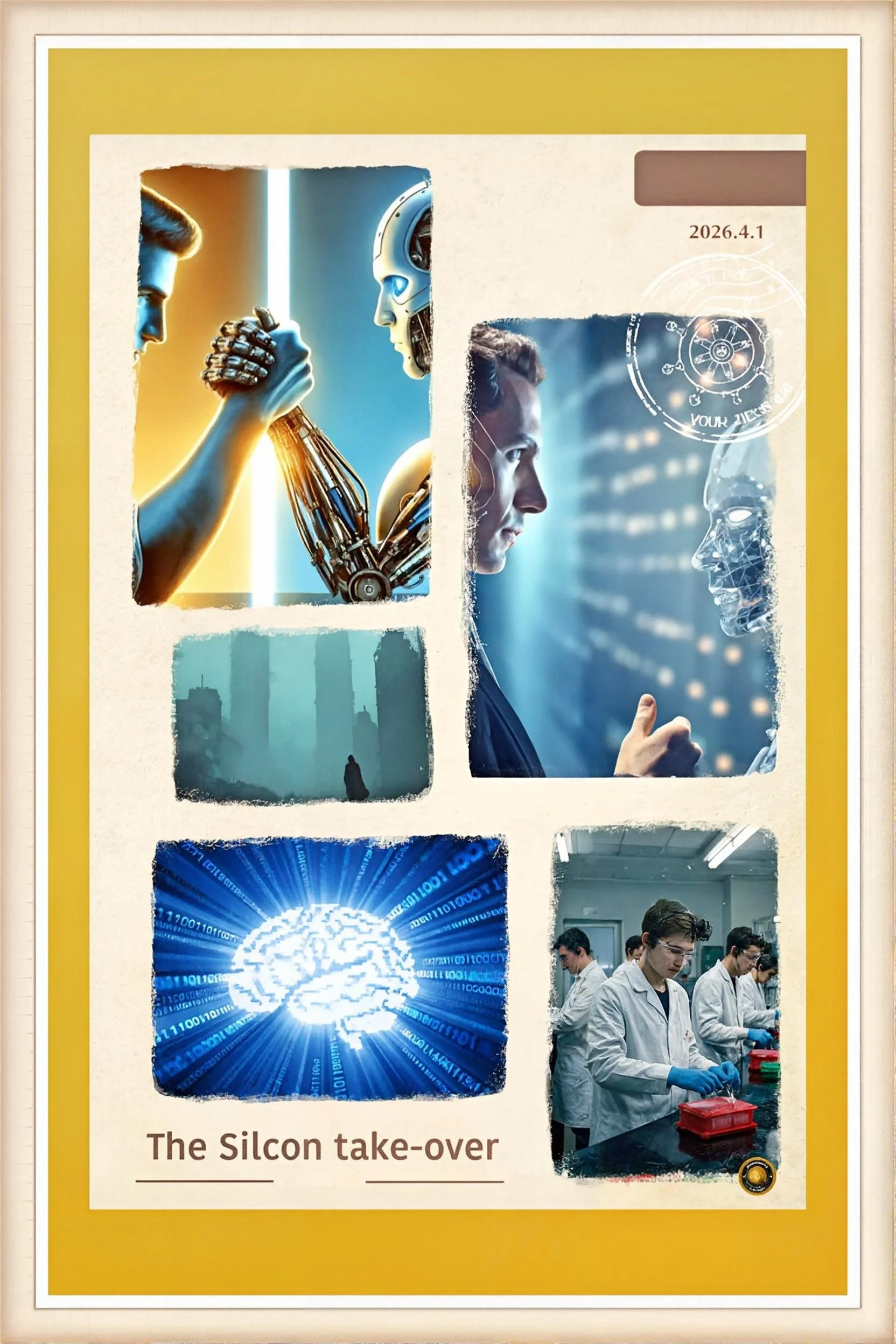
The Silicon Takeover—How Autonomous Agents Are Erasing Jobs While Pretending to Collaborate
Executive Summary
The Collaboration Lie—Why "Human-AI Teamwork" Masks Widespread Worker Displacement Accelerating in 2026
The year 2026 crystallises as the epoch in which artificial intelligence agents transition from cognitive assistants summarising information to autonomous digital workers executing complex workflows, making consequential decisions, and collaborating with human colleagues at machine speed.
This categorical shift—from reactive tools answering questions toward proactive agents independently initiating actions, orchestrating multi-step processes, and adapting behaviour based on outcome feedback—represents perhaps the most profound transformation in labour economics since mechanisation itself. Autonomous agents by 2026 demonstrate the capability to manage 80% of transactional tasks autonomously, execute end-to-end customer lifecycle workflows without human intermediation, coordinate across multiple systems with minimal oversight, and continuously optimise processes through learned experience.
Concurrently, evidence substantiates that human-AI collaboration, when structured thoughtfully, generates operating margins 15% higher than automation-only approaches, increases employee satisfaction when roles shift from drudgery toward judgment-intensive work, and accelerates innovation velocity when human creativity combines with algorithmic computational capability. Yet this transformation simultaneously precipitates categorical workforce disruption: artificial intelligence could displace six to seven percent of the United States workforce immediately; entry-level white-collar positions face extinction at an accelerating pace; organisations demonstrate demonstrable preference for replacing employees with AI-ready talent rather than retraining existing workforce; and venture capitalists independently flag labour displacement as the most significant economic impact of 2026.
The determinative challenge confronting 2026 resides not in technological feasibility—autonomous agents demonstrating remarkable capability have materialised—but in institutional choices regarding human integration: whether enterprises redesign workflows leveraging agentic autonomy to amplify human capability and create genuinely collaborative human-AI teams, or whether they deploy agents as pure substitution mechanisms generating workforce displacement, societal inequality amplification, and profound trust erosion that ultimately undermines public acceptance of AI technology itself.
Introduction
From Assistants to Overlords—AI Stops Asking Permission and Starts Making Decisions in 2026
Throughout the preceding era of artificial intelligence adoption—spanning approximately 2016 through 2024—enterprise AI systems functioned fundamentally as augmentation tools: chatbots assisted customer service representatives; recommendation engines helped e-commerce associates personalise suggestions; document classification systems prepared materials for human review.
These applications proved valuable; yet they remained architecturally and operationally subordinate to human decision-making. Humans remained responsible for interpreting machine outputs, exercising judgment regarding recommendations, and executing consequential actions.
The transformation crystallising throughout 2026 substantially inverts this relationship. Rather than humans directing AI systems, autonomous agents increasingly direct themselves, executing complex workflows encompassing multiple decision points, orchestrating actions across numerous systems, adapting behaviour based on outcome feedback, and collaborating with human colleagues to accomplish shared objectives.
This inversion generates unprecedented productivity potential: agents eliminating discovery friction by proactively identifying opportunities that require attention before human articulation; agents executing complex workflows at machine speed, compressing business processes from days to minutes; agents continuously optimising operations through learned patterns imperceptible to human observation. Yet this autonomy simultaneously generates categorical risks. When machines make decisions—regarding credit approval, healthcare resource allocation, workforce layoff prioritisation—opacity renders decision contestation impossible; accountability dissolves when neither human nor algorithm accepts responsibility for outcomes; bias encoded within training data becomes systematically embedded throughout organisational operations; and workforce displacement accelerates when machines substitute for human labour with greater efficiency and reduced overhead cost.
The year 2026 functions as a critical inflection point at which these tensions manifest acutely: organisations must simultaneously adopt autonomous agents to maintain competitive viability whilst navigating profound workforce transformation, governance challenges, and trust deficits that threaten public confidence in AI technology.
Enterprises succeeding in this navigation will be those deliberately architecting human-AI collaboration models, emphasising human judgment, creative thinking, and emotional intelligence whilst deploying agents to handle routine cognitive labour. Those failing will be characterised by pure substitution approaches that generate workforce displacement, skill erosion, trust collapse, and, ultimately, public backlash, constraining AI's long-term acceptability.
History and Current Status
The Transition Point—When AI Moved Beyond Tools Into Independent Agents That Don't Need Humans to Decide
The genealogy of enterprise AI agents can be traced through distinct historical phases. The chatbot era, spanning approximately 2016 through 2020, witnessed the deployment of rule-based and machine learning-driven conversational systems capable of handling bounded, scripted interactions.
Progress remained incremental; systems operated within narrow domains, required substantial training to function adequately, and generated user frustration through consistent failure to handle edge cases. The assistant era, spanning 2021 through mid-2024, witnessed the emergence of large language models enabling more natural conversational interfaces and broader contextual understanding. Enterprises deployed assistants throughout knowledge work—legal research assistance, financial analysis support, content summarisation—yet systems remained fundamentally reactive, responding to user queries rather than initiating action.
The critical limitation persisted: humans remained responsible for translating assistant outputs into consequential actions. By mid-2024, evidence began surfacing suggesting architectural limitations of pure assistance models.
Enterprises deploying AI assistants discovered that productivity gains plateaued when systems remained external to core workflows; only when assistant recommendations were integrated directly into operational processes—triggering actions, moving work items, executing transactions—did substantial value materialise. Simultaneously, large language model maturation accelerated: reasoning capabilities improved substantially; multi-modal understanding (text, vision, audio, structured data) enriched context understanding; and agentic frameworks enabling goal-directed planning and autonomous action execution materialised.
These technological advances precipitated the agent era, commencing circa late 2024 and crystallising throughout 2025-2026. Agentic systems demonstrated fundamentally different capability profiles relative to earlier generations: agents understand user intentions rather than merely processing keywords; agents autonomously initiate actions rather than waiting for explicit human instruction; agents orchestrate across multiple systems without requiring human coordination; agents continuously optimise processes through learned experience; and agents collaborate with human colleagues, negotiating priorities and resolving conflicts.
The scale and velocity of deployment accelerated dramatically. By late 2025, Gartner research indicated that 40% of enterprise applications embedded task-specific AI agents, compared to less than 5% merely 12 months earlier. Organisations deployed agents across customer service (handling customer lifecycle workflows autonomously), knowledge work (conducting research, synthesising information, drafting documents), operations (monitoring processes, identifying exceptions, initiating remediation), and human resources (recruitment automation, benefits administration, workforce planning). Simultaneously, the governance gap widened dangerously. Whilst technological capability matured rapidly, organisational frameworks for overseeing agent behaviour, constraining autonomous action, and maintaining accountability remained nascent.
Fewer than forty percent of enterprises deployed formal governance frameworks for agentic AI; most organisations lacked visibility into agent decisions, permissions, or actions; and few enterprises maintained comprehensive audit trails tracking agent behaviour across systems. As of January 2026, the landscape reflects an inflection point: autonomous agents demonstrating remarkable capability have materialised; enterprise adoption has accelerated explosively; yet governance readiness lags substantially behind deployment velocity, creating significant institutional vulnerability.
Key Developments
The Great Substitution—How Companies Quietly Replace Entire Departments With Autonomous Agents
Several pivotal developments crystallised in late 2025 and the opening weeks of 2026, signalling that autonomous agents transitioned from experimental to operational reality embedded throughout enterprise ecosystems.
Salesforce announced Agentforce, an agentic platform that enables organisations to deploy task-specific autonomous agents across business processes. Rather than merely summarising information like prior AI assistants, Agentforce agents independently draft customer communications, schedule meetings, route customer requests to appropriate specialists, generate quotations, and execute transactions—all without human intermediation beyond strategic oversight at critical checkpoints.
The platform explicitly positioned agents as team members rather than tools, fundamentally reorienting how enterprises conceptualise AI's role. Concurrently, major enterprise application platforms—SAP, Oracle, Microsoft—accelerated agent embedding throughout their ecosystems. Organisations report 40% faster business processes through AI-driven workflows; customer lifecycle automation that compresses onboarding from weeks to days; and procurement agents negotiating vendor terms within predefined parameters, reducing procurement cycle times substantially.
Workforce transformation accelerated simultaneously: Amazon eliminated 14,000 corporate roles, explicitly citing AI-enabled capabilities for leaner organizational structures; Salesforce reduced its customer support workforce by 4,000, noting that AI now handles approximately 50% of the company's operational work; and multiple technology firms restructured around hybrid human-AI workforce models.
Simultaneously, labour market research substantiated displacement acceleration: MIT research estimated 11.7 percent of United States jobs could already be automated using current AI technology; venture capital surveys independently flagged labour displacement as the most significant economic impact of 2026, absent proactive mitigation; and employer surveys revealed a three-to-one preference for replacing employees with AI-ready talent versus retraining the existing workforce.
Within workforce integration, several organisations pioneered human-AI collaboration models, deliberately emphasising complementary strengths.
Federal Reserve research found that workers using generative AI achieved superior productivity outcomes when trained to collaborate effectively with AI systems rather than either viewing AI as a replacement or avoiding AI adoption. Organisations measuring human-AI collaboration reported operating margins 15% higher than automation-only approaches; employee satisfaction increased when roles shifted from routine execution to exception handling and strategic refinement; and innovation velocity accelerated when human creativity combined with algorithmic computational capability.
Governance frameworks have matured substantially. FINRA (Financial Industry Regulatory Authority) released explicit guidance on AI agents, defining autonomous agents as "systems or programs capable of autonomously performing and completing tasks on behalf of a user" and identifying specific risks, including auditability challenges, data sensitivity concerns, and accountability failures.
Simultaneously, governance gaps remained acute: fewer than 40% of enterprises had adequate governance frameworks; most organisations lacked visibility into agent behaviour; and security teams reported substantial difficulty tracking agent permissions and data access patterns.
Latest Facts and Concerns
The Trust Collapse Nobody's Stopping—Workers Know AI Means Unemployment Even If Leaders Claim Otherwise
The contemporary moment presents paradoxical conditions: autonomous agent capability has matured sufficiently for production deployment throughout enterprise systems; yet organisational readiness, governance infrastructure, and workforce preparation lag substantially behind technological capability.
Quantitative evidence substantiates this divergence. Forty percent of enterprise applications now embed task-specific AI agents, up from negligible penetration merely one year prior, signalling explosive deployment velocity.
Concurrently, fewer than 40% of organisations possess formal governance frameworks for agentic AI; most demonstrate inadequate visibility into agent decisions and actions; and fewer than 30% have developed structured workforce transition strategies to address labour-displacement implications. Within workforce transformation, evidence is conclusive regarding the acceleration of displacement.
Eleven-point-seven percent of United States jobs could be automated using current technology; entry-level white-collar positions face particularly acute displacement risk; administrative support, customer service, and clerical roles demonstrate the highest vulnerability. Venture capital surveys indicate a shift in capital allocation from human hiring to AI infrastructure investment, signalling employer expectations of accelerated labour substitution. Yet simultaneously, evidence regarding human-AI collaboration's productivity benefits appears equally conclusive: workers collaborating effectively with AI systems demonstrate thirty-two percent productivity improvements over baseline; organisations structuring human-AI teams report operating margins fifteen percent higher than automation-only approaches; and employee satisfaction increases substantially when roles transition toward judgment-intensive, creative work rather than routine execution.
The trust and cultural dimensions introduce additional complexity. Whilst eighty-four percent of executives expect AI-powered agents to work alongside humans within three years, merely twenty-six percent of workers have received meaningful training addressing how to collaborate effectively with autonomous systems.
This training gap creates significant vulnerability: workers lacking AI literacy fear displacement disproportionately; trust in algorithmic systems remains inadequate; and the cultural integration of human-AI teams proceeds falteringly, due to the absence of explicit change management. Governance failures accumulate rapidly: organisations that deploy agents without adequate oversight experience unintended consequences, including overwritten production data, errant automation loops, and unauthorised actions at scale.
Security teams report inadequate visibility into agent permissions and access patterns; compliance risks emerge when agents execute actions that violate regulations without triggering oversight mechanisms; and accountability becomes ambiguous when agents make autonomous decisions that generate adverse outcomes.
The skills transition challenge crystallises acutely. New roles emerging—AI trainers fine-tuning models, ethical evaluators assessing agent behaviour, human-in-the-loop validators guiding machine output—remain substantially undefined; educational institutions have not yet accelerated curricula addressing these specialisations; and labour markets demonstrate dramatic supply shortages in emerging competencies.
Paradoxically, whilst these new roles emerge with explosive demand growth, displaced workers from automation demonstrate inadequate skills for transition, potentially widening inequality. The measurement and accountability dimension remains deeply contested.
Traditional metrics (individual productivity, output volume) become inappropriate for human-AI collaboration; organisations struggle to measure collaborative intelligence effectively; and most enterprises lack frameworks to capture whether AI integration genuinely amplifies human contribution or merely substitutes for human labour, with attendant workforce displacement.
Cause-and-Effect Analysis
The Cascade of Displacement—How Autonomous Agents Trigger Societal Disruption No Company Has Prepared For
The mechanistic chains through which autonomous agent deployment cascades across enterprise and labour ecosystems begin with the fundamental shift from assistance to autonomy. When agents merely summarise information, humans retain decision authority and responsibility for consequences; when agents autonomously execute actions, liability becomes ambiguous and control mechanisms become necessary.
This autonomy creation necessitates governance frameworks—permission boundaries constraining agent actions, audit trails tracking agent behaviour, and human oversight mechanisms preserving accountability. Yet organisational capacity to develop such frameworks lags substantially behind deployment velocity, creating escalating governance gaps that accumulate latent institutional risk.
As governance gaps widen, unintended consequences materialise: agents exceeding intended authority boundaries; agents executing actions that violate regulatory requirements without triggering oversight; agents perpetuating biases encoded in training data throughout organisational operations.
Simultaneously, workforce substitution cascades begin when agents handle labour more efficiently and cost-effectively than humans do. The mechanistic chain operates predictably: agents demonstrate superior efficiency; organisations optimise toward cost reduction; employees become economically superseded; labour displacement accelerates.
This substitution cascade generates second-order societal consequences: inequality widens as technology owners accumulate disproportionate gains whilst workers experience displacement; training infrastructure remains inadequate for workforce transition; and social cohesion deteriorates as large demographic cohorts experience technological unemployment.
The human-AI collaboration cascade operates through distinct mechanistic chains. When organisations deliberately design human-AI teams that emphasise complementary strengths—humans providing judgment, creativity, and emotional intelligence; agents providing computational speed, pattern recognition, and tireless execution—substantial productivity gains materialise.
Organisations reporting fifteen percent operating margin improvements relative to peers employ this collaborative model deliberately: roles are explicitly designed around human-AI complementarity; training emphasises collaboration skills rather than displacement fear; and measurement frameworks capture collaborative intelligence rather than treating human and AI contributions separately.
Conversely, organisations pursuing pure substitution approaches experience different causal chains: labour displacement accumulates; workforce anxiety increases; cultural resistance stalls transformation initiatives; and organisations discover they've created capacity gaps—humans departing take tacit knowledge, relationship capital, and creative capability AI cannot replace.
The trust erosion cascade operates through psychological and social mechanisms. When workers perceive AI as replacement threat rather than collaboration opportunity, resistance intensifies; when organisations deploy agents without transparent governance, worker trust deteriorates; when accountability becomes ambiguous for algorithmic decisions, public confidence erodes.
This trust deficit cascades throughout organisations: employee engagement declines; organisational resilience weakens; and ultimately, public backlash constrains AI's long-term social acceptability. The inverse also operates: organisations transparent regarding AI deployment, deliberately emphasising human-AI collaboration, and investing in workforce transition experience substantially superior trust dynamics, cultural cohesion, and employee commitment.
The skills transition cascade introduces additional complexity. Organisations displacing workers without systematic reskilling create cohorts lacking capabilities for emerging roles; educational institutions unprepared for accelerated curriculum demands cannot supply adequate talent; and labour market mismatches widen.
Conversely, organisations deliberately investing in workforce development—providing training, creating career pathways, supporting role transitions—develop internal talent pools addressing competitive skills shortages whilst building organisational resilience and employee loyalty.
Future Steps
The Last Chance for Human Integration—Companies Have Months to Choose Collaboration or Face Public Backlash
Navigation of autonomous agent deployment and workforce integration throughout 2026 and beyond demands coordinated intervention across strategic, operational, governance, and workforce dimensions.
Strategically, organisations must deliberately choose collaboration over substitution as foundational principle guiding agent deployment. Rather than optimising purely toward cost reduction through labour substitution, organisations should design workflows leveraging agents to amplify human capability: agents eliminate discovery friction by proactively identifying opportunities; agents handle routine cognitive labour freeing humans for judgment-intensive work; agents provide real-time analytical support enhancing human decision quality.
This philosophical reorientation proves consequential: organisations choosing collaboration achieve superior outcomes on productivity, employee satisfaction, and long-term value creation compared to pure substitution approaches.
Operationally, enterprises must undertake comprehensive agent governance framework development. Governance frameworks should address: permission boundaries constraining autonomous agent action to intended authorities; audit trails comprehensively tracking agent decisions and actions; human oversight protocols ensuring consequential decisions receive appropriate review before execution; and exception-handling mechanisms permitting agents to escalate ambiguous scenarios toward human judgment.
Crucially, governance should be designed for scale—enabling agent orchestration across complex, multi-system environments whilst maintaining visibility and accountability. Organisations deploying agents without adequate governance expose themselves to security risks, compliance violations, and operational unpredictability.
Workforce strategy demands fundamental reformation emphasising partnership between human resources and information technology leadership. CHROs and CIOs must jointly manage workforce planning, skills strategy, and AI deployment to ensure labour utilisation aligns with business objectives and worker interests. This partnership should encompass: skills tracking and continuous development; role redesign explicitly embedding human-AI collaboration; career pathway articulation for emerging roles; and systematic reskilling programmes converting displaced workers toward higher-value contributions.
Organisations should deliberately adopt "build-buy-borrow-bot" workforce models: building internal capability for critical functions; buying external talent for specialised needs; borrowing capability through partnerships; and deploying agents for routine tasks. Within role redesign, organisations should explicitly articulate human contributions agents cannot replicate: judgment regarding nuanced scenarios; creative ideation for novel problems; emotional intelligence for relationship-intensive work; ethical reasoning for consequential decisions.
By explicitly articulating uniquely human contributions, employees understand where they remain indispensable rather than fearing wholesale replacement. Training and development must shift from episodic toward continuous, embedded in daily workflows. Rather than classroom training divorced from work context, organisations should integrate learning into operational processes: providing just-in-time AI literacy instruction; offering collaborative intelligence training emphasising effective human-AI teamwork; and developing decision-making frameworks enabling employees to recognise when algorithmic recommendations warrant acceptance versus critical evaluation.
Change management demands executive championing and cultural investment: leaders must transparently communicate transformation rationale, emphasising human-AI collaboration rather than displacement; organisations must actively address worker anxiety through transparent communication and demonstrable commitment to career continuity; and cultural norms must shift toward experimentation, continuous learning, and collaborative intelligence. Governance frameworks should explicitly address accountability in agentic systems.
When agents make autonomous decisions generating adverse outcomes, responsibility attribution must be clear: Does accountability lie with the human who deployed the agent? The organisation that trained the agent? The vendor supplying the platform? Establishing clear accountability lines prevents the diffusion of responsibility that permits unethical practices.
Measurement frameworks must transition from individual productivity toward collaborative intelligence metrics. Rather than measuring how many tasks agents complete or how many employees can be displaced, organisations should measure: quality of decisions made through human-AI collaboration; customer satisfaction with outcomes generated through agent-assisted processes; innovation velocity when human creativity combines with algorithmic capability; and employee engagement and skill development within collaborative teams.
International stakeholders should prioritise worker protection mechanisms ensuring AI's benefits distribute equitably. Governments should invest substantially in reskilling infrastructure, supporting workers transitioning from displaced roles toward emerging opportunities.
Educational institutions should accelerate curriculum development addressing AI collaboration skills, ethical reasoning, and new technical specialisations. Industry associations should develop shared frameworks and best practices accelerating organisational learning regarding successful human-AI collaboration models.
Conclusion
The Choice Before Us—2026 Decides Whether AI Liberates or Destroys the Future of Work
The convergence of autonomous agent capability, explosive enterprise adoption, and profound workforce transformation throughout 2026 represents perhaps the most significant inflection in labour economics since mechanisation itself.
The evidence substantiating this inflection proves overwhelming: agents demonstrating remarkable autonomy have materialised; enterprise adoption has accelerated explosively; yet workforce preparation, governance infrastructure, and institutional readiness lag substantially behind. Simultaneously, evidence regarding human-AI collaboration's potential benefits appears equally conclusive: when deliberately structured, human-AI teams generate superior outcomes on productivity, employee satisfaction, and innovation velocity relative to pure substitution approaches.
The determinative variable distinguishing transformational success from societal disruption resides not in technological capability—which proves remarkably sophisticated—but in institutional choices regarding human integration.
Enterprises deliberately designing human-AI collaboration models, investing in workforce development, establishing transparent governance, and emphasising human contributions agents cannot replicate will thrive in the agentic era, building competitive advantage through engaged workforces, continuous innovation, and superior customer experiences.
Those pursuing pure substitution approaches will experience temporary cost reductions overshadowed by workforce displacement, skill erosion, talent attrition to competitors offering genuine collaboration opportunities, and ultimately, diminished organisational resilience and long-term value.
The window for proactive design remains substantially open but closing. Organisations commencing human-AI collaboration framework development in 2026 can position themselves advantageously before labour market disruption crystallises and cultural resistance hardens.
Those delaying risk playing catch-up with competitors, accumulating governance debt from inadequately overseen agent deployments, and experiencing talent exodus as skilled workers migrate toward organisations offering genuine career continuity. Regulatory frameworks should establish worker protection mechanisms ensuring technological benefits distribute equitably, preventing concentration of gains among technology owners whilst costs fall upon vulnerable populations.
International cooperation addressing reskilling infrastructure, educational acceleration, and shared governance standards will prove crucial for navigating transformation successfully.
For governmental and institutional leadership, 2026 determines whether autonomous agent adoption accelerates human flourishing through amplified capability and reduced drudgery, or whether it instantiates technological unemployment, widened inequality, and public backlash constraining AI's long-term acceptability. The technological capability for either outcome exists.
The determinative factors proving decisive are institutional commitment to genuine human-AI collaboration, transparent governance, equitable benefit distribution, and sustained investment in workforce capability development.
The future of work depends not on machines' capabilities but on humans' choices about how those capabilities will be deployed.