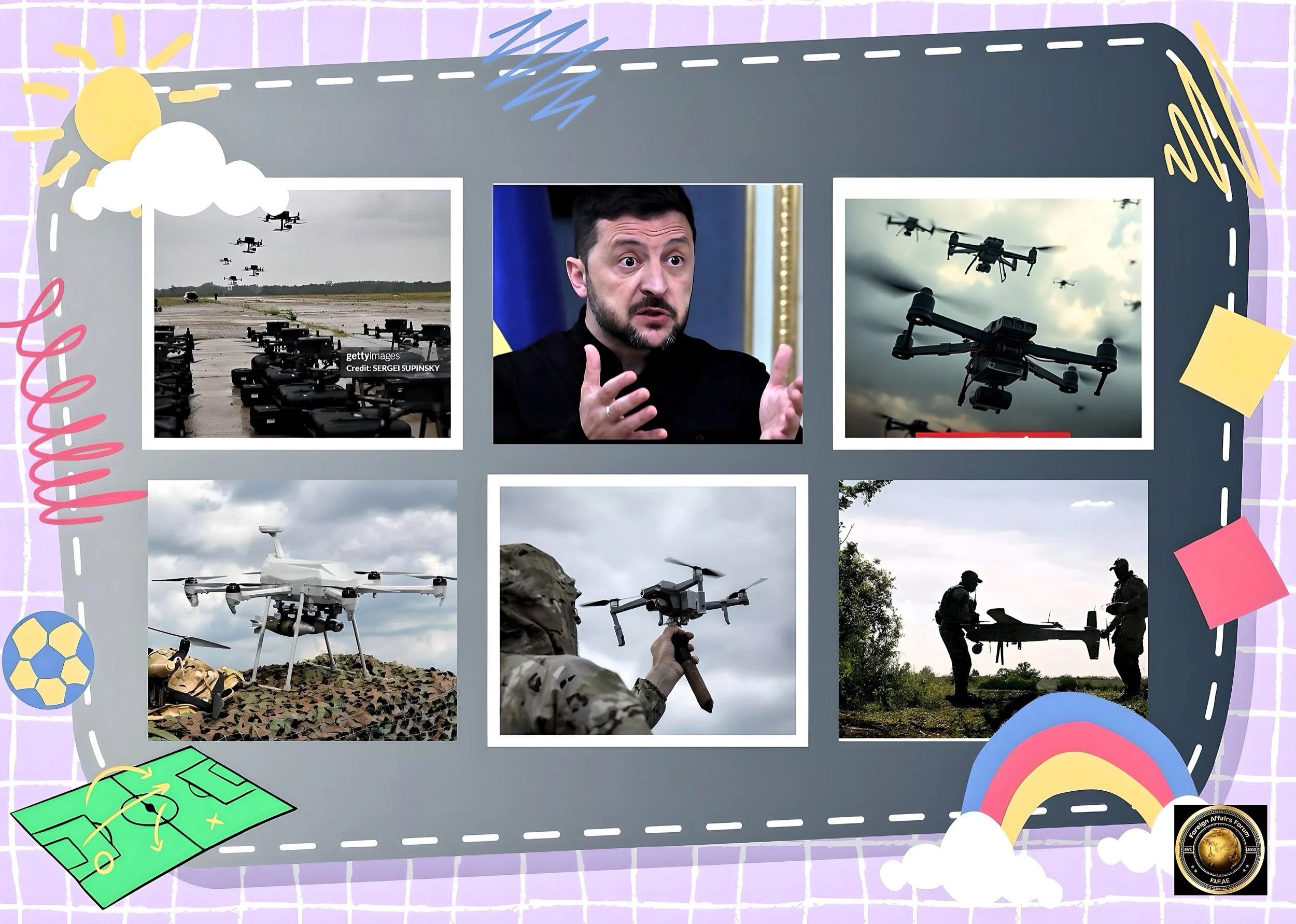
Ukraine’s Revolutionary Approach to Modern Warfare: Innovation Through Necessity
Introduction
Ukraine’s conflict with Russia has fundamentally transformed modern military thinking, demonstrating how necessity-driven innovation can more effectively reshape the battlefield than traditional military-industrial approaches.
FAF, Europe.BI analyzes the development of Ukraine’s Sky Fortress acoustic sensor network, and the audacious Operation Spiderweb represents not isolated tactical successes but emblematic examples of a new paradigm in warfare that prioritizes speed, cost-effectiveness, and decentralized innovation over conventional military procurement processes.
This transformation has created what experts term “flat war” - a philosophy that bypasses traditional military hierarchies to empower front-line innovation, fundamentally challenging established doctrines about how modern militaries should organize, equip, and fight.
The Sky Fortress Revolution: Redefining Air Defense Economics
Genesis and Development of Acoustic Defense
The Sky Fortress system emerged from a critical vulnerability that appeared in the fall of 2022 when Russia began bombarding Ukrainian cities with swarms of Iranian Shahed drones.
These low-altitude, small-profile drones proved exceptionally difficult to track using conventional radar systems, creating a defensive gap that threatened to overwhelm Ukraine’s air defense capabilities.
Working from a garage, two Ukrainian engineers developed one of modern warfare's most cost-effective defense innovations.
The system’s fundamental simplicity belies its effectiveness. Each sensor costs between $400 and $500 per unit and consists of a microphone and cell phone mounted on a six-foot pole.
These 9,500 sensors are distributed across Ukraine at intervals of four to five kilometers, creating a comprehensive acoustic detection network that can identify drones flying at altitudes of 8,000 to 10,000 feet.
The acoustic signatures are processed through a central computer system that synthesizes the data and provides real-time tracking information to mobile fire teams equipped with anti-aircraft guns and iPads that display flight paths.
Operational Effectiveness and Cost Analysis
The operational success of Sky Fortress has been remarkable. The system achieves a 99.6% detection rate for cruise missiles and Shahid drones.
Ukraine successfully intercepted 80 of 84 Russian drones using this network during one notable engagement. The system’s effectiveness extends beyond mere detection - it has fundamentally altered the cost dynamics of air defense.
General James Hecker, Commander of U.S. Air Forces in Europe, noted that the entire Sky Fortress network costs less than a pair of Patriot air-defense missiles.
This cost-effectiveness becomes even more significant compared to traditional Western approaches to similar threats.
In April 2024, the United States expended missiles worth millions of dollars to counter $30,000 in drones launched at Israel from Iran and Iranian proxies.
This asymmetric cost relationship highlighted the unsustainable use of expensive interceptors against cheap attack platforms, a problem that Sky Fortress addresses through its low-cost, high-volume approach.
Technological Adaptation and Evolution
The Sky Fortress system demonstrates remarkable adaptability in the face of evolving threats.
When Russia attempted to counter the network by changing the noise signatures and employment altitudes of Shahid drones, the system’s detection rate temporarily dropped to 95.5% before software updates restored effectiveness.
This adaptive capability reflects the system’s foundation in continuously learning machine learning algorithms embedded at the edge of each sensor.
The network has evolved through multiple generations, with current second-generation sensors featuring enhanced microphone sensitivity, improved environmental resilience, and Linux-based microcomputers replacing cell phones.
These improvements have enabled the system to cover 80% of Ukraine, providing comprehensive early warning capabilities for low-altitude threats.
Operation Spiderweb: Projecting Power Through Asymmetric Innovation
Strategic Planning and Execution
Operation Spiderweb, executed on June 1, 2025, represents the culmination of 18 months of meticulous planning by Ukraine’s Security Service (SBU).
The operation demonstrated Ukraine’s capability to project power deep into Russian territory through innovative tactics that circumvented traditional air defense systems.
The attack targeted four strategic Russian air bases across vast distances - from Murmansk above the Arctic Circle to the Amur region over 8,000 kilometers from Ukraine.
The operational methodology exemplified the creative problem-solving that characterizes Ukraine’s new approach to warfare. Ukrainian operatives smuggled 117 FPV (First Person View) drones into Russia concealed within wooden cabin structures mounted on truck beds.
These mobile platforms were driven by individuals unaware of their cargo to positions near target air bases, where remote activation systems deployed the drones for precision strikes.
Technological Integration and AI Implementation
The drones employed in Operation Spiderweb incorporated advanced artificial intelligence capabilities that enabled autonomous target identification and engagement without GPS dependency.
Each drone, which costs between $400 and $1,200 to produce, utilizes AI algorithms to process real-time video data, avoid obstacles, and execute mission-specific operations.
This integration of AI with low-cost platforms demonstrates Ukraine’s ability to leverage emerging technologies to maximize operational impact while minimizing resource expenditure.
The operation’s success relied heavily on 20-year-old open-source software - ArduPilot - initially developed by hobbyists for remote-controlled aircraft.
This utilization of freely available, community-developed software illustrates how Ukraine has embraced open-source solutions to rapidly deploy sophisticated capabilities without the lengthy development cycles typical of traditional military programs.
Strategic Impact and Damage Assessment
Operation Spiderweb inflicted substantial damage on Russia’s strategic aviation capabilities, with Ukrainian officials claiming the destruction or damage of 41 military aircraft, including nuclear-capable bombers and radar planes.
The estimated $7 billion in damages significantly degrades Russia’s long-range strike capabilities.
Satellite imagery from Capella Space confirmed extensive damage at the Belaya military air base in Irkutsk, showing dismantled debris and ashen aircraft remains along runways and in protective revetments.
The operation’s strategic significance extends beyond immediate material damage. It demonstrated Ukraine’s ability to reach previously secure Russian military assets, forcing Moscow to redirect resources toward internal security and potentially constraining future offensive operations.
The psychological impact of striking targets thousands of kilometers from the front lines also challenged Russian assumptions about territorial security and defensive capabilities.
The Philosophy of “Flat War”: Decentralized Innovation in Practice
Organizational Transformation and Cultural Adaptation
Ukraine’s approach to wartime innovation represents a fundamental departure from traditional military organizational structures. The concept of “flat war” reflects the country’s embrace of decentralized decision-making that empowers soldiers and entrepreneurs to develop solutions directly addressing battlefield needs.
This philosophy emerged organically from Ukraine’s predicament. Faced with a larger, better-equipped adversary, creative solutions that could be implemented rapidly without bureaucratic delays were required.
The transformation involved shifting from Soviet-style, top-heavy military structures to nimbler approaches that integrate private companies directly into weapons development processes.
Front-line units received greater autonomy to develop and procure their own systems, creating feedback loops between operational experience and technological innovation that accelerated capability development.
This decentralization aligns with broader Ukrainian political reforms over the past decade, suggesting cultural compatibility with distributed decision-making approaches.
Speed of Development and Deployment
The timeline for Sky Fortress development exemplifies the accelerated innovation possible under wartime conditions with reduced bureaucratic constraints.
The developmental progression from concept to operational deployment occurred with remarkable speed: radar coverage gaps were identified shortly after Russia’s February 2022 invasion, concepts were developed by May 2022, operational testing began in October 2022, and over 8,000 sensors covered 65% of Ukraine by December 2022.
This eight-month development cycle contrasts sharply with typical Western military procurement timelines, which often require ten or more years for new radar development.
The acceleration resulted from several factors: loosened funding deliberations, skilled workers redirecting attention to the war effort, and adjusted risk tolerances that permitted less traditional solutions.
The wartime environment created conditions where rapid prototyping and iterative improvement replaced lengthy formal evaluation processes.
Integration of Civilian Technology and Military Applications
Ukraine’s success in military innovation stems significantly from its ability to leverage civilian technology and expertise for defense applications.
The Sky Fortress system exemplifies this integration, utilizing commercial-off-the-shelf components including cell phones, microphones, and standard networking equipment.
This approach enabled rapid procurement, assembly, and deployment of large quantities of hardware without waiting for specialized military-grade components.
The collaboration between civilian technologists and military operators created synergies that enhanced both development speed and operational effectiveness.
Sky Fortress developers maintained partnerships with major network operators of electrical grids and cellular networks, leveraging existing workforces to service thousands of sensors across the acoustic network.
This civilian-military integration provided both technical expertise and logistical support that would have been difficult to replicate within traditional military structures.
Strategic Implications and Future Warfare Paradigms
Cost-Curve Dynamics and Economic Warfare
Ukraine’s innovations have fundamentally altered the economics of modern warfare by demonstrating how low-cost solutions can effectively counter expensive military systems.
The Sky Fortress network’s total cost of approximately $4.75 million (9,500 sensors at $500 each) provides air defense coverage that would require hundreds of millions of dollars using conventional radar and missile systems.
This dramatic cost differential creates sustainable defensive capabilities that can absorb sustained attacks without depleting resources.
The broader implications extend to what defense experts call the “cost curve” problem in modern warfare. Traditional Western military thinking has emphasized sophisticated, expensive platforms that provide technological superiority but create vulnerability to attrition through cheap, numerous threats.
Ukraine’s approach inverts this relationship, using inexpensive systems to impose costs on adversaries deploying expensive assets. Operation Spiderweb exemplified this dynamic, with $140,000 worth of drones potentially destroying $7 billion in aircraft.
Lessons for NATO and Allied Militaries
The success of Ukrainian innovations has prompted serious consideration among NATO allies about adopting similar approaches.
General Hecker has actively lobbied allied air chiefs to pursue acoustic sensor technologies, hosting demonstrations at Ramstein Air Base and encouraging Baltic states, Poland, Romania, and Finland to deploy these systems.
The urgency increased following Russian drone incursions into NATO airspace, highlighting vulnerabilities that Ukraine’s innovations could address.
The challenge for established militaries lies in adapting organizational cultures and procurement processes to enable rapid innovation.
Traditional defense acquisition systems, designed to ensure thorough testing and minimize risk, may inhibit the speed and flexibility that characterized Ukrainian development processes.
Successfully incorporating lessons from Ukraine’s experience will require balancing established quality assurance procedures with the agility needed for rapid capability development.
Proliferation and Global Security Considerations
Ukraine’s innovations raise important questions about technology proliferation and global security implications.
The open-source nature of many Ukrainian solutions, combined with their reliance on commercially available components, makes these capabilities potentially accessible to a wide range of state and non-state actors.
The use of ArduPilot software and commercial drones demonstrates how existing technologies can be repurposed for sophisticated military applications without significant barriers to entry.
This accessibility creates both opportunities and risks for global security. While allied nations can potentially adopt Ukrainian innovations to enhance their defensive capabilities, the same technologies could enable adversaries or terrorist organizations to develop similar offensive capabilities.
The democratization of advanced military technologies through open-source development and commercial components represents a fundamental shift in how military capabilities are developed and distributed globally.
Conclusion
Ukraine’s wartime innovations represent more than tactical adaptations to specific battlefield challenges - they demonstrate a fundamentally different approach to military capability development that prioritizes speed, cost-effectiveness, and operational integration over traditional procurement methodologies.
The Sky Fortress acoustic sensor network and Operation Spiderweb illustrate how necessity-driven innovation can produce strategic advantages that exceed the capabilities of far more expensive conventional systems.
The emergence of “flat war” as an organizational philosophy reflects broader trends toward decentralization and rapid innovation that extend beyond military applications.
Ukraine’s success in integrating civilian technology, expertise, and organizational approaches with military requirements provides a model for how modern militaries might adapt to rapidly evolving technological and operational environments.
The strategic implications of Ukraine’s innovations extend far beyond the current conflict, potentially reshaping how militaries worldwide approach capability development, resource allocation, and operational planning.
As the conflict continues to evolve, Ukraine’s example of innovation through necessity will likely influence military thinking for decades to come, demonstrating that technological sophistication matters less than the ability to rapidly adapt and deploy effective solutions to emerging challenges.