Is America Becoming a Kleptocracy? Examining the Transformation of American Governance
Introduction
The United States is experiencing significant institutional changes that have prompted serious questions about its democratic foundations.
In recent months, the Trump administration has made sweeping changes to anti-corruption mechanisms, raising concerns about America’s vulnerability to kleptocratic governance.
These changes include shuttering key anti-corruption initiatives, shifts in enforcement priorities, and a growing tolerance for conflicts of interest at the highest levels of government.
FAF analysis examines whether these developments indicate America’s transition toward kleptocracy and what such a shift would mean for citizens across the socioeconomic spectrum.
Understanding Kleptocracy: Definition and Global Context
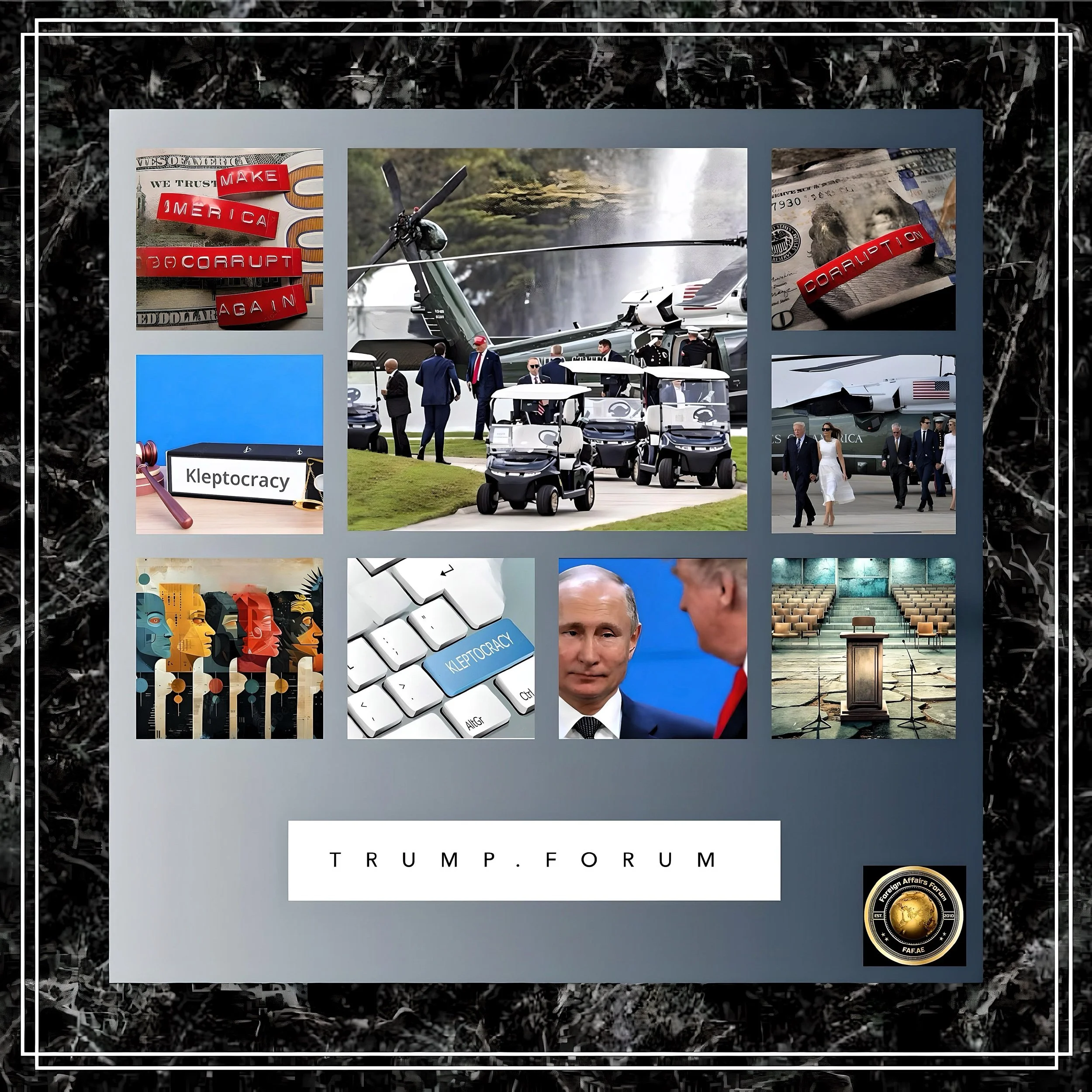
Kleptocracy, which means “rule by thieves,” is a system in which government officials exploit their positions to steal massive public funds.
Unlike ordinary corruption, which may involve isolated incidents of malfeasance, kleptocracy is characterized by systematic, strategic, and permanent criminal behavior that permeates the highest levels of government.
In such systems, officials deliberately work to enrich themselves and then use their accumulated wealth to perpetuate their hold on power while treating the common good and people’s needs as secondary considerations.
Modern kleptocracy has evolved beyond the stereotype of despotic tyrants in distant, impoverished nations.
Today’s kleptocracies operate as sophisticated global networks involving world leaders and influential business figures who effortlessly move money across borders.
These operations are facilitated by professional enablers who launder funds through anonymous offshore companies and secure them in luxury assets in Western nations.
Signs of Kleptocratic Behavior in American Governance
Dismantling Anti-Corruption Infrastructure
One of the most concerning developments has been systematically dismantling anti-corruption mechanisms within the U.S. government.
The Trump administration has fired at least 17 inspectors general—watchdogs installed after the Watergate scandal to provide independent checks on mismanagement and abuse of power.
Additionally, Attorney General Pam Bondi has ordered the Justice Department to prioritize cases related to criminal cartels while closing down both Task Force KleptoCapture and the Kleptocracy Asset Recovery Initiative.
Perhaps most significantly, President Trump has ordered a six-month pause in new investigations or enforcement of the Foreign Corrupt Practices Act (FCPA), a cornerstone of global anti-corruption efforts.
This directive represents a stark departure from traditional enforcement priorities and could signal to businesses that foreign bribery offenses are no longer serious concerns for the U.S. government.
Proliferation of Conflicts of Interest
The administration has demonstrated an unprecedented tolerance for conflicts of interest.
During Trump’s first term, officials like Vice President Mike Pence took detours to stay at Trump properties, but advisors and potential legal consequences somewhat constrained Trump.
Now, emboldened by having escaped accountability for various offenses, he operates with fewer restraints.
In December, the Trump Organization announced plans for a Trump Tower in Saudi Arabia, creating an apparent conflict of interest for the president-elect.
Additionally, Trump’s family launched a cryptocurrency venture, World Liberty Financial, which critics argue could be a vehicle for indirect bribes.
The administration appears indifferent to ethical appearances, as evidenced by the Treasury Department halting a civil investigation into Justin Sun, a Chinese advisor for World Liberty Financial who had invested at least $75 million in the enterprise.
Recent reporting indicates that Binance executives while negotiating a private deal with World Liberty Financial, met with Treasury officials to request reduced oversight—despite Binance having previously faced a record $4.3 billion fine for allowing terrorists, drug traffickers, and sanctioned individuals to use its exchange.
America as a Global Offshore Haven
While the United States has long positioned itself as a leader in fighting global corruption, it has simultaneously become the world’s greatest offshore haven, attracting hundreds of billions of dollars in illicit finance tied to corrupt regimes and extremist networks.
States like Delaware, Nevada, and South Dakota have perfected the art of anonymous shell companies, allowing wealthy individuals and entities to hide assets from tax authorities and law enforcement.
This contradiction undermines American credibility in the global fight against corruption.
As Casey Michel argues in “American Kleptocracy,” the United States has built “the largest illicit offshore finance system the world has ever known,” enabling foreign elites to dominate American coastlines, industries, and even entire towns across the American Midwest.
The Trump administration has exacerbated this problem by announcing it would not enforce the Transparency Act, hindering congressional efforts to combat money laundering and tax evasion by anonymous investors.
This decision, coupled with reduced enforcement of the Foreign Corrupt Practices Act, creates an environment where illicit financial flows can flourish with minimal oversight.
Arguments Against Classifying America as a Full Kleptocracy
Despite these concerning developments, several factors suggest that America has not yet become a full-fledged kleptocracy. According to RepresentUs, “While the United States is not formally classified as a kleptocracy, elements of kleptocratic behavior exist in parts of its political and economic systems.”
While public corruption is concerning, it remains less pervasive in the United States than in established kleptocracies.
America’s democratic institutions, though strained, continue to function. Civil society organizations, independent media outlets, and opposition political figures maintain the ability to criticize government actions and advocate for accountability.
The mere existence of public discourse about the risk of kleptocracy indicates that democratic norms have not been entirely abandoned.
Additionally, the United States maintains a complex federal system with power distributed across multiple branches and levels of government, making it difficult for any single group to exert total control.
This structural resistance to centralized power protects against kleptocratic networks' complete capture of state resources.
How Life Could Change If Kleptocratic Trends Continue
For the Wealthy
If kleptocratic trends accelerate, America’s wealthiest citizens stand to benefit in several ways. The disproportionate influence of big money in politics, already significant following the Supreme Court’s Citizens United decision, would likely increase.
Wealthy individuals and corporations would gain even greater ability to shape policy outcomes in their favor.
Weakening financial regulations and oversight could also create new opportunities for tax avoidance and wealth concealment.
As transparency requirements diminish, high-net-worth individuals would find it easier to shield assets from taxation through complex offshore arrangements and anonymous shell companies.
Those connected to the administration might receive preferential treatment in government contracts, regulatory decisions, and other matters affecting their business interests.
Blurring the lines between public service and private gain would normalize a system in which political connections, rather than merit or fair competition, determine economic success.
For the Middle Class and Poor
Middle and lower-income Americans would likely bear the brunt of kleptocratic governance. Social programs for vulnerable populations are curtailed, underfunded, or eliminated in kleptocratic systems.
Essential services like healthcare, education, and infrastructure maintenance would deteriorate as public funds are diverted to enrich those in power.
Economic growth would likely slow as corruption undermines productive investment and distorts market incentives. This economic stagnation would exacerbate existing inequalities, widening the gap between the haves and have-nots.
One source notes, “While the kleptocrats amass wealth, ordinary people struggle to survive.”
The erosion of regulatory protections could also expose middle and lower-income Americans to more significant environmental, financial, and workplace risks.
As regulatory agencies are captured by the industries they oversee, their ability to protect public health and safety would diminish.
For All Americans
Regardless of socioeconomic status, all Americans would experience the degradation of democratic norms and institutions. Public trust in government would continue to decline as citizens perceive their leaders as self-serving rather than public-spirited.
This disillusionment could lead to increased political apathy and disengagement, weakening democratic accountability.
Freedom of expression might face new constraints as those in power seek to silence criticism and dissent. Independent journalism would become more difficult as media outlets face pressure to avoid scrutiny of powerful interests.
The space for civil society organizations to operate freely would be narrow, limiting their ability to advocate for accountability and reform.
America’s international standing would also suffer. One source notes, “Kleptocratic nations become international pariahs, and investors shy away, fearing instability and unfair business practices.”
This diminished global reputation could have concrete consequences for American businesses and citizens engaged in international activities.
National Security Implications of Kleptocratic Governance
The shift toward kleptocratic governance poses significant national security challenges. According to a George Mason University report, “Kleptocratic regimes abscond with national assets and use those assets against both their citizens and the United States and its allies.”
The national security implications of this global phenomenon are “wide-ranging, overlapping, and poorly recognized.”
Kleptocracy creates fertile ground for terrorism and radicalization. When governments divert public funds for private gain, they leave inadequate resources for public services, delegitimize the regime, and often resort to repression of dissent—all factors fuel radicalization and conflict.
Extremist groups frequently draw on public anger at corruption and abuse of power to recruit followers.
Corrupt state institutions can also facilitate the operations of extremist groups by enabling the movement of money, fighters, weapons, and supplies.
Additionally, security institutions in kleptocracies often become “hollowed out” by corrupt practices such as ghost soldiers and misappropriation of procurement funds, leading to low combat readiness and reduced capacity to respond to threats.
Conclusion
Democracy at a Crossroads
Is America a kleptocracy? While the evidence suggests that the United States has not yet fully transformed into a kleptocratic state, several concerning trends indicate it is.
The dismantling of anti-corruption infrastructure, normalization of conflicts of interest, and America’s role as a global offshore haven all represent significant departures from traditional democratic governance.
Perhaps most troubling is the speed and scale of these changes. In just a few months, the Trump administration has reversed decades of anti-corruption progress, signaling a fundamental shift in how America approaches public integrity and accountability questions.
The United States now stands at a critical juncture. If current trends continue, the country risks sliding further toward kleptocratic governance, which would have profound implications for economic prosperity, democratic values, and national security.
Addressing this challenge will require a renewed commitment to transparency, accountability, and the rule of law from citizens, civil society organizations, and principled leaders across the political spectrum.
As Casey Wetherbee argues, “While it is commendable to tackle corruption abroad, it is at least as much of a problem closer to home.”
To preserve its democratic character, America must confront the kleptocratic elements within its system while recommitting to the ideals of good governance that have sustained the republic for nearly two and a half centuries.